US-Russia Veto Clash Ends MINURSO Mission in Moroccan Sahara
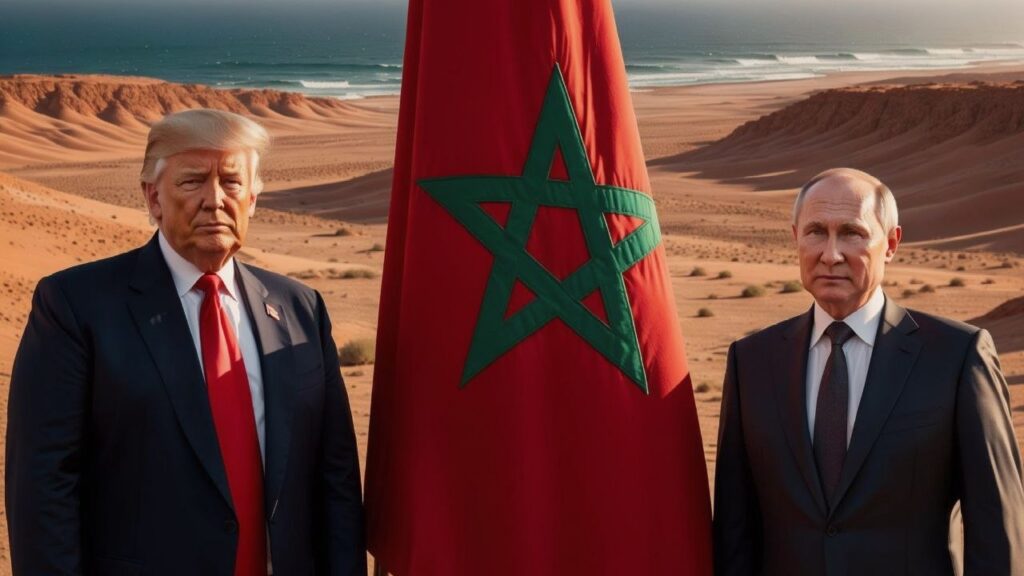
The United Nations Security Council became the site of an unprecedented development in the management of the Western Sahara issue on October 30, 2026. A Russian veto blocked a US-led draft resolution, while a subsequent American veto rejected a Russian counter-proposal. This diplomatic deadlock resulted in the failure to renew the mandate of the United Nations Mission for the Referendum in Western Sahara (MINURSO) before its expiration on October 31, 2026.
The significance of this rupture lies in the fact that the disagreement is no longer limited to the content of a political solution. It now extends to the very existence of the UN mission, the nature of its functions, and the fundamental framework of the UN-supervised negotiations.
Russia exercised its veto against the American draft resolution, which had otherwise received 11 votes in favor, one against, and three abstentions. Despite the majority support, the text failed to pass. The United States’ proposal envisioned major political and institutional transformations. Specifically, it sought to extend the mandate until October 31, 2027, and rename the mission. Starting November 1, 2026, the Mission for the Referendum in Western Sahara (MINURSO) was to become the United Nations Mission in Western Sahara (MINUSO).
The American text also proposed establishing the Moroccan autonomy initiative as the sole basis for negotiations, arguing that genuine autonomy under Moroccan sovereignty represents the most viable solution. While the revised wording maintained the principle of self-determination and the pursuit of a consensual political solution, the project called for a structural reassessment of the mission’s military and human resources. The Secretary-General was expected to submit proposals to this effect by January 30, 2027. Furthermore, the UN Refugee Agency (UNHCR) was tasked with completing a census of the populations in the Tindouf camps within six months. The proposal also called for political consultations to be expanded to include various Sahrawi actors, whether within the territory, in the camps, or in the diaspora.
Moscow justified its position by refusing the paradigm shift proposed by Washington regarding the negotiating framework. Russia also opposed the restructuring and the change of the mission’s identity, arguing that such measures would impose a predefined political direction on the talks.
In response, the United States vetoed the Russian draft resolution, which garnered only three votes in favor, one American vote against, and 11 abstentions. The Russian text primarily aimed to extend the MINURSO mandate for another year, until October 31, 2027, while maintaining its current name, missions, and structure. Russia insisted on upholding the traditional UN negotiating framework, the principle of self-determination, and a mutually acceptable political solution, without making the Moroccan autonomy proposal the exclusive basis for discussions.
Ultimately, the American position was not merely a rejection of the Russian phrasing; it was an opposition to continuing the mission in its current form without a revision of its objectives and the direction of the political process. This head-on collision led to an impasse. With neither project adopted, no new resolution was passed to extend the MINURSO mandate.
The current mandate of MINURSO is based on Resolution 2797 of 2025, which set the mission’s end date for October 31, 2026. Under the United Nations Charter—specifically Articles 24, 25, 27, and 29—the creation of UN missions and the definition of their powers and duration fall exclusively under the jurisdiction of the Security Council. Consequently, the rejection of both draft resolutions does not lead to any automatic extension. The Secretary-General does not have the authority to establish an alternative mandate on his own initiative.
As a result, the current mandate expires on the scheduled date of October 31, 2026, unless an extraordinary session of the Security Council produces a new decision. This situation necessitates a UN-led solution to manage the mission’s institutional and operational status, including ceasefire monitoring and mine clearance. The conflict and the political process will continue, as the end of the mission’s mandate does not signify the end of the dispute or the settlement of the sovereignty issue. Similarly, the end of the authorization does not mean the immediate disappearance of the force on the ground; short-term administrative and logistical arrangements are typically in place to liquidate the mission or reorganize its presence. The failed vote does not invalidate Resolution 2797 of 2025, which remains the last valid UN reference.
Three primary paths are now open to the Security Council and the Secretariat to break the deadlock. The first involves returning to the Council to negotiate a new consensus draft during an extraordinary session. This could be a temporary extension—an unlikely option given American firmness—or, more likely, an agreement on revising the missions and structure. This path was suggested by the Russian ambassador, who called for the UN mission not to be “sentenced to death.” A vote on a six-month technical rollover could serve as a possible compromise.
The second path is the intervention of the UN General Assembly via the “Uniting for Peace” mechanism (Resolution 377 of 1950). The Assembly could convene an emergency special session to discuss the consequences of the blockage and issue recommendations. However, these recommendations cannot replace a Security Council decision and are not legally binding. The third path relies on an intervention by the UN Secretary-General, who could present an urgent report and recommendations on the legal and operational situation while continuing his good offices without overstepping the Council’s prerogatives.
These developments require Morocco to adopt a strategy of diplomatic initiative. This would involve acknowledging the end of MINURSO and inviting major powers to develop a new formula. This new entity would be dedicated to implementing autonomy, maintaining security, and mine clearance, while preserving the gains of Resolution 2797. Moroccan efforts should also confirm that the failure of the two drafts does not cancel the validity of Resolution 2797, call for an urgent Security Council meeting to fill the institutional vacuum, and intensify international contacts to clarify its position.
The steps to follow also include preparing a preventive legal memorandum on the effects of the mandate’s end, and strengthening field management by maintaining stability in the Southern Provinces—including the integration of the buffer zone. Morocco must also continue its efforts regarding identity, institutional, economic, and social development to ensure the credibility of its development model and human rights record.
The double veto from Russia and the United States reveals a profound crisis of consensus within the Security Council, effectively ending the MINURSO mandate. This outcome now links the future of the mission to a new international agreement. It represents a major challenge for Moroccan diplomacy, which must transition from a reactive stance dependent on UN decisions to a comprehensive diplomatic and legal initiative, prepared for all possible configurations of international presence in the region.
Arabic version | French version