Aspects of Amazigh Oral Literature In Morocco: Poetics, Performance, And The Memory Of A Civilization Of The Word – Analysis
Key Takeaways:
Amazigh oral literature in Morocco—spanning sung poetry, ahidous and ahwach, tales, proverbs and sacred registers across Tachelhit, Central Atlas Tamazight and Tarifit—is presented as a living system of thought, sociability and law whose primary mode of existence is performance rather than a fixed text.
The essay traces its collection from colonial scholarship to contemporary Amazigh studies and IRCAM institutionalization, emphasizing female transmission, formulaic composition, and continuous dialogue with Arabic, Islam and modern media.
It concludes that the heritage’s survival depends on rigorous archiving, translation and schooling alongside the freedom of poets, singers and storytellers to renew forms without freezing them as museum pieces.
Amazigh oral literature in Morocco is one of the largest reservoirs of verbal creation in North Africa: sung poetry, tales, legends, proverbs, riddles, ritual formulas, and religious narratives have circulated for centuries across the three major linguistic areas of Tachelhit, Central Atlas Tamazight, and Tarifit. This essay offers a dense, problem-oriented overview of that corpus. It first situates the corpus within theoretical debates on orality (Ong, Zumthor, Finnegan, Vansina), then traces the history of its collection from colonial scholarship to contemporary Amazigh studies, and goes on to analyze poetry, collective song and dance, the tale, short speech forms, and the registers of the sacred. It concludes with the contemporary transformations of this heritage (cassette, radio, television, institutionalization by IRCAM, the emergence of a written neo-literature) and the stakes of transmission and heritage-making. The central argument is that this literature is not an archaic “remnant” but a living system of thought, sociability, and law, whose mode of existence is performance itself.
1. Introduction: A Civilization of the Word
To speak of “oral literature” in connection with the Imazighen of Morocco is to confront at the outset a lexical paradox that specialists have often noted: the word “literature” refers etymologically to the letter, whereas the object it designates is by definition a living word, uttered, sung, and performed before an audience. The paradox is, however, only apparent. Once we accept, with Zumthor (1983), that oral poetry is a complete work endowed with its own formal laws, its own aesthetics, and its own history, the expression “oral literature” ceases to be an oxymoron and becomes a programme: that of recognizing the voice as an art and collective memory as a library.
This recognition was slow in coming. For nearly a century, the verbal production of Berber-speaking populations was regarded sometimes as a folklore to be collected, sometimes as a pre-Islamic survival to be classified, and only rarely as a literature in its own right. In his Essai sur la littérature des Berbères [Essay on the Literature of the Berbers], Basset (1920) had already laid down the framework that would long dominate the discipline: an essentially oral literature, anonymous in its ancient forms, dependent on transmission from mouth to ear, and whose inventory fell to colonial philology. It took the work of Mouloud Mammeri (1969, 1980), Paulette Galand-Pernet (1998), Salem Chaker (1984), and Abdellah Bounfour (1994, 1999) for this literature to be thought from within, in its own categories, with its poets, its genres, its aesthetics, and its publics.
In Morocco the question is especially acute. Together with Algeria, the kingdom is the principal present-day stronghold of the Amazigh language, which the 2014 census recorded as the language of use of a little over a quarter of the population (Haut-Commissariat au Plan [HCP], 2014). The three regional varieties—Tachelhit in the Souss and the High and Anti-Atlas, Tamazight in the Middle Atlas and the central High Atlas, and Tarifit in the Rif—have produced distinct but related corpora, linked by a shared conception of speech as social act, as commitment, and as memory. Since the Amazigh language was made official by the 2011 Constitution (Article 5) and the passage of Organic Law No. 26-16 (2019), this heritage is no longer merely an object of study: it has become a stake in cultural policy, education, media, and symbolic sovereignty. It is also, in places, an endangered one. The ancestral oral knowledge carried by Tamazight, in the Rif in particular, is exposed to a real danger of extinction as its bearers disappear and the conditions of transmission change (Chtatou, 2023).
The argument defended here rests on three propositions. First, Amazigh oral literature is neither a minor genre nor a stage prior to writing, but a complete system with multiple functions—aesthetic, cognitive, legal, religious, political, affective—whose logic can be grasped only if it is thought of as performance. Second, this literature is profoundly pluralistic, because it is the product of an ancient and uninterrupted dialogue with Arabic, with Islam, with Moroccan Judaism, and, more recently, with the mass media; it is Amazigh without being closed in on itself, Moroccan without being uniform. Third, its survival depends neither on nostalgia nor on museification but on the capacity of its bearers—itinerant poets, ahidous singers, storytellers, young neo-Amazigh writers—to reinvent it without betraying it. This last idea echoes an observation already made about poetry and dance: oral tradition and new creation are not opposed, since oral transmission preserves the heritage while reshaping it with each generation (Chtatou, 2020).
The essay follows a path in fourteen sections. Sections 2 and 3 set out the theoretical and historiographical frameworks; Section 4 maps the corpus; Sections 5 to 9 examine poetry, collective song and dance, the tale, short speech forms, and the sacred; Sections 10 and 11 offer a stylistic analysis and three case studies; Sections 12 and 13 address contemporary transformations and the stakes of transmission, before the conclusion.
2. Theoretical Framework: Orality, Performance, and Memory
2.1. Beyond the “Great Divide”
Reflection on orality was long dominated by what has been called the “great divide” between societies of writing and societies of speech. Walter Ong (1982) gave it its most influential formulation: the “primary orality” of cultures without writing would structure thought in an additive rather than subordinating manner, aggregative rather than analytic, redundant, close to lived experience, empathic, and participatory. Jack Goody (1977), for his part, attributed to writing major cognitive effects—classification, the list, the table, critical thought—which oral cultures could not develop to the same degree. These theses had the merit of drawing attention to the materiality of communication; they were also strongly criticized, notably by Ruth Finnegan (1970), whose survey of oral literature in Africa showed that cultures of the voice know highly elaborate genres, recognized specialists, criteria of aesthetic judgment, and learned forms of composition.
The study of Amazigh literature invites us to side with this second reading. Amazigh societies were never societies without writing in the strict sense: Tifinagh, attested in ancient Libyco-Berber inscriptions and preserved among the Tuareg; the manuscript tradition in Arabic script in the Souss, where scholars composed treatises on law, theology, and religious poetry in Tachelhit from the early modern period; and then the neo-Tifinagh standardized by IRCAM all attest to a long coexistence of the oral and the written (Galand-Pernet, 1998; Bounfour, 1994). Yet the immense majority of verbal creation circulated, and still circulates, through the voice. Recent work reminds us, moreover, that this creation was not the privilege of a literate elite: in all traditional Amazigh-speaking societies, poems, tales, myths, and sacred chants were shared by the whole community and woven into daily life, ritual, and social structures (Lamri & Messouaf, 2026). It is this integration that makes the specificity of the Amazigh literary fact: poetic speech is not a separate leisure activity but a function of the social bond.
2.2. Formula, Performance, and “Mouvance”
The second fundamental theoretical contribution comes from the work of Milman Parry and Albert Lord (1960) on the oral composition of epics. They showed that the oral poet does not memorize a fixed text but recomposes at each performance from a stock of internalized formulas, themes, and metrical patterns. Applied to the Amazigh domain, this perspective illuminates the flexibility of forms: the same poem may have many variants, none of which is “the original,” because the notion of an original has no meaning in a regime of orality. Paul Zumthor (1983) extended this intuition by introducing the notions of “vocality” and “performance”: the oral poem fully exists only in the act of its utterance, with voice, gesture, rhythm, place, audience, and moment. The transcribed text is only an impoverished trace of it. From this constitutive instability arises what he calls the mouvance of works, that is, their life in variation.
For Amazigh literature, this framework is remarkably fruitful. The ahidous singer who improvises a couplet in reply to her partner, the itinerant poet who adapts a verse to the occasion, the storyteller who modulates her voice, pauses, and opening formulas according to her audience: all accomplish works whose form is never settled but always in act. Jane Goodman (2005), writing about village song in Kabylia, recalls that women interrupt the singing to discuss, that a young voice may say “That’s all” when an older woman wants to go on, and that performance is therefore the site of a permanent negotiation of meaning and authority (as cited in Chtatou, 2020). Performance is not the illustration of a text: it is the text.
2.3. Orality as History and as Law
A third axis is orality as social memory. Jan Vansina (1985) demonstrated that oral traditions are historical sources in their own right, provided they are studied in their conditions of transmission, compared with other sources, and restored to their social functions. In the Moroccan Amazigh context this dimension is crucial. The poems of resistance composed during the “pacification” campaigns of the early twentieth century, the songs commemorating battles, recited genealogies, and foundation narratives of villages and tribal fractions together form a popular historiography parallel to official chronicles. Michael Peyron observes that village Imazighen, often regarded by urban populations as less cultured, responded to this devaluation by recalling in poetry the “stirring achievements of their heroes, both during the resistance phase and in earlier centuries” (Peyron, as cited in Chtatou, 2020).
Speech also has, in these societies, a legal function. Village assemblies, customary rules (izerfan), oaths, arbitrations, and mediations rest on the given word and on the collective memory of precedents; Ernest Gellner (1969), writing on the mediating saints of the High Atlas, showed how far social regulation there depended on forms of eloquence, blessing, and imprecation. Oral literature is therefore not merely an art: it is a social technology that fabricates agreement, honour, memory, and belonging.
2.4. An Amazigh Conception of Speech
Finally, the value attached to speech is itself a cultural trait. Abdellah Bounfour (1994) analyzed, in the Tachelhit domain, the way poetic speech is conceived as speech that is “bound,” worked, and measured, as opposed to ordinary speech, and how the poet is invested with a specific responsibility. Katherine Hoffman (2008), drawing on her fieldwork among the Ishelhin of the Souss, showed that speakers do not use language in the same way in everyday conversation and in poetic speech, and that the latter is invested with particular social and moral value. This observation joins the idea, developed elsewhere, that Amazigh identity rests on a “cultural trinity” in which language (awal), land (tamurt, akal), and kinship and solidarity (ddam, tamunt) are inseparable (Chtatou, 2018, 2025b): poetic speech is the point where the three converge, for it utters the language, summons the lineage, and names the territory.
3. A History of Collection: From Colonial Scholarship to Amazigh Studies
3.1. The First Collectors
The history of Amazigh oral literature in Morocco cannot be separated from the history of its collection. The first great undertakings date from the second half of the nineteenth century. Adolphe Hanoteau (1867) published his Poésies populaires de la Kabylie du Jurjura [Popular Poetry of Jurjura Kabylia] in Algeria, inaugurating the tradition of the bilingual edition; Auguste Mouliéras (1893–1895) gathered legends and tales from Greater Kabylia; Hans Stumme (1895), a German linguist, edited tales of the Shluh of Tazerwalt, the first substantial corpus of Tachelhit. In Morocco, the establishment of the Protectorate in 1912 gave this work an institutional impetus: Léopold Justinard (1914), Émile Laoust (1920, 1936, 1949), and Arsène Roux (1942) assembled, within the framework of the Institut des hautes études marocaines and Berber education, collections of texts that remain irreplaceable. Laoust’s Contes berbères du Maroc (1949) and Roux’s Récits, contes et légendes berbères en Tachelhit (1942) are still major references for the narrative corpus.
A different kind of ethnographic documentation comes from Edward Westermarck, whose fieldwork in Morocco, centred on the customs of the Berbers rather than on those of the Moroccan Arabs, produced the two-volume Ritual and Belief in Morocco (Westermarck, 1926) and a detailed study of wedding rites (Westermarck, 1914). A recent reappraisal underlines the richness of the Amazigh cultural practices that he recorded in farming villages, the linguistic material left in his archives, including texts written by his Moroccan research assistant, and the continuing value of this archive for a critical but appreciative reading of the popular culture of the Imazighen (Chtatou, 2025a).
These works call for a double reading. On the one hand, they saved an immense body of material from oblivion, collected with an often admirable philological precision and accompanied by translations and glossaries; the historian of literature cannot do without them. On the other hand, they belong to a political context that is not neutral. The Protectorate’s “Berber policy,” of which the dahir of 16 May 1930 is the emblem, sought to instrumentalize Amazigh specificity against the unity of the country by opposing a “Berber” supposedly attached to custom and resistant to Islam to an urban “Arab.” The collection of oral traditions did not always escape this grid: tales and rites were sometimes searched for “pagan survivals,” to the detriment of their real integration in the Moroccan Muslim universe. This reading has weighed durably on the reception of the corpus, and one of the tasks of contemporary research is precisely to correct its biases (Boukous, 1995; Chaker, 1984).
3.2. The Turning Point of the 1960s–1980s
Renewal first came from Algeria, with Mouloud Mammeri, whose Les isefra of Si Mohand ou M’hand (1969) and Poèmes kabyles anciens (1980) imposed the idea that the Kabyle poem was an authored work, situated, datable, and analyzable, and not merely ethnographic testimony. Camille Lacoste-Dujardin (1970) made the Kabyle tale an object of rigorous ethnological and structural study. In Morocco, the momentum was extended by the birth of the Amazigh cultural movement: the Association marocaine de recherche et d’échange culturel, founded in the late 1960s, gathered intellectuals, poets, and researchers around the defence and study of Amazigh culture. In parallel, ethnomusicologists such as Bernard Lortat-Jacob (1980) documented the festivals and music of the High Atlas with great finesse, while Ahmed Boukous, Abdellah Bounfour, and Hassan Jouad, among others, renewed the approach to poetry, language, and popular culture (Boukous, 1977; Bounfour, 1994).
This turning point rests on an epistemological shift: the researcher is no longer only a collector but becomes a reader, even a co-enunciator. Poets are named, circumstances of composition restored, registers distinguished. Paulette Galand-Pernet’s Littératures berbères : des voix, des lettres (1998) offers the most accomplished synthesis: she shows that Berber literature comprises both a dominant oral corpus and minority written traditions, and that the border between the two regimes is more porous than was believed.
3.3. From Corpus to Discipline
Since the 1990s the discipline has been institutionalized. Amazigh studies departments have opened in several Moroccan universities; the Royal Institute of Amazigh Culture (IRCAM), created by dahir in October 2001 following the royal speech of Ajdir, received the mission of preserving, promoting, and standardizing the Amazigh language and culture; and numerous theses have renewed knowledge of the genres (Boukous, 2012). Oral literature is now studied at once as heritage, as linguistic source, and as material for new creation. The challenge is now less to collect than to understand, to compare, to archive durably, and to transmit.
4. Geography of the Corpus: Three Areas, One Poetics
Amazigh oral literature in Morocco is distributed across the three great linguistic areas. This division is not watertight, but it corresponds to distinct practices, genres, and terminologies.
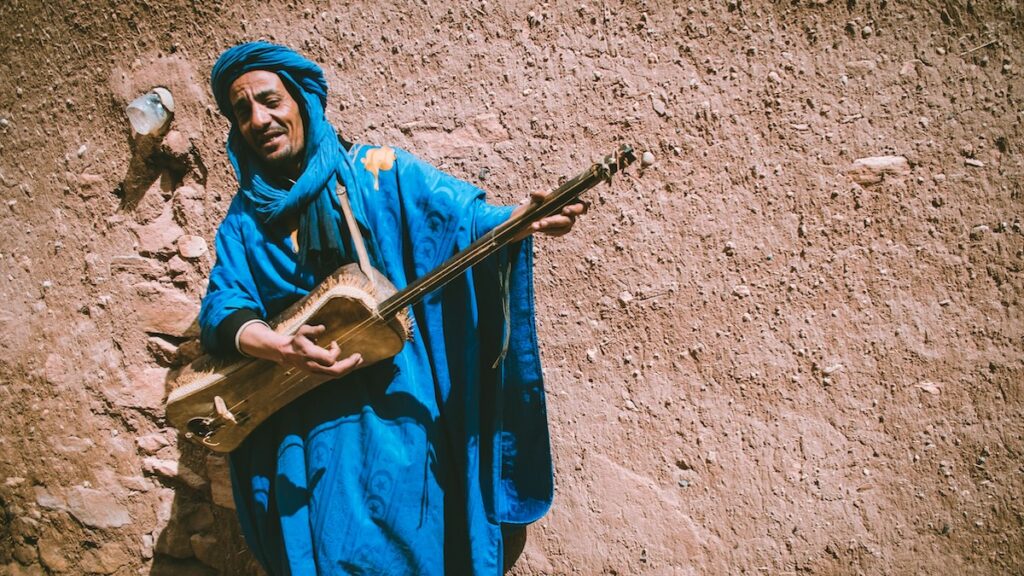
In the Tachelhit area (Souss, western High Atlas, Anti-Atlas, Draa), poetic creation is dominated by several interlocking traditions: village collective song of the ahwach type; the sung poetry of the rways, professional musician-poets whose founding figure is Lhaj Belaid, born around 1873 near Tiznit, whose poetry describes places from Morocco to Paris and Egypt and treats emigration; and, more recently, the poetry of popular singers. The Tachelhit area is also distinguished by a learned tradition in Arabic script, which produced religious poems and treatises on law and theology in the Amazigh language (Galand-Pernet, 1998).
In the area of Central Moroccan Tamazight (Middle Atlas, central High Atlas, eastern Morocco), the centre of gravity of orality is the ahidous, a collective performance of song and dance, and the izli (pl. izlan), an improvised or reworked sung couplet. Michael Peyron, a leading specialist of this poetry, described how in a century it passed from a mainstream literary genre to an “archetypal form of minority expression” (Peyron, as cited in Chtatou, 2020): the observation is essential to understanding the present relationship of communities to their heritage.
In the Rif (north-eastern Morocco), sung poetry (izran) holds a pre-eminent place, as do the tale and the narratives of resistance linked to the memory of the Rif War. David Hart’s (1976) study of the Aith Waryaghar remains a precious source on Riffian social organization and public speech. Tarifit itself has been described as playing a primordial role in the Amazigh culture of northern Morocco: it is intrinsically cultural, reflecting norms and values at once subtly and explicitly, and its transmission from mothers to children has compensated for the near absence of favourable state language policy (Chtatou, 2024). Printed poetry, which appeared in the early 1990s with Sellam Semghini’s (1992) collection, has remained numerically dominant over other written genres, which, according to the researchers of the MULOSIGE project (n.d.), attests to the persistence of the importance of oral culture.
These three areas nevertheless share invariants: the central place of the sung poem, the role of women in transmission, the collective dimension of performance, the coexistence of the profane and the sacred, the mnemonic function of narratives, and rootedness in a named territory.
5. Poetry: Asefru, Izli, Tamdyazt, Izran
5.1. An Art of Brevity and Intensity
Poetry holds a pre-eminent place in Amazigh oral literature, to the point that in several regions “speaking poetically” is the very sign of social competence. The terms that designate it vary from one area to another—asefru in Kabyle, izli in the Middle Atlas, izran in the Rif, timdyazin (for poetry composed by imdyazn) in Tachelhit—but they refer to the same demand: to concentrate in a few lines an experience, an emotion, a judgment, and to make it memorable by rhythm, rhyme, or alliteration. Bounfour (1994) showed that this poetry obeys precise prosodic rules that cannot be reduced to simple spontaneity. A comparative study of the Kabyle and Riffian traditions stresses that the traditional character of poetry rests on a set of elements—orality, conditions of performance, the link with song, the status of the poet and the relation to the public—that structure the Kabyle asefru as well as the Riffian izli or izri (Idrici & Djellaoui, 2022).
The themes are extremely diverse: love and separation, exile and nostalgia, praise of ancestors, commemoration of combats, social criticism, humour, satire, religious meditation. Love holds a central place, but in forms that go beyond individual lament: the poet’s pain becomes a shared experience, universalized by image, metaphor, and landscape. Nature—mountain, spring, flock, tree, cloud—functions as a symbolic language common to all listeners.
5.2. Professional Poets and Occasional Poets
Two broad categories of creators are traditionally distinguished. The first are professional poets, itinerant or semi-itinerant, who live by their art, travel from village to village and market to market, and compose to order poems of praise, circumstance, or criticism: the imdyazn of the Souss and the Middle Atlas are the best-known example. They play a role as chroniclers, informants, mediators, and sometimes political spokesmen. Bounfour (1994) stresses their ambivalent status: admired for their art, feared for the power of their speech, they occupy a position at once central and marginal in society.
The second are occasional poets, men and women, who compose in the framework of festivals, ceremonies, and labours: weddings, harvests, pilgrimages, markets. Women hold a central place here. The poet Mririda n’Aït Attik, from the Tassaout valley, whose poems were collected and translated by René Euloge, offers a striking illustration: her poetry addresses love, nature, human relations, land ownership, conflicts, youth, marriage, and death (Euloge, 1952; cf. Chtatou, 2020). She recalls that the female voice is not only a voice of transmission but also of creation, criticism, and freedom. It is no accident that women have been described as the genuine guardians of Amazigh language and culture in Morocco (Chtatou, 2022).
5.3. The Poem as a Space of Freedom and Criticism
Amazigh poetry is also, consistently, a space of freedom of tone. It allows one to say what ordinary speech cannot: love outside marriage, criticism of the notable, satire of power, regret of exile. This critical function is particularly visible in the poems of resistance to colonization, in the songs of identity claim that accompany from the 1970s the rise of the Amazigh cultural movement, and in contemporary Riffian poetry which, according to the MULOSIGE project, resembles a poetry of “protest” dealing with historical marginalization, oppression, linguistic and cultural emancipation, homeland, and identity (MULOSIGE, n.d.).
5.4. The Poem, Memory, and the Land
It would be reductive to see in this poetry only a lyrical expression. It is also a cartography. Every valley, pass, spring, and saint’s tomb is named in it, associated with an event, a name, an emotion. As Gellner (1969) noted regarding the High Atlas, the memory of territory is inseparable from the memory of social bonds and mediations; the poem fixes this double memory. In the context of the massive emigration of the Imazighen of the Souss toward Moroccan cities, then toward Europe, this function of affective cartography has become even more pronounced: the rways sing exile, separation, the impossible return, and their poetry has become for generations of migrants a link with the village of origin.
5.5. Metre, Rhythm, and Voice
In formal terms, Amazigh poetry is inseparable from the voice that utters it. Metre, which varies by area and genre, rests on short rhythmic units, an alternation of symmetrical verses, patterns of alliteration and rhyme, and the fundamental principle of the refrain. For professional singers, instrumental accompaniment—one-string rebab, lute, frame drum, reed flute—structures the form of the poem and its articulation. In collective singing, rhythm merges with the dancers’ step, the clapping of hands, and the breathing of the group. Lortat-Jacob (1980) described precisely, in the High Atlas, this articulation of text, music, and choreography, showing that the poetry cannot be dissociated from the whole apparatus that carries it. The poem is thus a total sensory event, in which speech is one component among others.
6. Collective Song and Dance: *Ahidous, Ahwach*, and Village Sociability
6.1. A Total Performance
If poetry is the soul of Amazigh oral literature, ahidous (Middle Atlas, central High Atlas) and ahwach (Souss, High and Anti-Atlas) are its body. These two forms, related but distinct in their organization, belong to collective performance, where song, poetry, dance, percussion, and sociability merge. Cynthia Becker (2006), on the basis of her fieldwork among the Ait Khabbash of the Tafilalet, defines ahidous as a “collective performance at weddings and other celebrations that incorporate oral poetry” (as cited in Chtatou, 2020). This definition, modest in appearance, highlights the essential: ahidous is not a mere spectacle but a social apparatus in which oral poetry finds its natural place of production and reception.
Modalities vary from one group to another—rhythm, steps, costume, singing techniques, arrangement of participants. Becker notes that among the Ait Khabbash the performance is initiated by men forming a line, with women joining them in a parallel line facing the men, whereas in the High Atlas men and women stand side by side in a single line (as cited in Chtatou, 2020). These differences are not anecdotal: they manifest the finesse of the local anchoring of cultural forms and recall that a global Amazigh identity is declined into a multitude of narrower belongings at the scale of the valley, the tribal fraction, the village.
6.2. A Public Space of Speech
Ahidous stands at the heart of village life. Goodman (2005) observes that the evening wedding dance, which she calls urar for Kabylia, “is the only place where almost everyone present in the village shows up at the same time” (as cited in Chtatou, 2020). The formula holds for the whole Amazigh world: collective song is the village agora, a space where the community gathers, recognizes itself, judges itself, and reconciles. This is a capital point for understanding oral literature: it is not destined for isolated readers but for an assembled public whose presence conditions the very meaning of the work. In some villages, failing to appear may even constitute an affront to the community (Chtatou, 2020).
Learning there is informal and continuous. Children watch, imitate, and absorb steps, refrains, and melodies; adolescents dare their first improvisations; elders correct, support, and complete. Frequent criticism is a mechanism of excellence: dancers, singers, and the public judge each other, which ensures the vitality and quality of the performance (Goodman, 2005). A direct observation at Zawyat Ahansal shows how much the physical proximity of the dancers, the common breathing, and shared movement produce a sense of belonging in the literal as in the figurative sense: one learns the steps because one is taken by the shoulder and swayed along with the circle (Chtatou, 2020).
6.3. The Place of Women
In ahidous as in all oral transmission, women hold a central place. They are at once performers, composers, guardians, and teachers. Becker (2006) brought out their role in the making of Amazigh aesthetic identity, notably through sung poetry and textile arts. Fatima Sadiqi (2003) showed, from a sociolinguistic perspective, that the speech of Moroccan women, Amazigh and Arab, constitutes a specific space of creation and resistance, often invisible in the official public sphere but essential to cultural reproduction. Women have accordingly been presented as the genuine guardians of language and culture in Morocco (Chtatou, 2022). Regarding the High Atlas it is even established that, just as there is a term for one who can recite the Qur’an, there is a term for the woman versed in Amazigh poetry (Chtatou, 2020).
This centrality excludes neither constraints nor evolutions. Becker (2006) recalls that “social pressure from Arabs in the 1960s and increased exposure to Islamic modesty requirements caused their previously nomadic ancestors to modify ahidous to include the head covering as a physical barrier between unrelated men and women facing each other during the performance” (as cited in Chtatou, 2020), and that women have in some cases reduced the amplitude of their steps. This example illustrates an important methodological point: an oral tradition is never frozen; it constantly negotiates with its social and religious environment. It also invites caution toward idealizing readings that make Amazigh society an original matriarchy later corrupted; reality is more nuanced, made of differentiated roles, real constraints, and margins of freedom (Sadiqi, 2003).
6.4. Improvisation, Dialogue, and Emulation
Collective song relies largely on improvisation and dialogue. In the Middle Atlas ahidous, singers answer singers, couplets answer couplets, performers provoke, complete, or contradict one another. This dialogic dimension, which Zumthor (1983) ranks among the constitutive traits of oral poetry, ensures both novelty and continuity: at each evening, new couplets are added to a shared fund of motifs, refrains, and images. It is also a place of friendly competition, of symbolic rivalry between villages, fractions, or singers, and of natural selection of the best formulas, which pass into the common repertoire.
7. The Tale, the Legend, and the Myth
7.1. An Abundant Narrative Literature
The tale occupies a major place in Amazigh oral literature in Morocco. Collected from the end of the nineteenth century (Stumme, 1895), then edited and translated by Laoust (1949) and Roux (1942), Amazigh tales cover a very wide spectrum: wonder tales, animal tales, trickster tales, tales of ogres and ogresses, etiological narratives, legends of saints and foundations, tragic love stories. Abdellah Bounfour (1999) offered an overall analysis in the second volume of his Introduction à la littérature berbère, devoted to the tale, in which he stresses the coherence of this corpus, its narrative procedures, and its social function. Camille Lacoste-Dujardin (1970), writing on the Kabyle tale, had already shown how much can be gained from a structural and ethnological reading that articulates narrative with family, kinship, sexuality, and the relation to the world.
The Amazigh tale is traditionally transmitted within the family, in the evening, often in the cold season, and largely by women, grandmothers and mothers, who deploy an elaborate oratorical art: opening and closing formulas, repetitions, onomatopoeia, vocal play, narrative rhythm. The figure of the ogress, the trickster, the orphan, the stepmother, the speaking animal returns from tale to tale, but each storyteller renews it according to her personality and her audience. These narratives do not only entertain: they socialize the child, initiate him or her into norms, dangers, and prohibitions, give models of conduct, and teach how to face fear.
7.2. Legend: Between History, Rite, and Landscape
Alongside the tale properly speaking, the legend holds an essential place: it attaches to a place, a character, an event, and claims, unlike the tale, to tell something that really happened. The best known is doubtless that of the fiancés of Imilchil, Isli and Tislit, whom tribal rivalry prevents from uniting, and whose tears are said to have formed two lakes of the High Atlas—an etiological narrative that explains a landscape, justifies a collective ritual of meeting and marriage, and expresses the tension between the demand for endogamy and individual desire. Legends of saints, numerous, fix the memory of regional religious poles and justify the sacredness of a place, a spring, a tree. Narratives of the foundation of villages, fractions, and brotherhoods recall the origin of groups, their migrations, their alliances.
This function of making the landscape heritage is essential: in these narratives, territory is not a backdrop but an actor, a person to whom one speaks. This relation to the land joins one of the three pillars of what has been described as the Amazigh “cultural trinity,” alongside language and kinship (Chtatou, 2018, 2025b): the legend expresses the bond of man to land, of land to lineage, of lineage to speech.
7.3. Myths, Agrarian Rites, and Rain
The corpus also includes ancient mythical and ritual elements, which colonial collectors particularly sought. The rain-making rites, associated with figures such as Anzar (rain personified, sometimes conceived as a mythical being) or a “bride of the rain” (tislit n unzar), were described by Laoust (1920) in Mots et choses berbères. Spoon or ladle dolls, carried in procession by women and children in times of drought, were accompanied by songs and invocatory formulas. The interpretation of these rites was long a prisoner of the evolutionist grid that saw in them “survivals”; they should today be read as practices of an agro-pastoral society confronted with climatic uncertainty, which articulate in a single performance supplication, blessing, poetic speech, and collective solidarity—and which fit without difficulty into the Moroccan Muslim religious universe, where prayers for rain (istisqa’) follow the same logic of supplication.
7.4. Aesthetics and Functions of Narrative
Aesthetically, the Amazigh tale is characterized by a rigorous construction: initial situation, rupture, trials, help or trick, resolution. Motifs circulate among Amazigh areas, but also among Amazigh, Arab, African, and Mediterranean traditions: the ogress, the trickster, the triple trial, the talisman belong to a widely shared narrative heritage. This circulation is a sign of the historical openness of Amazigh societies, far from any isolation. It joins what Moroccan cultural pluralism shows on another scale, where dialogue and reciprocal borrowing between Amazigh, Arab, Jewish, and Andalusian cultures have shaped national identity (Chtatou, 2018).
7.5. Storytellers, Audiences, and Transmission
A last dimension deserves emphasis: the place of the public in the economy of the tale. The narrative is never delivered to a passive listener; the audience, composed of children, women, sometimes neighbours, reacts, interrupts, asks for a variant, comments. The storyteller adjusts her performance to these reactions, abbreviates or develops, changes tone, introduces an allusion to a local event. This plasticity explains why the same tale may exist in multiple versions, none of which has a privilege, and confirms, with Zumthor (1983), that the oral work is inseparable from its reception. It also explains the difficulty of collection: the researcher who asks a storyteller to tell a tale outside its context often obtains an abbreviated version, impoverished of its gestures and interactions, which transcription then freezes as “the” text.
Transmission, finally, is largely female. Storytellers are the first educators in the mother tongue, and it is through them that children acquire at once vocabulary, narrative structures, and values. This function, like that of ahidous singers and women poets, recalls that women are the principal bearers of Amazigh cultural memory: they are, for researchers as for young generations who have lost touch with their roots, the essential resources to which one must turn to document what has not yet been written down (Chtatou, 2020, 2022). An ethical responsibility for research follows: to recognize these women as authors and scholars in their own right, to cite their names when they agree, to return the fruit of surveys to the communities, and to associate storytellers themselves with the valorization of their art.
8. Short Speech: Proverbs, Riddles, Formulas, and Lullabies
8.1. An Art of Concision
Alongside the major genres, Amazigh oral literature comprises a whole set of short forms of considerable social importance: proverbs, sayings, riddles, nursery rhymes, lullabies, formulas of greeting, blessing and imprecation, oaths, language games. These forms constitute a tight network of codified speech that irrigates daily life. The proverb, in particular, is a form of condensed knowledge that states collective experience about nature, agricultural work, family, honour, neighbourhood, wealth, poverty, and death. It functions as an argument from authority in conversation, mediation, and judgment. Ahmed Boukous (1977), in his Langage et culture populaires au Maroc [Language and Popular Culture in Morocco], showed how much these forms are sociolinguistic revealers of Moroccan popular culture, and how they articulate Amazigh and Arabic registers in a continuum that is often bilingual.
8.2. The Riddle, Play of Wit and Pedagogy
The riddle holds a particular place: a play of wit proposed at evening gatherings, it develops perspicacity, observation, humour, and mastery of metaphor. It is also an exercise in socialization, since it requires the child to master a cultural code whose terms (animals, tools, domestic objects, natural elements) are drawn from the immediate environment. The formulation of the riddle often rests on a metaphor whose resolution presupposes fine knowledge of the milieu. One finds in it the conviction, shared by oral literature as a whole, that speech is a serious game: a way of seizing the world by naming it otherwise.
8.3. Lullabies, Nursery Rhymes, and First Learning
Lullabies and nursery rhymes finally hold a discreet but essential place: they are the child’s first contact with language, rhythm, melody, and affection. Transmitted by mothers, grandmothers, and elder sisters, they contribute to the transmission of the mother tongue in a context where it is often absent from school. Their place in the survival of Tamazight as a living language is probably underestimated: they form an affective and linguistic reservoir that Amazigh-language schooling, introduced progressively since 2003, now tries to formalize (Boukous, 2012).
8.4. Ritual Formulas and Performative Speech
Ritual formulas must finally be mentioned—blessings, vows, greetings, imprecations, oaths—which illustrate the performative character of Amazigh speech. To say is here to do: to bless is to transmit a force; to curse is to engage a destiny; to swear is to bind. This dimension joins Gellner’s (1969) theory of the role of the saints of the High Atlas, whose speech of blessing and mediation grounds authority. It shows that oral literature is far from being a mere “decoration”: it structures the major social acts of life.
9. Registers of the Sacred: Religious Poetry, Saints, and Rites
9.1. A Deeply Islamized Literature
Contrary to an image long maintained, Amazigh oral literature is not a refuge of “pre-Islamic” beliefs in opposition to Islam. It is, in its immense majority, a Muslim literature that expresses itself in the Amazigh language: poems in praise of the Prophet, narratives of the prophets, moral teachings, lives of saints, invocations, pilgrimage songs, versified catechetical and theological texts. The manuscript tradition of the Souss, in Arabic script, produced texts of this kind from the early modern period, which attests the antiquity of religious acculturation and of Amazigh writing in Arabic characters (Galand-Pernet, 1998; Bounfour, 1994).
This Islamization of Amazigh speech has not cancelled local specificities: the cult of saints, seasonal pilgrimages (moussems), agrarian rites, and formulas of blessing have integrated elements proper to the Amazigh universe. It would nevertheless be mistaken to see two superimposed layers; the reality is that of a historical synthesis, which Gellner (1969) described for the High Atlas as a coherent system of social mediation by the sacred. This synthesis has contributed to the full integration of the Amazigh component in the Moroccan religious model.
9.2. The Saint, the Poet, the Mediator
The figure of the saint (agurram, pl. igurramn) and that of the poet present remarkable affinities: both are specialists of efficacious speech, whose voice acts on the world—the former by blessing and intercession, the latter by song and praise. In many cases they merge: religious poets are at once clerics, mediators, and cantors. The moussems, great seasonal gatherings around saints’ tombs, are also privileged moments of poetic performance, collective song, trade, and arbitration. They offer a remarkable illustration of the interweaving of registers: the sacred, the poetic, the economic, and the political are intertwined there.
9.3. The Sacred in Profane Poetry
Even profane poetry, of love or of social criticism, is traversed by religious references: opening invocations, formulas of blessing, references to the prophets, pilgrimage, death. A singer such as Ben Mohamed, studied by Goodman for Kabylia, held that “the essential is said in two lines, then you start with a religious thing . . . and it’s just to garnish” (as cited in Chtatou, 2020): the remark, which concerns Algeria but illuminates a shared dynamic, shows that religious references belong at once to the convention of enunciation and to an aesthetic choice, and that they may be omitted or accentuated according to context—notably in milieus of identity claim that seek to free Amazigh-ness from any confessional connotation (Chtatou, 2020).
10. The Stylistics of the Oral: Formula, Parallelism, and Economy of Image
10.1. The Formula as Memory
Oral composition rests on procedures that ensure both memorization and beauty. Lord (1960) insisted on the role of the formula, understood as a group of words regularly employed under the same metrical conditions to express an essential idea. In Amazigh poetry this principle is found in various forms: stereotyped openings that place speech under the protection of God or the Prophet, consecrated turns of phrase to designate the beloved, the horse, the rifle, the mountain, the spring, and refrains that scan the stanzas and allow the chorus to take up the word. These elements are not clichés in the pejorative sense; they constitute the common fabric on which each poet embroiders his or her singularity. The listener recognizes the formula, anticipates, rests in it, then savours the deviation the poet introduces.
In this respect the difference with modern written poetry is instructive. Where written modernity values absolute originality, oral poetry values mastery of a repertoire and the art of variation. The poet is judged by the ability to insert into a known frame a new image, a fine allusion, an apt reply. Zumthor (1983) described this aesthetic regime as one of “creative reiteration”: the work is recognized by the fact that it replays a shared model while renewing it.
10.2. Parallelism, Symmetry, and the Play of Sounds
Parallelism is one of the most frequent structuring devices: one verse calls for a symmetrical verse, whether by repetition with variation, by antithesis, or by complement. It organizes the dialogue of singers in ahidous, where the couplet of one group finds its answer in that of the other, and it organizes the internal structure of the couplet itself. Sound play—assonance, alliteration, internal rhyme—reinforces this symmetry and has an obvious mnemonic function. Bounfour (1994) stresses that these devices belong to a true prosody, which is reducible neither to rhyme nor to syllable count but combines several parameters: accent, duration, structure of musical phrases, relation between verse and melody.
10.3. The Image: Metaphor, Symbol, Ellipsis
As for images, Amazigh poetry favours a repertoire drawn from the environment: water, stone, flock, tree, cloud, snow, mountain, migratory bird. These elements function as a shared symbolic code: love is thirst, separation is drought, exile is a bird that cannot find its nest, dignity is a rock the torrent cannot hollow. Ellipsis is another striking trait: the poem does not say everything, it suggests, leaving to the listener the task of completing, which creates complicity between the poet and the public. In a society where speech is public, this economy of saying is also a form of prudence and politeness: one evokes rather than accuses, and lets the audience draw the conclusion.
10.4. Poetic Language and Ordinary Language
Hoffman’s (2008) work on the Ishelhin of the Souss showed that speakers resort to different registers depending on whether they speak in everyday conversation or in a poetic situation: more elevated lexicon, archaizing turns, more constrained syntax. This distinction contributes to the social value of poetic speech, perceived as “high” speech, and explains why young speakers, perfectly at ease in conversation, may have difficulty understanding older poems. It also illuminates the question of standardization: the standardization of Amazigh by IRCAM, necessary for teaching, must take account of these registers if it is not to impoverish poetic language. Ahmed Boukous (2012) insisted on the need for a revitalization that sacrifices neither the diversity of regional varieties nor the richness of their expressive uses.
10.5. Language Contact and Borrowing
Finally, Amazigh poetic language is not hermetic to Arabic. The history of its contacts with Moroccan Arabic has produced a vast fund of borrowings, particularly in the religious, legal, and commercial domains, and phenomena of code-switching found in conversation as well as in song. Ennaji (2005) described Moroccan multilingualism as a complex system in which languages feed one another, and where the boundaries between “Amazigh” and “Arabic” are often more porous than identity discourses claim. Oral poetry offers a dazzling illustration of this porosity: one finds entire verses in Moroccan Arabic inserted in an Amazigh poem, bilingual refrains, and borrowings of motifs and themes between the two traditions.
11. Three Case Studies: Mririda, the *Rways*, and Riffian Poetry
11.1. Mririda n’Aït Attik: The Voice of a Woman of the Tassaout
The figure of Mririda n’Aït Attik, a poet of the Tassaout valley at the foot of the High Atlas, is emblematic in several respects. She is one of the rare Amazigh female voices whose name has imposed itself in literary memory, and her work, collected and translated into French by René Euloge (1952), reached a public well beyond her region. Her poems address, in a stripped-down language, themes of great diversity: love and desire, nature, human relations, land ownership, conflicts, youth, marriage, death (cf. Chtatou, 2020). This thematic openness is striking in its freedom of tone: Mririda speaks of the condition of women with a lucidity that escapes stereotypes.
Her case raises, however, a question of method. Our access to her work is mediated by a foreign collector and translator whose choices—selection, order, translation—shaped its reception. This mediation is a general problem of oral literature: one never reads living speech, one reads a text produced by a third party. It invites a critical reading, attentive to what the passage from voice to writing and from Amazigh to French may have transformed, and a valorization of current initiatives of return to the Amazigh text by Amazigh-speaking researchers and writers.
11.2. The Rways and the Poetry of Exile
The second case is that of the rways, professional musician-poets of the Souss, whose song has established itself as the musical canon of the Tachelhit area. A founding figure is Lhaj Belaid, born around 1873 in the environs of Tiznit, whose poetry describes places from Morocco to Paris and Egypt, and whose theme of migration goes beyond the geography of Morocco to reach the Middle East and Europe. This poetry is precious testimony on the mobility of southern Moroccan populations well before the great contemporary migratory waves. It also shows that Amazigh societies were never isolated: their poets travelled, observed, compared, and brought back what they saw in a language that is anything but “closed.”
The heirs of the rways—singers who, from the 1960s to the 2000s, won the public through cassette and radio—extended the register of song to social and political themes: criticism of local power, cultural claim, hymns to the language, praise of solidarity. They thus contributed to making sung poetry one of the principal vectors of Amazigh consciousness at the moment when official education and media struggled to make room for it. In this function they illustrate what was stressed above: poetic performance is, for the Imazighen, a means of affirming their identity and awakening it among the youngest (Chtatou, 2020).
11.3. Contemporary Riffian Poetry: From Izri to Protest
The third case is the Rif. To the traditional forms of the izri (pl. izran), sung or recited, has been added since the 1990s a printed poetry which, according to the analysis of the MULOSIGE project (n.d.), marks a “modernist” moment in Riffian poetry by departing from the traditional izran in form as in content. It is a poetry of protest that expresses a sense of Amazigh and Riffian identity and an increasingly pronounced cultural and linguistic activism in Morocco over four decades, treating the themes of historical marginalization, oppression, linguistic and cultural emancipation, homeland, and identity. The theme of the land is recurrent, and some poems convey the idea, deeply rooted in Riffian society, that women are the “carriers of culture” (MULOSIGE, n.d.). Given the quasi-sacred status that Tarifit enjoys among Rifians, and the oral transmission of the language by mothers (Chtatou, 2024), it is not surprising that the poem should remain, in the Rif, the privileged place where language, land, and solidarity are declared together.
This case is instructive in several respects. It shows that Amazigh poetry is not reducible to an ancient heritage but is a place of contemporary debate. It also shows that formal modernity (free verse, publication) does not break with orality: it takes up its themes, images, sometimes its scansion, and addresses a public that continues to receive these poems through public reading, recitation, and song. It shows, finally, that the passage to writing is neither a betrayal nor a culmination but one of the modalities of the life of texts.
11.4. What These Cases Teach Us
Taken together, these three cases draw a common lesson. First, Amazigh poetic creation is, in all periods, situated: it answers a historical circumstance, a community, a geography. Second, it is traversed by the tension between fidelity to tradition and the demand for novelty: each of the poets mentioned draws on a shared repertoire while introducing a singular voice. Finally, it is a space of permanent negotiation with power, religion, modernity, and the dominant representations of Amazigh culture—a negotiation conducted through image, song, irony, or open protest. These three lessons make it possible to understand why oral literature remains, today still, at the heart of the debate on Moroccan identity.
12. Contemporary Transformations: Media, Institutions, and Neo-Literature
12.1. Cassette, Radio, Television: The Amplified Voice
The twentieth century profoundly transformed the conditions of circulation of oral literature. Rural exodus, urbanization, schooling in Arabic and then French, and emigration to Europe weakened the village frameworks of transmission. But at the same time new media multiplied the reach of the voice. The rise of the cassette industry, particularly in the Souss, enabled singers—the rways and their heirs—to reach considerable audiences within Morocco and in the diaspora, turning sung poetry into a mass phenomenon. Radio, then television, notably with the creation in 2010 of a public channel in the Amazigh language, widened the audience further, while subjecting creation to new constraints: duration, format, standardization, commercial imperatives.
Jane Goodman (2005), studying these phenomena in Kabylia, spoke of a passage “from village to video”: song, detached from its village context, becomes a media product, which modifies its aesthetics and function. In Morocco, comparable dynamics are at work. They raise the question of authenticity: is the mediatized performance a betrayal of village performance, or its extension? The most recent work invites us to move beyond this alternative. Michael Peyron notes, for example, that the choreographic style of a great master of Middle Atlas ahidous, “Maestro” Moha Oulhoussain Achibane, is a relatively recent invention that has established itself in the area of Azrou, Imzouane, and Ifrane: proof, according to the analysis given, that Amazigh culture is not only turned toward the past but evolves, transforms, and remains in motion (Chtatou, 2020).
12.2. Purism, Nostalgia, and Idealization
One of the risks of heritage-making is to freeze what is alive. It has been observed that Amazigh cultural activism, in its quest for a “fund” preserved from every foreign influence—Arab and Islamic in the first place—tends to privilege the ancient, sometimes the archaic, and to rewrite poems in a language purified of its borrowings, to the point of nourishing a poetry “replete with nostalgia for a bygone era,” where the idealized village and the Amazigh household acquire an almost mythical value while their real evolution recedes into the background (Chtatou, 2020). This purism meets the reality of a culture whose whole history is made of exchanges. Contemporary research must therefore maintain a double vigilance: against oblivion, which threatens the heritage, and against idealization, which distorts it.
12.3. Institutionalization: IRCAM, School, Constitution
The second major transformation is political. For decades after independence, language policy privileged Arabization and marginalized Amazigh in the public sphere. The turning point occurred in the late 1990s and early 2000s, with the rise of the Amazigh movement, the royal speech of Ajdir of 17 October 2001, and the creation of IRCAM, an institution charged with standardizing the language, developing its teaching, and supporting research and creation (Boukous, 2012). The adoption of neo-Tifinagh as the official script, the introduction of Amazigh in school from 2003, the creation of a television channel, and then the official status conferred on the language by the 2011 Constitution (Article 5) and Organic Law No. 26-16 of 2019 define a legal and institutional framework without precedent.
The movement continues: the press reports, in October 2026, the announcement by the new government of an envelope of two billion dirhams for the Amazigh language (AkalPress, 2026). Whatever the detail of its implementation, this announcement attests that the Amazigh question has changed status: it is no longer a peripheral claim but an assumed public policy. For oral literature the stake is considerable: institutionalization offers means of archiving, teaching, and diffusion that no earlier generation had known, but it also carries the risk of a normalization that erases regional diversity and the flexibility of performances.
12.4. Written Neo-Literature and Its Relation to Orality
The third transformation is the emergence of a modern written Amazigh literature, which feeds on the oral while transforming it. In the Souss, the poet and historian Ali Sidqi Azayku, with the collections Timitar (1989) and Izmulen (1995), is considered the initiator of a poetic renewal in its aesthetic, metrical, and metaphorical dimensions. In the Rif, Sellam Semghini’s collection, published in 1992, opens the cycle of a printed poetry of protest, while the first Moroccan Amazigh novel, Rez ttabu ad tffegh tfucht, by Mohamed Chacha, appeared in 1997 in the Netherlands, followed by some thirty other novels over the following decades (MULOSIGE, n.d.).
The relation of this neo-literature to orality is close. Short stories and novels take up narratives transmitted by families, some story collections presenting themselves almost as transcriptions of oral texts, with however a manifest aesthetic concern on the part of their authors. Printed poetry, for its part, remains dominant among written genres, which attests, according to researchers, to the continuity of oral culture (MULOSIGE, n.d.). Orality is thus not supplanted by writing: it fecundates it, supplies its forms, its themes, and its publics. This articulation answers the thesis developed by Galand-Pernet (1998): Berber literature is a literature of voices and of letters.
13. Stakes: Transmission, Intangible Heritage, and Pluralism
13.1. Transmission and Generational Rupture
The first stake is that of transmission. Rural exodus has emptied many villages of their young people; elderly storytellers and women poets disappear without always having transmitted their repertoire; the ways of life that made the storytelling evening possible are transformed under the effect of electricity, television, and the telephone. The ancestral oral knowledge of Tamazight, in the Rif in particular, is thus exposed to a danger of extinction that research can no longer ignore (Chtatou, 2023). Initiatives of collection, digital archiving, and teaching are therefore vital. They demand rigorous methods—consent of the bearers of tradition, respect for their rights, recording of the performance context, detailed metadata, durable archiving—and a real partnership among academics, cultural institutions, and communities. Since mothers and women elders are the principal channel of transmission (Chtatou, 2022, 2024), such partnership must begin with them.
13.2. Intangible Cultural Heritage
The second stake is the safeguarding of intangible cultural heritage, a notion consecrated by the 2003 UNESCO Convention, which defines this heritage as the practices, representations, expressions, knowledge, and skills that communities recognize as part of their heritage, and which expressly includes oral traditions and expressions and the performing arts (UNESCO, 2003). Amazigh oral literature is a paradigmatic example. But heritage-making is double-edged: it can protect, finance, and valorize, but also fix, folklorize, and subject to a touristic or event-driven logic. The decisive criterion, under the Convention, is the role of the communities themselves in identifying and managing their heritage; this presupposes that the bearers of the tradition—women, poets, storytellers, singers—be associated with all decisions concerning them.
13.3. A Plural National Heritage
The third stake is the integration of this literature in a pluralist conception of Moroccan identity. The 2011 Constitution placed Amazigh-ness at the heart of national identity, alongside the Arab-Islamic, Saharan-Hassanic, African, Andalusian, Hebraic, and Mediterranean tributaries. In this perspective, Amazigh oral literature is not the property of one group but a Moroccan common good that school, media, universities, and cultural institutions must make known to all Moroccans, including those who do not speak the language. It has been argued that Amazigh culture is the foundation of Moroccan culture, that its three components—language, tribal kinship, and bond to the land—have been broadly accepted by Moroccan society as a whole, which facilitated the cultural integration of Amazigh-ness in national identity (Chtatou, 2018, 2025b). This thesis invites us to think of oral literature as a bond among the components of the country rather than as a marker of separation.
13.4. Research, Translation, Education
Research, finally, must pursue three projects. The first is translation: a large part of the corpus remains inaccessible for lack of translations into Arabic, French, or English, which limits its recognition in the Moroccan and world literary field. The second is teaching: integrating oral texts, transcribed and translated, in school textbooks of all tracks, so that young Moroccans, whatever their mother tongue, encounter this heritage. The third is comparative research: situating Moroccan Amazigh literature in the broader perspective of the oral literatures of Africa and the Mediterranean (Finnegan, 1970), in order to overcome disciplinary partitions and bring to light the circulations of forms, motifs, and narratives. The critical re-reading of the great ethnographic archives, such as that of Westermarck, is part of this agenda, since it allows the communities concerned to use the accumulated scholarly record as a resource for their own work of cultural reclamation (Chtatou, 2025a).
13.5. Digital Technology, Sound Archives, and New Mediations
Digital technology opens unprecedented perspectives. Sound and video recordings of performances, once rare and costly, are today produced on a large scale by the communities themselves: recordings of weddings, moussems, and evening gatherings, shared on social networks and broadcasting platforms. This spontaneous documentation constitutes an archive of exceptional richness, which restores what the transcribed text loses—voice, gesture, interaction with the public—and thus answers the demands of a performance-based approach (Zumthor, 1983). It also poses problems of conservation, rights, contextualization, and scientific quality of metadata: a recording without notice, without indication of place, date, performers, and circumstance, is worth only as a sound trace, not as a research document.
Digital technology also modifies modes of transmission. Young people who have never attended a storytelling evening discover narratives on platforms; singers from isolated villages reach worldwide audiences; collaborative dictionaries and online media in the Amazigh language build a digital public space where the language circulates and is standardized. These evolutions are neither purely beneficial nor purely threatening. They require us to think hybrid institutions—universities, archive centres, associations, communities—capable of linking the living memory of the bearers of tradition and the technologies of conservation, so that the archive does not replace transmission but serves it. Vansina (1985) recalled that every oral tradition can be understood only from its conditions of transmission: this requirement holds all the more for digitized oral traditions, whose conditions of reception have profoundly changed.
14. Conclusion
This survey has sought to show that Amazigh oral literature in Morocco constitutes a complex, living, and plural whole. It is complex, because it articulates multiple genres—sung poetry, collective song, tale, legend, short speech, religious texts—each obeying its own logic yet illuminating the others. It is living, because its truth resides in performance: a poem exists only in the voice that carries it, before a public that receives and transforms it. It is plural, because it was constituted in contact with Arabic, with Islam, with Judaism, with Andalusia, and with modern media, and continues to evolve in contact with school, writing, and digital technology.
It also carries a wider lesson. In a world where the voice is threatened by the text, gesture by the screen, and collective memory by individual memory, Amazigh societies remind us that speech can be an art, a law, an ethics, and a politics. The women who sing at the centre of the circle, the itinerant poets who cross the markets, the storytellers who lull children, the young writers who invent a new Amazigh prose: all perpetuate a civilization of the word whose survival is the concern of all Moroccans.
The task that opens is twofold. We must protect, that is, collect, archive, translate, and teach, with rigorous methods and in partnership with communities. And we must let live, that is, accept that tradition evolves, that new voices seize it, that forms are renewed. Between these two demands, Amazigh oral literature in Morocco traces its path: that of a heritage that is conserved only by being transmitted, and transmitted only by being renewed.
References
AkalPress. (2026, October 19). El Mansouri announces 2 billion dirhams for the Amazigh language. https://en.akalpress.com/735-el-mansouri-amazigh-language/
Basset, H. (1920). Essai sur la littérature des Berbères [Essay on the literature of the Berbers]. Carbonel.
Becker, C. (2006). Amazigh arts in Morocco: Women shaping Berber identity. University of Texas Press.
Boukous, A. (1977). Langage et culture populaires au Maroc : Essai de sociolinguistique [Popular language and culture in Morocco: A sociolinguistic essay]. Dar El Kitab.
Boukous, A. (1995). Société, langues et cultures au Maroc : Enjeux symboliques [Society, languages, and cultures in Morocco: Symbolic stakes]. Faculté des lettres et des sciences humaines.
Boukous, A. (2012). Revitalisation de la langue amazighe : Défis, enjeux et stratégies [Revitalization of the Amazigh language: Challenges, stakes, and strategies]. Institut royal de la culture amazighe.
Bounfour, A. (1994). Introduction à la littérature berbère : 1. La poésie [Introduction to Berber literature: 1. Poetry]. Peeters.
Bounfour, A. (1999). Introduction à la littérature berbère : 2. Le conte [Introduction to Berber literature: 2. The tale]. Peeters.
Chaker, S. (1984). Textes en linguistique berbère (introduction au domaine berbère) [Texts in Berber linguistics (introduction to the Berber domain)]. Éditions du CNRS.
Chtatou, M. (2018, October). Reflecting on the Amazigh cultural trinity. Morocco World News. https://www.moroccoworldnews.com/2018/10/85728/tamazight-amazigh-culture-morocco-trinity/
Chtatou, M. (2020, June 29). Poetry, songs and dance as Amazigh strong markers of identity. AkalPress. https://en.akalpress.com/71-poetry-songs-and-dance-as-amazigh-strong-markers-of-identity/
Chtatou, M. (2022, June 29). Amazigh women, the genuine guardians of language and culture in Morocco. Fondation pour la Culture Islamique (FUNCI).
Chtatou, M. (2023, December 18). Les savoirs oraux ancestraux de Tamazight et le danger de leur extinction dans le Rif [The ancestral oral knowledge of Tamazight and the danger of its extinction in the Rif]. Le Monde Amazigh.
Chtatou, M. (2024). Tarifit et son rôle primordial dans la culture amazighe du nord du Maroc [Tarifit and its primordial role in the Amazigh culture of northern Morocco]. International Journal of Berber/Amazigh Research, 1(1), 37–74.
Chtatou, M. (2025a). La culture populaire des Imazighen selon Edvard Westermark [The popular culture of the Imazighen according to Edvard Westermarck]. International Journal of Berber/Amazigh Research, 3(3), 7–50.
Chtatou, M. (2025b). Introducing the Amazigh cultural trinity. International Journal of Berber/Amazigh Research, 2, 7–43.
Dahir No. 1-01-299 of 17 October 2001 establishing the Royal Institute of Amazigh Culture [Dahir n° 1-01-299 du 17 octobre 2001 portant création de l’Institut royal de la culture amazighe]. (2001). Bulletin officiel du Royaume du Maroc.
Ennaji, M. (2005). Multilingualism, cultural identity, and education in Morocco. Springer.
Euloge, R. (1952). Les chants de la Tassaout : Poèmes berbères de Mririda n’Aït Attik [The songs of the Tassaout: Berber poems of Mririda n’Aït Attik]. Éditions de l’Atlas.
Finnegan, R. (1970). Oral literature in Africa. Clarendon Press.
Galand-Pernet, P. (1998). Littératures berbères : Des voix, des lettres [Berber literatures: Voices and letters]. Presses universitaires de France.
Gellner, E. (1969). Saints of the Atlas. Weidenfeld & Nicolson.
Goodman, J. E. (2005). Berber culture on the world stage: From village to video. Indiana University Press.
Goody, J. (1977). The domestication of the savage mind. Cambridge University Press.
Hanoteau, A. (1867). Poésies populaires de la Kabylie du Jurjura [Popular poetry of Jurjura Kabylia]. Imprimerie impériale.
Hart, D. M. (1976). The Aith Waryaghar of the Moroccan Rif: An ethnography and history. University of Arizona Press.
Haut-Commissariat au Plan. (2014). Recensement général de la population et de l’habitat 2014 [2014 general census of population and housing]. Royaume du Maroc.
Hoffman, K. E. (2008). We share walls: Language, land, and gender in Berber Morocco. Blackwell.
Idrici, N., & Djellaoui, M. (2022). [Tradition in the Amazigh poetic field: Kabylia and the Rif]. Maarif, 17(2), 765–782.
Justinard, L. (1914). Manuel de berbère marocain (dialecte chleuh) [Manual of Moroccan Berber (Shilha dialect)]. Guilmoto.
Lacoste-Dujardin, C. (1970). Le conte kabyle : Étude ethnologique [The Kabyle tale: An ethnological study]. Maspero.
Lamri, W., & Messouaf, Y. (2026). Orality and cultural preservation: A study of Imuhaɣ (Tuareg) oral literature and its enduring legacy. El Ihyaa, 26(1), 27–50. https://doi.org/10.59791/ihy.v26i1.4929
Laoust, É. (1920). Mots et choses berbères [Berber words and things]. Challamel.
Laoust, É. (1936). Cours de berbère marocain : Dialectes du Sous, du Haut et de l’Anti-Atlas [Course in Moroccan Berber: Dialects of the Souss, High Atlas, and Anti-Atlas] (2nd ed.). Geuthner.
Laoust, É. (1949). Contes berbères du Maroc [Berber tales of Morocco]. Larose.
Loi organique n° 26-16 relative à la détermination des étapes de mise en œuvre du caractère officiel de la langue amazighe [Organic Law No. 26-16 on determining the stages of implementation of the official character of the Amazigh language]. (2019). Bulletin officiel du Royaume du Maroc.
Lord, A. B. (1960). The singer of tales. Harvard University Press.
Lortat-Jacob, B. (1980). Musique et fêtes au Haut-Atlas [Music and festivals in the High Atlas]. Mouton; École des hautes études en sciences sociales.
Mammeri, M. (1969). Les isefra : Poèmes de Si Mohand ou M’hand [The isefra: Poems of Si Mohand ou M’hand]. Maspero.
Mammeri, M. (1980). Poèmes kabyles anciens [Ancient Kabyle poems]. Maspero.
Mouliéras, A. (1893–1895). Légendes et contes merveilleux de la Grande Kabylie [Legends and wonder tales of Greater Kabylia]. Leroux.
MULOSIGE. (n.d.). Riffian literature, MULOSIGE translations. SOAS, University of London. https://mulosige.soas.ac.uk/?p=7010
Ong, W. J. (1982). Orality and literacy: The technologizing of the word. Methuen.
Roux, A. (1942). Récits, contes et légendes berbères en Tachelhit [Berber narratives, tales, and legends in Tachelhit]. Institut des hautes études marocaines.
Royaume du Maroc. (2011). Constitution du Royaume du Maroc [Constitution of the Kingdom of Morocco], art. 5.
Sadiqi, F. (2003). Women, gender, and language in Morocco. Brill.
Stumme, H. (1895). Märchen der Schluh von Tazerwalt [Tales of the Shluh of Tazerwalt]. Hinrichs.
UNESCO. (2003). Convention for the safeguarding of the intangible cultural heritage. UNESCO.
Vansina, J. (1985). Oral tradition as history. University of Wisconsin Press.
Westermarck, E. (1914). Marriage ceremonies in Morocco. Macmillan.
Westermarck, E. (1926). Ritual and belief in Morocco (Vols. 1–2). Macmillan.
Zumthor, P. (1983). Introduction à la poésie orale [Introduction to oral poetry]. Seuil.
Dr. Mohamed Chtatou is a senior professor of business communication at the International University of Rabat -IUR- as well at Mohammed V University in Rabat. He is currently a political analyst with Moroccan, Gulf, French, Italian and British media on politics and culture in the Middle East, Islam and Islamism as well as terrorism.