The Jerusalem–Rabat–Washington Strategic Axis: Geopolitical Relevance, Strategic Importance, And Operational Efficiency – Analysis
Key Takeaways:
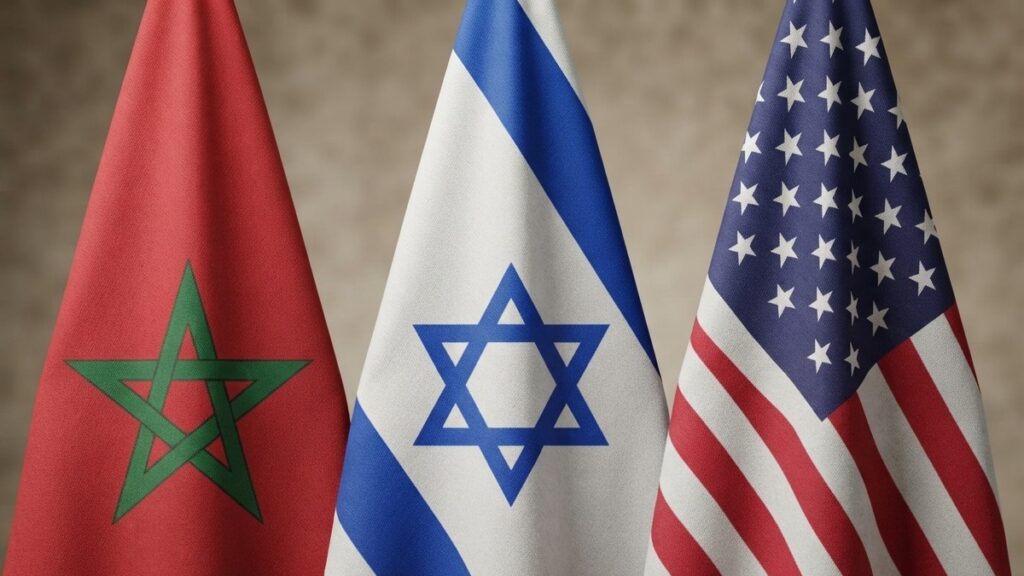
The Jerusalem–Rabat–Washington axis, rooted in the 2020 Sahara-normalization package and reaffirmed at the September 2026 summit, is relevant and important because it matches each capital’s priorities and touches the Sahara process, Maghreb balance and Gaza stabilization.
Efficiency is high in diplomatic leverage, defense-industrial transfer and institutional resilience, but low in popular legitimacy (Moroccan support collapsed after October 2023), economic breadth and progress on the Palestinian question.
The axis is durable yet conditional; its main weakness is the gap between strategic gains and public consent, so its value depends on a credible Palestinian horizon and Morocco’s plural, sovereignty-based diplomacy.
This essay evaluates the Jerusalem–Rabat–Washington axis against three criteria: relevance, importance, and efficiency. It argues that the triangle, born of the December 2020 package that joined Moroccan–Israeli normalization to United States recognition of Moroccan sovereignty over the Sahara, has moved from a transactional bargain to an institutionalized convergence, formalized by the trilateral summit of September 16, 2026. Relevance is demonstrated by the fit between each capital’s strategic problems and what the others can supply; importance by the diplomatic, security, economic, and geographic stakes involved; efficiency by comparing the axis’s yields with its costs, durability, and legitimacy. The analysis finds the axis highly efficient in diplomatic leverage, defense-industrial transfer, and institutional resilience, and markedly less efficient in popular legitimacy, economic breadth, and its contribution to the Palestinian question. Its principal vulnerability is an asymmetry between the tiers that carry the greatest strategic weight and those that enjoy the weakest public consent. The essay concludes that the axis is best understood as a durable but conditional instrument whose value will depend on disciplined linkage to a credible political horizon for Palestinians and on Morocco’s capacity to keep its sovereignty-based diplomacy plural.
1. Introduction
On September 16, 2026, in New York, the foreign ministers of Morocco and Israel met with the United States ambassador to the United Nations to reaffirm the spirit of the Abraham Accords and to agree on a package of practical steps (U.S. Mission to the United Nations, 2026). The two countries elevated their liaison offices to full embassies and committed to appoint ambassadors, to conclude investment-protection and double-taxation agreements by the end of the year, and to widen direct air links to include Moroccan carriers (Ynetnews, 2026b; i24NEWS, 2026). The venue mattered as much as the content. The meeting took place a day after Washington marked the sixth anniversary of the Accords, at a moment when the Gaza war, the war with Iran, and a tense Spanish–Moroccan episode over Ceuta were all unresolved (Ara, 2026; Naharnet, 2026). A relationship that many observers had expected to retreat into discretion after October 2023 was instead moved into the open, under American sponsorship.
That choice invites a question larger than any single communiqué. Is the Jerusalem–Rabat–Washington axis a passing convenience, a bargain struck in the last weeks of one American administration and sustained by inertia? Or is it a structure with its own logic, capable of producing outcomes none of its members could obtain alone? And if it is the latter, how efficiently does it convert shared interests into results, given the substantial costs it imposes, above all the cost of public disaffection in Morocco itself?
The argument advanced here is that the axis is relevant, important, and, in qualified terms, efficient. It is relevant because each of its three legs answers a pressing problem for the others: Rabat’s need for international consolidation of its sovereignty and for advanced defense and technological capacity, Jerusalem’s need for deep, durable partnerships in the Arab world that do not depend on the fortunes of a single Gulf relationship, and Washington’s need for low-cost partners who can stabilize peripheries while it manages commitments elsewhere. It is important because the stakes it touches are large: the Western Sahara settlement, the military balance in the Maghreb, access to African and Atlantic markets, and the shape of Gaza’s post-war order. It is efficient to the degree that it delivers disproportionate yields for modest marginal costs, but this efficiency is uneven. The yields are concentrated in the diplomatic and defense-industrial domains, while the costs are concentrated in the domain of legitimacy, where Moroccan public opinion has moved sharply against normalization since October 2023.
The essay proceeds in six steps. It first sets out an analytical framework drawing on alliance theory and the literature on two-level games. It then reconstructs the three bilateral legs of the triangle and the 2020 synthesis that joined them. Next it assesses relevance, importance, and efficiency in turn. A penultimate section tests the argument against the strongest objections, and a final section sets out strategic pathways. The analysis draws on official statements, defense-industry reporting, survey data, and the author’s own earlier work on Moroccan–Israeli and Moroccan–American relations (Chtatou, 2026b; 2026c; 2026d). Defense transactions are often opaque, and press reporting varies in reliability; claims resting on single sources are flagged as such.
2. Conceptual Framework: Reading a Triangular Axis
2.1 Axis, alliance, and convergence
An axis is not a treaty alliance. No mutual-defense clause binds Rabat to Jerusalem, and Washington’s relationship with each is governed by instruments of a different kind: a formal security partnership and a quasi-alliance of unusual intimacy with Israel, and a long-standing treaty tradition, a free trade agreement, and a Major Non-NATO Ally designation with Morocco. What binds the three is a convergence of interests, institutionalized to varying degrees. Stephen Walt (1987) argued that states ally less to balance raw power than to balance threats, a function of aggregate power, geographic proximity, offensive capability, and perceived intentions. The Moroccan–Israeli leg fits this logic only partly. Iran’s regional activism supplies a shared threat perception, and Algeria’s military buildup supplies a second for Rabat, but the axis also rests on non-threat foundations: heritage, commerce, technology, and diplomatic recognition.
Glenn Snyder’s (1984) account of the alliance security dilemma is more useful for understanding how such a structure behaves under stress. Every partnership carries two fears: abandonment, that the partner will fail in a crisis, and entrapment, that the partner’s quarrels will drag one into unwanted conflict. Rabat’s calculus can be read through both. It seeks protection against abandonment by Washington on the Sahara, and it fears entrapment in Israel’s confrontations, whether in Gaza, Lebanon, or the Gulf. The Moroccan response, visible since 2020, has been to hedge through compartmentalization: to deepen defense and diplomatic ties while preserving a distinct Moroccan voice on Palestine, symbolized by the monarch’s chairmanship of the Al-Quds Committee and the explicit restatement of the two-state position in the royal cabinet’s account of the December 2020 meeting (Asharq Al-Awsat, 2020a).
2.2 Institutions, reciprocity, and two-level games
Robert Keohane (1984) showed that cooperation among self-interested states can persist after the conditions that produced it have changed, provided institutions lower transaction costs and reward reciprocity. The Joint Military Committee, the trilateral ministerial format, the Free Trade Agreement Joint Committee, and the Board of Peace are, in this sense, the machinery through which the axis converts one-time bargains into routine exchange. Robert Putnam’s (1988) two-level game framework adds a necessary second dimension. Every leader negotiates simultaneously with foreign counterparts and with a domestic audience whose ratification, formal or informal, determines whether commitments hold. The Moroccan leadership holds near-exclusive authority over foreign policy, which lowers the domestic veto risk but does not eliminate the cost of acting against public sentiment. Israeli and American leaders face more conventional ratification constraints, in the form of coalition politics and congressional and electoral calendars.
Joseph Nye’s (2004) concept of soft power, and William Zartman’s (1989) notion of ripeness in conflict resolution, round out the toolkit. The first draws attention to the attraction generated by culture, values, and policies, which in this case includes Morocco’s reputation for Jewish–Muslim coexistence. The second helps explain why diplomatic initiatives succeed at particular moments, when parties perceive a mutually hurting stalemate and a credible way out.
2.3 Three criteria
The essay assesses the axis on three criteria, each defined operationally.
2.3.1 Relevance
Relevance measures the fit between the problems each actor faces and the resources the axis supplies. An arrangement is relevant when it addresses a priority of at least two of its members and when the priority is durable rather than episodic.
2.3.2 Importance
Importance measures the magnitude and irreplaceability of the stakes. A relationship is important when the interests it touches are large in scale and when alternative channels cannot easily replicate its outputs.
2.3.3 Efficiency
Efficiency measures the ratio of outcomes to costs, adjusted for three qualifiers: durability, whether outcomes survive shocks; legitimacy, whether outcomes are accepted by the societies that must live with them; and additionality, whether outcomes would have occurred without the axis. This last qualifier matters because the axis must not be credited with results that flow from other causes, for instance from Morocco’s own diplomatic campaign across Africa and Europe or from Israel’s pre-existing arms export policy.
Throughout, the three capitals are treated as unequal nodes. Washington is the sponsor and penholder, Jerusalem the technology and security partner, and Rabat the regional anchor whose sovereignty agenda supplies much of the axis’s motivating purpose. A triangle with unequal sides distributes costs and benefits unequally, and the analysis keeps that asymmetry in view.
3. Historical Foundations: Three Bilateral Legs
3.1 Morocco and the United States: the oldest leg
Morocco’s relationship with the United States is the oldest and the most institutionalized. In 1777 the sultan opened Moroccan ports to American shipping, an act commonly treated as the first recognition of the new republic by a foreign sovereign, and the Treaty of Peace and Friendship concluded in 1786 became the longest unbroken treaty relationship in American history (Chtatou, 2026d). This lineage matters analytically because it gives the Moroccan–American leg a depth of legitimacy and administrative habit that the other two legs lack. Its modern expression includes the Free Trade Agreement, signed in 2004 and in force since January 1, 2006, which remains the only such agreement between the United States and an African country (Morocco World News, 2025). Goods and services trade between the two countries totaled an estimated $9.6 billion in 2025, with American goods exports to Morocco of $5.5 billion and a goods surplus in the United States’ favor of $3.7 billion (USTR, n.d.). The State Department’s own investment climate assessment credits the agreement with an almost eightfold increase in bilateral goods trade since it entered into force (Morocco World News, 2025).
The security dimension is equally long-standing. The annual African Lion exercise, the largest American military exercise on the continent, has been held largely on Moroccan soil, and in May 2026 Moroccan Apache helicopters took part in maneuvers in the Tan-Tan region (Jerusalem Post, 2026). Morocco’s designation as a Major Non-NATO Ally in 2004 consolidated a practice of intelligence sharing and arms procurement that predated it. The leg is therefore anchored by treaty, trade, and routine military contact, and these anchors explain why American policy toward Morocco has shown unusual continuity across administrations, including with respect to the 2020 Sahara proclamation.
3.2 Morocco and Israel: from kinship to statecraft
The Moroccan–Israeli leg has a different character. For most of its history it has been less a relationship between two states than one between Morocco and its own Jewish subjects, and between Morocco and the wider Jewish and Sephardic world (Chtatou, 2026c). Jewish presence in Morocco spans roughly two millennia, and the Moroccan monarchy developed a tradition of protecting its Jewish communities that, as the historiography of North African Jewry shows, was real but hierarchical, combining protection with legal subordination and episodic violence (Laskier, 1994; Stillman, 1979; Chtatou, 2026a). The mass emigration of Moroccan Jews after 1948, including the organized departures of the early 1960s, produced a large diaspora in Israel whose descendants now number upward of eight hundred thousand by commonly cited estimates. Their continued cultural attachment to Morocco provides what might be called a human infrastructure for official relations, an asset that no other Arab–Israeli normalization possesses to the same degree.
State-to-state contact was episodic and often discreet. King Hassan II received Israeli leaders in the 1980s, and after the Oslo Accords Morocco and Israel opened liaison offices in 1994, which were closed in 2000 after the Second Intifada. Throughout, Morocco maintained a posture that distinguished contact with Israel from abandonment of the Palestinian cause. The renewal of relations in December 2020 thus resumed an interrupted practice, and Morocco has consistently framed it that way, as a resumption rather than as a new accession to the Abraham Accords framework (Ynetnews, 2026b). The distinction is not semantic. It signals that Rabat locates the relationship in its own history and in royal prerogative, rather than in an American-designed regional architecture.
3.3 The United States and Israel: the anchor
The third leg, between Washington and Jerusalem, is the anchor of the triangle and its principal source of both leverage and risk. The United States supplies Israel with military assistance, diplomatic cover, and intelligence cooperation of a depth without parallel in its other relationships. For the axis, this intimacy serves two functions. It gives Israel standing to act as a security and technology partner for third countries, since much Israeli defense technology rests on American components and approvals. And it gives Washington a convening power that neither Rabat nor Jerusalem can replicate, as the September 2026 summit demonstrated. The risk is that the axis inherits the volatility of the American–Israeli relationship and of American domestic politics, a point taken up below.
3.4 The 2020 synthesis
The three legs were joined in December 2020. On December 10, after a telephone call between President Trump and King Mohammed VI, the United States recognized Moroccan sovereignty over the Sahara and Morocco agreed to resume official contacts with Israel (Gearan, 2020; Asharq Al-Awsat, 2020b). The White House declared an independent Sahrawi state “not a realistic option” and described genuine autonomy under Moroccan sovereignty as the only feasible solution (Asharq Al-Awsat, 2020b). Twelve days later, on December 22, a trilateral joint declaration was signed in Rabat after a delegation led by Jared Kushner arrived on the first direct flight between the two countries (Asharq Al-Awsat, 2020a). Prime Minister Netanyahu characterized the outcome as the beginning of a “very warm peace” (Gearan, 2020).
The synthesis was a linkage bargain in the classic sense: concessions in one domain were exchanged for gains in another, and the domains were brought under a single sponsor. Its critics have argued that this linkage tainted normalization by making it appear a payment for Sahara recognition. Its defenders, including this author in earlier work, have argued that Morocco’s own history and its sustained support for the two-state solution made the step less an expedient purchase than a reactivation of existing ties on better terms (Chtatou, 2022; 2026b). Whichever reading one prefers, the linkage created the structural feature that distinguishes this axis from a series of bilateral understandings: each leg is strengthened by the existence of the others. Moroccan sovereignty gains from Israeli and American recognition, Israeli integration gains from American sponsorship and Moroccan legitimacy, and American credibility as a peace broker gains from visible results in North Africa.
4. Relevance: Why the Axis Answers Real Problems
4.1 Relevance for Rabat: consolidating sovereignty and building capacity
For Morocco, the Sahara is the organizing priority of foreign policy, and relevance must be judged first against it. The axis addresses this priority in three ways. It supplies recognition from the most consequential Security Council member, it supplies a procedural mechanism through which that recognition is converted into negotiations, and it supplies the military and technological means to hold territory and secure borders. The first is the 2020 proclamation. The second is the American role as penholder on the Western Sahara file, which produced Security Council Resolution 2797 on October 31, 2025, adopted by eleven votes with three abstentions, extending the mandate of the United Nations mission until October 31, 2026, and specifying that negotiations proceed on the basis of Morocco’s 2007 autonomy plan (ASIL, n.d.). The third is the defense relationship with Israel and the United States, discussed below.
The relevance extends beyond the Sahara. Morocco faces a demanding development agenda that includes water scarcity, agricultural productivity, energy transition, and industrial upgrading. Israeli expertise in precision agriculture and water management, and Israeli interest in Moroccan phosphates as an input for fertilizer production, correspond to genuine Moroccan needs and Israeli requirements (Bladi.net, 2026). American markets, investment, and technology serve the same agenda, and the Free Trade Agreement offers a rare platform from which Morocco can position itself as a gateway to Africa, a theme the Moroccan trade minister has pressed in dialogue with American officials (Morocco World News, 2025).
4.2 Relevance for Jerusalem: depth beyond the Gulf
Israel’s interest in the axis is a function of the limits of its other normalization partnerships. The Accords with the United Arab Emirates and Bahrain are commercially and strategically valuable but geographically confined to the Gulf, and the Israeli peace treaties with Egypt and Jordan have produced security cooperation without societal warmth. Morocco offers something distinct: a western Arab state with a large Israeli-origin population, a monarchy with symbolic authority across the Muslim world, a diplomatic reach into Africa and the Atlantic, and a defense market that increasingly values Israeli systems. One Israeli analyst quoted in the Israeli press argued that the Moroccan agreement stands on sounder ground than Israel’s treaties with Egypt and Jordan, precisely because of the human and historical ties on which it draws (JNS, 2026).
The relevance has sharpened since the war with Iran began on February 28, 2026. By the seventh month of that conflict, after a ceasefire in April and a memorandum of understanding in June, the United States and Iran were still negotiating through mediators amid deadlock, with Qatar publicly affirming that talks continued (Naharnet, 2026). Israeli commentary has noted that the war strengthened Israel’s ties with the United Arab Emirates while leaving relations with Morocco close, and that Gulf states, drawing closer to Tehran for self-protection, have pushed their own relations with Israel below the surface (Ynetnews, 2026a). Within that more guarded landscape, a Moroccan partnership that is formal, institutionalized, and publicly affirmed by an American sponsor becomes proportionally more valuable to Israel.
4.3 Relevance for Washington: leverage at low cost
For the United States, the axis is relevant as a demonstration of what American mediation can deliver at modest cost. The Trump administration has cast itself as a peacemaker, and the Abraham Accords framework is among its most cited achievements. Morocco is a partner that cooperates with that self-image: it was a founding member of the Board of Peace established at a Washington summit in January 2026, was among the first countries to honor its financial pledges, and became in February the first Arab country to commit troops publicly to the International Stabilization Force for Gaza (Morocco World News, 2026b; 2026c). Analysts quoted in the press have suggested that Washington’s active role on the Sahara file also reflects a desire to be seen concluding agreements between longtime adversaries while supporting a key ally (Africanews, 2026).
There is also a geostrategic rationale. Morocco’s location at the Strait of Gibraltar and on the Atlantic seaboard, its ports and airfields, its stable monarchy, and its position as the gateway to Francophone and Anglophone Africa make it a platform for American interests that few other states can provide. The State Department describes it as a regional hub for business and industry with an investment-grade outlook and the unique advantage of the Free Trade Agreement (Morocco World News, 2025). Israel, as a technological and defense partner for Morocco, extends and complements that platform without requiring additional American deployments.
4.4 Relevance in a reordered region
Finally, the axis is relevant because the Middle East of late 2026 is not the Middle East of 2020. The Gaza war and the ceasefire framework of October 2025 created a new institutional setting, the Board of Peace, in which Morocco and the United States, and indirectly Israel, are all present (Morocco World News, 2026b). The Iran war has redrawn alignments, producing what one Israeli analysis describes as the rise of a bloc of hardline Sunni states, including Saudi Arabia, Qatar, Turkey, and Pakistan, which regards Israel as a problematic actor (Ynetnews, 2026a). In such an environment, partnerships that rest on bilateral convergence and institutional ties are more resilient than alignments that rest on a shared enemy. This is a first indication that the axis may be more durable than critics assumed when it was formed in the shadow of a single electoral transition.
5. Importance: The Stakes the Axis Touches
5.1 Diplomatic importance: the Sahara and the architecture of recognition
The most consequential output of the axis is diplomatic. Before December 2020 the United States, like most major powers, formally maintained neutrality on the Sahara while supporting the United Nations process. After the proclamation, and above all after Resolution 2797, the weight of Council practice shifted toward the autonomy framework. The resolution mentions the autonomy plan repeatedly and calls on the parties to negotiate on its basis, while welcoming American readiness to host talks (ASIL, n.d.; Morocco World News, 2026f). The Secretary-General’s annual report subsequently credited the resolution with giving renewed momentum to the political process, citing three rounds of direct negotiations facilitated by the United States among Morocco, Algeria, the Polisario Front, and Mauritania, and describing genuine autonomy as potentially the most feasible outcome (Morocco World News, 2026d). On October 15, 2026, the General Assembly’s Fourth Committee adopted a text that, while reaffirming self-determination, incorporated a reference to Resolution 2797 (Morocco World News, 2026g).
Three features of this record deserve emphasis. First, the American role transformed the process procedurally. The talks held in Madrid in early February 2026 and in Washington on February 23 and 24, led by President Trump’s Africa envoy Massad Boulos and Ambassador Mike Waltz, were conducted under strict discretion, brought Algeria to the table, and were reported as a clear departure from the long-stalled United Nations format (Africanews, 2026). A Washington Institute analysis cited in the Moroccan press stressed that securing Algerian participation was itself a significant achievement. Second, Morocco’s negotiating position was substantively developed: the updated autonomy document, reportedly of some forty pages, specifies powers over health, education, culture, local taxation, and urban planning for the southern provinces while reserving defense, foreign policy, currency, and security to the central government. Third, important disagreements persist. The Polisario Front and Algeria reject any solution that excludes self-determination, and reporting indicates sharp disagreement over symbols of Sahrawi identity (Africanews, 2026). Moroccan officials, for their part, insist that the Council abandoned the referendum option decades ago (Morocco World News, 2026e).
The author’s argument is not that the Sahara is settled. It is that the axis has altered the probable shape of settlement by shifting the burden of proof. Zartman’s (1989) ripeness theory suggests that negotiations succeed when parties perceive that continued conflict is costly and that a formula is available. The axis has made the Moroccan formula the default option on the table and raised the cost to others of rejecting it. Whether Algiers perceives the stalemate as sufficiently hurting is a question beyond the axis’s control, but the axis has shaped the conditions in which that perception forms. The Security Council’s decision on the mission’s renewal, due by October 31, will be an early indicator of how durable the shift is.
5.2 Security and defense-industrial importance
The second domain is security. Since the Moroccan–Israeli defense cooperation agreement concluded in Rabat in November 2021, the Royal Armed Forces have become one of the leading clients of Israel’s defense industry (Yabiladi, 2026). Reported acquisitions include the Barak MX air and missile defense system contracted with Israel Aerospace Industries in 2022, Ofek observation satellites, the PULS rocket artillery system, Heron and Hermes-900 drones, ATMOS howitzers, SPYDER air defense, and the LORA tactical ballistic missile (North Africa Post, 2026; Atalayar, 2023). Press estimates in early 2026 ranked Israel as Morocco’s third-largest arms supplier, behind the United States and France (Bladi.net, 2026).
The significance, however, lies less in procurement than in institutionalization and local production. In January 2026 the third session of the Joint Military Committee, held in Jerusalem, produced a military work plan for the year covering long-term capacity building, industrial projects, joint ventures, technology transfer, strategic planning, and joint training; the Israeli army described Morocco as a key partner for regional stability (North Africa Post, 2026; Yabiladi, 2026). Israeli firms have established local production: BlueBird Aero Systems opened a factory for SpyX loitering munitions in 2025, reported as the first advanced Israeli drone technology produced locally in North Africa, and Israeli defense companies were preparing in autumn 2026 to exhibit at the Marrakesh Air Show with air-defense, precision-strike, unmanned, and space portfolios (Jerusalem Post, 2026). Morocco’s defense budget, reported at roughly seventeen billion dollars for 2026, is directed in part toward building a domestic defense industry (Ynetnews, 2026c).
Why does this matter beyond the bilateral relationship? Because it changes the character of Morocco’s defense posture from dependence on purchases to participation in production chains, which carries consequences for autonomy, employment, and export potential. It also reshapes the Maghreb security environment. Algeria, in a rivalry with Morocco that produced the rupture of diplomatic ties in 2021, regards the buildup with hostility, and the dynamics are those of a classic security dilemma in which each side’s defensive modernization appears offensive to the other (Snyder, 1984). The axis’s defense dimension is therefore double-edged: it enhances Moroccan deterrence while raising the risk of an arms spiral. Honest assessment requires acknowledging both edges.
The American contribution is equally significant. African Lion, intelligence cooperation, access to American platforms, and the broader sponsorship of Moroccan modernization supply the quality assurance and interoperability that anchor the Israeli component. An Israeli system integrated into a Moroccan force that exercises regularly with the United States is a different proposition from an Israeli system purchased in isolation.
5.3 Economic and technological importance
The economic dimension is real but should be sized with care. Israeli and Moroccan sources report rapid growth in bilateral trade. A commentator quoted in the Jewish press reported growth of seventy percent in the first half of 2026, which the same source described as unprecedented (JNS, 2026). Such rates, however, are computed from a small base and should not be mistaken for scale; the trade relationship remains modest next to Morocco’s trade with the European Union, and next to American goods exports to Morocco of $5.5 billion in 2025 (USTR, n.d.). Tourism data point in the same direction. Before October 2023, the Moroccan tourism ministry estimated about 200,000 Israeli visitors in a year, and direct flights, suspended after the Hamas attack, resumed only in August 2026 (Berman, 2026).
The relevant question is therefore less current volume than structural complementarity. Morocco holds the great majority of known global phosphate reserves, and Israel’s fertilizer and agricultural technology sectors depend on such inputs. Israel leads in desalination, drip irrigation, cyber-security, and agritech, sectors in which Morocco has pressing needs. The commitments of September 2026 on investment protection and avoidance of double taxation, and the discussion of cooperation in trade, finance, innovation, tourism, water, agriculture, food security, energy, and telecommunications, address the legal prerequisites for scaling these complementarities (Ynetnews, 2026b; U.S. Mission to the United Nations, 2026). The American dimension amplifies them: Morocco’s Free Trade Agreement provides a platform for Israeli and American firms that wish to produce in Morocco for African and European markets.
5.4 Geographic and strategic importance
Geography gives the axis a strategic significance disproportionate to its economic weight. Morocco overlooks the western entrance to the Mediterranean and the Atlantic approaches to Europe. In the aftermath of the Iran war, which disrupted shipping in the Gulf and the Strait of Hormuz and raised energy prices globally (Chtatou, 2026e), diversification of routes and suppliers has acquired new urgency, and the Atlantic façade of Africa has gained value as an alternative corridor. A Moroccan state that is simultaneously a partner of Washington, a hub for European and African trade, and a defense-industrial partner of Israel is a node in several networks whose intersection no other country in the region occupies.
5.5 Human and normative importance
The last dimension is often undervalued by realist analysis. The axis draws on a reservoir of human ties: Moroccan Jews in Morocco, Israel, France, Canada, and the United States, whose bond to the kingdom has been recognized in the trilateral statement of September 2026, in which the United States and Israel affirmed the special ties between Moroccan monarchs and Moroccan Jews worldwide (U.S. Mission to the United Nations, 2026). This soft-power asset, in Nye’s (2004) sense, affects how the relationship is experienced in societies and not only in ministries. It also frames Morocco’s claim to offer a model of coexistence. Whether that model is transferable to the Israeli–Palestinian context is, as the author has argued elsewhere, doubtful, since Moroccan convivencia was a durable but hierarchical arrangement within a settled sovereign state, whereas the Israeli–Palestinian conflict is a contest between two national movements over territory and sovereignty (Chtatou, 2026a). The model’s value lies elsewhere: in demonstrating that historical memory can support, rather than obstruct, diplomatic relations.
6. Efficiency: Measuring Yields Against Costs
6.1 Applying the criteria
Efficiency, as defined earlier, is the ratio of outcomes to costs adjusted for durability, legitimacy, and additionality. Applying it to a triangular axis requires disaggregation, since the three capitals bear different costs and receive different yields. The assessment below proceeds domain by domain and then offers a synthetic judgment. The evidence is uneven. Diplomatic and defense outputs are documented in official statements and industry reporting, whereas economic outputs rest on thin and partisan data, and the costs of legitimacy can be measured only through survey instruments and indirect indicators such as protest activity.
6.2 Where the axis is efficient
6.2.1 Diplomatic yield
The strongest case for efficiency lies in the Sahara file. The costs Morocco bore in 2020 were the political costs of resuming relations with Israel, a step with precedent in the 1990s and one that the monarchy could present as continuity. The yields were an American proclamation of sovereignty, a reorientation of the American role from observer to penholder, a Security Council resolution naming the autonomy plan as the basis for negotiation, and a series of facilitated direct talks in which Algeria participated (ASIL, n.d.; Africanews, 2026). The additionality test requires caution. Morocco’s own campaign had already won a wave of support in Africa, with consulates opened in Laayoune and Dakhla by a large number of African states, and European positions were shifting, notably Spain’s in 2022 (Morocco World News, 2026f). Yet the American step was of a different order, because it came from a permanent member and a penholder, and it is difficult to see how the 2025 resolution could have been drafted and adopted in its present form without it. The yield-to-cost ratio is therefore high, and the outcome is durable to the extent that American policy continued across administrations and that the Fourth Committee’s October 2026 text incorporated the resolution’s reference (Morocco World News, 2026g).
6.2.2 Defense-industrial yield
The second efficient domain is defense. Here the logic is one of compounding returns. Procurement from Israel and the United States, institutionalized through the Joint Military Committee, has converted into local production lines and technology transfer, which in turn create employment, skills, and export options (North Africa Post, 2026; Jerusalem Post, 2026). Compared with alternatives, notably sole reliance on French and American platforms or on far more costly indigenous development, the Israeli partnership has offered niche capabilities, drones, loitering munitions, air defense, and satellite observation, at relatively rapid delivery. The costs are real: dependence on specific suppliers, exposure to Algerian counter-mobilization, and the political price of association with Israeli military conduct in Gaza and Lebanon. But in strictly material terms the return on investment appears favorable, which is why Israeli officials and Moroccan planners alike describe the relationship as moving from transactional purchases to institutionalized force development (Ynetnews, 2026c).
6.2.3 Institutional resilience
Third, the axis has displayed durability under stress. Between October 2023 and mid-2026 it survived a regional war, mass protests in Moroccan cities, the suspension of direct flights, and a Moroccan envoy’s retreat from public events (Berman, 2026). Despite these shocks, the Joint Military Committee met in January 2026, the foreign ministers met in September, and the two states agreed to upgrade their missions. A structure that sustains institutional output through a period of maximal public hostility has demonstrated a resilience that a simple bargain would not have had. Keohane’s (1984) argument about the stickiness of cooperative institutions fits this case: the costs of dismantling dense, multi-layered arrangements exceed the costs of maintaining them, even when the original conditions have changed. The author has previously characterized this pattern as layered resilience, in which the long historical and social foundations of the relationship absorb shocks that would destabilize an arrangement resting only on diplomatic convention (Chtatou, 2026c).
6.2.4 Convening efficiency
A fourth, less obvious source of efficiency is convening power. The trilateral format of September 2026 allowed three states to settle in a single meeting questions that would have taken a series of bilateral exchanges: the status of missions, the timetable for tax and investment agreements, aviation, and the reaffirmation of positions on the Sahara (U.S. Mission to the United Nations, 2026; i24NEWS, 2026). The presence of a sponsor with leverage over both partners reduces transaction costs and enforcement problems, as institutional theory would predict.
6.3 Where the axis is less efficient
6.3.1 The Palestinian track
The axis’s contribution to progress on the Israeli–Palestinian question has been limited. The original premise of normalization was that it would give Arab states influence over Israeli behavior. Morocco has used its position to advocate the two-state solution, to send aid, to contribute to the Board of Peace, and to commit up to five hundred troops to the Gaza stabilization force, with training reportedly hosted on Moroccan soil from August 2026 (Morocco World News, 2026a; 2026c). These are significant undertakings, and Morocco is the first Arab country to commit forces publicly. Yet the political horizon for Palestinians remains undefined. The Board of Peace’s mandate is confined to Gaza and runs through 2027 (Morocco World News, 2026b), and Moroccan officials have publicly hoped that Gaza’s stabilization will launch a genuine peace process based on two states (Morocco World News, 2026h), language that signals aspiration rather than achievement. If efficiency is measured against the stated purpose of normalization as a lever for peace, the yield is thin. An optimistic reading holds that Morocco’s role is itself the lever: the willingness of an Arab state with Israeli relations to deploy forces in Gaza under an American-led framework offers the stabilization effort a legitimacy that other contributors cannot supply. A pessimistic reading holds that Morocco risks being used to legitimize an arrangement whose political terms it does not control. Morocco’s potential as an intermediary between the parties remains plausible but unproven.
6.3.2 Popular legitimacy
The weakest dimension is public consent. Arab Barometer data, summarized in the Moroccan press, show support for normalization falling from 31 percent in the early years after the Accords to 13 percent after October 7, 2023, and to 9 percent among respondents who describe Israel’s campaign in Gaza as genocide (2025a; 2025b). The survey’s authors concluded that Morocco offers a cautionary example for those who expect normalization to produce warm peace (Yabiladi, 2025). These figures stand in tension with other readings of the same period. An Israeli think tank, writing a year after the renewal of relations, highlighted a survey result of 41 percent support, significantly higher than elsewhere in the region (INSS, n.d.), while the Arab Barometer’s own October 2020 phone survey, conducted before the Moroccan agreement, found only 9 percent favoring the Accords concluded with the Emirates and Bahrain (Arab Barometer, 2020). Differences in question wording, timing, and sampling doubtless explain part of this dispersion, and the larger lesson is that Moroccan attitudes are volatile, strongly event-driven, and sensitive to the framing of the question, whether it concerns relations with Israel, the Accords, or the Sahara-linked package. What is not in dispute is the direction after 2023.
The efficiency implications are substantial. Legitimacy is a qualifier in the efficiency formula because outcomes that are rejected by the societies that must live with them are fragile. The asymmetry is instructive: the tiers of the relationship that carry the greatest strategic weight, defense cooperation and the Accords framework, are those with the weakest popular support, while the tiers with the strongest popular foundation, the historical and social ties to Moroccan Jews, carry the least strategic weight (Chtatou, 2026c). Left unmanaged, this misalignment could convert a technical success into a political liability.
6.3.3 Economic breadth
The economic dividends are narrower than the rhetoric suggests. The Moroccan–Israeli trade relationship, even at seventy percent growth, remains small, and the American relationship, though large, is characterized by a marked goods surplus in the United States’ favor, which fuels periodic Moroccan efforts to re-open the Free Trade Agreement to improve agricultural access and to attract investment (USTR, n.d.; Morocco World News, 2025). The axis has not yet produced the diversified investment flows its architects envisaged. The agreements promised for the end of 2026 will be a test of whether declaratory commitments translate into legal frameworks capable of attracting capital.
6.3.4 Regional spillovers
The axis also generates costs in Moroccan relations with neighbors and partners. Algeria’s hostility has deepened. In September 2026, a Spanish press analysis connected the announcement of the embassy upgrade with the Ceuta crisis, noting that the Spanish prime minister had accused Israel of helping to amplify disinformation about Spanish migration policy during the episode (Ara, 2026). Whether or not that accusation is well founded, it illustrates how association with Israel can complicate relations with a European partner whose positions on the Sahara and on migration are consequential to Morocco. Rabat’s skill at compartmentalizing, treating Spain, France, and Israel as separate files, mitigates but does not eliminate this exposure.
6.4 Synthetic judgment
Weighting these domains requires a view on which matters most for each capital. For Morocco, the Sahara dominates, and on that criterion the axis has an excellent record. For Israel, the axis provides a stable, high-quality partnership at the western end of the Arab world, with defense-industrial gains and a symbolic win; the costs are mostly reputational. For Washington, the axis delivers visible diplomatic achievements and an ally contributing to Gaza stabilization at low direct cost. On balance, efficiency is high at the level of states and strategic interests, and moderate to low at the level of societies. That divergence is the central finding of this essay. It does not invalidate the axis, but it defines the principal task of those who wish to sustain it: reducing the gap between strategic gains and social acceptance without sacrificing the former.
7. Comparative Perspectives: What Is Distinctive About the Moroccan Case?
Efficiency judgments gain precision when set against comparators. Three are instructive: the Emirati–Israeli partnership, the older Egyptian and Jordanian peace treaties, and the still-unrealized prospect of Saudi normalization.
7.1 The Emirati comparator
Israeli commentary describes the United Arab Emirates as the one Arab state in a strong alliance with Israel, benefiting in particular from military and technological advancement, and reports that the relationship strengthened during the Iran war (Ynetnews, 2026a). The Emirati case differs from the Moroccan in three respects that bear on efficiency. First, it is driven overwhelmingly by threat perception and technological aspiration, with limited societal ballast, since the Emirati public sphere is far more tightly managed and the Emirati population contains no community with historical ties to Israel comparable to Moroccan Jews. Second, the Emirati relationship has no territorial-sovereignty linkage of the Moroccan kind. Third, the Emirati state’s exposure to Iranian missiles and drones makes the relationship hostage to the Gulf theater in a way that Morocco’s is not. The Moroccan axis is therefore less intense but more diversified in its foundations. It is less likely to produce rapid technological transformation of the Emirati kind, and more likely to survive a change in the regional threat landscape.
7.2 The Egyptian and Jordanian comparator
The treaties of 1979 and 1994 gave Israel peace with its immediate neighbors, but the resulting arrangements have been described as cold, with security and diplomatic coordination unaccompanied by significant commercial or societal exchange. An Israeli scholar cited in the Jewish press contends that the Moroccan arrangement stands on sounder footing than these because it draws on a reservoir of historical and human ties that Egypt and Jordan do not share (JNS, 2026). The comparison cuts in two directions. On one hand, it supports the proposition that the Moroccan leg has unusually deep social roots and therefore potentially greater long-run efficiency than an arrangement resting on government-to-government coordination alone. On the other, the experience of Egypt and Jordan is a warning about what happens when societal opposition persists for decades despite official peace: the relationship becomes institutionally stable and politically hollow. Moroccan survey data after 2023, which place support for normalization in the same low range as in countries without formal ties, suggest that the human reservoir has not translated into mass approval (Yabiladi, 2025).
7.3 The Saudi horizon
The prospect of Saudi normalization looms over every discussion of the Accords. American officials have discussed expansion of the framework to Saudi Arabia, and the anniversary events of September 2026 gathered representatives not only of the Gulf signatories and Morocco but also of Kazakhstan, which joined the framework later (i24NEWS, 2026; Ynetnews, 2026b). Israeli analysts, however, observe that Riyadh purchases its weapons primarily from the United States, maintains contacts below the surface, and has moved closer to a Sunni bloc critical of Israel (Ynetnews, 2026a). For present purposes the significance of the Saudi question is indirect. Morocco’s experience is the most cited precedent for what a Saudi step might entail and what it might cost. A Moroccan axis that delivers tangible diplomatic and security benefits without eroding domestic stability would strengthen the case for expansion; one that visibly strains Moroccan society would weaken it. The efficiency of the axis therefore has external value for American diplomacy, which gives Washington an incentive to help manage its costs.
7.4 What the comparison shows
Taken together, the comparators suggest that the Moroccan axis occupies a distinctive position. It is broader in its foundations than the Emirati partnership, deeper in its human ties than the Egyptian and Jordanian treaties, and more advanced in institutionalization than any prospective Saudi arrangement. It shares with all of them the problem of reconciling elite strategy with public sentiment. This finding reinforces the central claim of the essay: the axis’s distinctiveness lies in its capacity to generate durable institutional ties, and its characteristic weakness is the legitimacy gap that nearly all normalization arrangements in the region share.
8. An Efficiency Scorecard
To make the preceding judgments explicit, it is useful to summarize them in a qualitative scorecard that rates the axis on each domain according to the efficiency criteria, while recognizing that such ratings are interpretive and not measurements.
In the diplomatic domain, yield is high, cost moderate, durability high, legitimacy moderate (the Sahara commands broad Moroccan consensus even though the Israeli component does not), and additionality substantial, since the American role as penholder altered the structure of the process. In the defense domain, yield is high, cost moderate to high once the dilemma with Algeria is included, durability high given the institutionalization of the Joint Military Committee, legitimacy low to moderate, and additionality substantial but partly offset by alternative suppliers. In the economic domain, yield is currently modest, cost low, durability uncertain pending the legal agreements, legitimacy low among consumers and civil society but higher among business circles, and additionality moderate, because many of the complementarities could be pursued through other partners. In the Palestinian domain, yield is limited so far, cost high in reputational terms, durability dependent on the Board of Peace’s trajectory, legitimacy contingent, and additionality uncertain. In the societal and cultural domain, yield is potentially high but under-exploited, cost low, durability very high, legitimacy high among those directly concerned, and additionality high, since this is the tier that is least replicable by any other partnership.
The scorecard confirms the pattern identified above. The axis is strongest where strategy is exercised by states and weakest where consent must be won from societies. It also identifies the most promising area for investment, the societal and cultural tier, which combines low cost, high durability, and high legitimacy and which could serve as the bridge between the strategic and popular tiers (Chtatou, 2026c).
9. Objections and Counterarguments
A credible assessment must test its thesis against the strongest objections. Six deserve attention.
9.1 The dependency objection
The first objection holds that the axis makes Morocco dependent on a single patron whose commitments are personal and electorally contingent. The recognition of 2020 was a presidential proclamation; the 2025 resolution was drafted under a particular administration; and the talks are driven by an envoy whose tenure is not guaranteed. American midterm elections fall next week, and presidential transitions have a history of reordering priorities. In Snyder’s (1984) terms, this is the abandonment fear in its purest form.
The objection has force but is partly answered by evidence. American policy on the Sahara survived the transition from the first Trump administration to the Biden administration without reversal, which suggests institutional ballast beyond personal preference. The Moroccan–American leg rests on treaty, trade, and military practice that long predate 2020 (Chtatou, 2026d; USTR, n.d.). Moreover, Resolution 2797 and the Fourth Committee text lodge the autonomy framework in multilateral instruments that will outlast any single American official (ASIL, n.d.; Morocco World News, 2026g). A rational Moroccan strategy nonetheless diversifies: maintaining the French and Spanish tracks, cultivating European, African, and Gulf support, and ensuring that Moroccan positions can be defended without reference to a specific American administration. The objection identifies a risk that must be managed, not a refutation of the axis.
9.2 The security dilemma objection
The second objection holds that the defense dimension provokes the very insecurity it is meant to counter. Algeria’s reaction, including its support for the Polisario and its own armament, shows that the axis feeds a spiral. The dynamic is real. A Moroccan defense budget in the seventeen-billion-dollar range, expansion of drone production, and integration with Israeli systems are, from Algiers’ perspective, threatening (Ynetnews, 2026c). Yet the counter-argument is that the Moroccan buildup responds to a prior rupture: the breakdown of the ceasefire in 2020, the severance of diplomatic relations in 2021, and the persistence of hostile rhetoric. A deterrence posture adopted after such developments is not obviously escalatory. The practical conclusion is that defense cooperation should be paired with confidence-building and diplomatic channels toward Algiers, a task in which American mediation, which has already brought Algeria to the table, is indispensable. Analysts have noted that Washington’s initiative depends on keeping Algeria meaningfully engaged.
9.3 The legitimacy objection
The third objection, voiced forcefully by critics of normalization, holds that the axis rests on an elite choice imposed on an unwilling society. Some commentary argues that the principal beneficiaries have been a narrow economic and political elite that gained access to Israeli markets, particularly in agriculture and agricultural technology, while popular anger was managed by involving the governing Islamist party in the signature of the agreement (Countercurrents, 2024). This characterization is polemical and contains inaccuracies and questionable inferences, but its core concern, that gains are concentrated and consent is thin, resonates with the survey evidence (2025a).
The response must distinguish between the foundations of the policy and its present reception. Foreign policy in Morocco is a royal prerogative, and the monarchy’s authority to resume relations with Israel rested on historical legitimacy, on the Jewish component of Moroccan identity enshrined in the 2011 constitution, and on the Sahara’s status as a national consensus issue. At the same time, the near-collapse of support after October 2023 shows that this foundation does not insulate the policy from public judgment. The correct inference is not that the policy lacks legitimacy but that its legitimacy is conditional on being perceived as compatible with Palestinian rights. The more the axis is seen as delivering for Palestinians, through the Gaza force, humanitarian access, and a credible political process, the more its legitimacy can be rebuilt. The more it is seen as shielding Israeli conduct, the more it will erode.
9.4 The coherence objection
A fourth objection concerns coherence. Morocco simultaneously deepens defense ties with Israel, contributes troops to a force that replaces Israeli forces in Gaza, chairs the Al-Quds Committee, and reaffirms the two-state solution. Is this a coherent strategy or an exercise in having it both ways? A skeptic would note that hedging eventually forces choices. A defender would reply that it reflects a long-standing Moroccan diplomatic style of multiple-track engagement, in which a state uses contacts with all parties to preserve influence, and that the Gaza deployment places Morocco physically and politically in the role of guarantor rather than spectator. The risk is that Moroccan personnel in Gaza could become targets or be drawn into confrontations, an entrapment scenario that requires clear rules of engagement and a defined mandate.
9.5 The Iran war objection
Finally, one may object that the axis is a creature of the anti-Iran coalition and will weaken if the regional order shifts. The Iran war has produced ambiguous results, with Gulf states hedging toward Tehran and a Sunni bloc of Saudi Arabia, Qatar, Turkey, and Pakistan emerging as a powerful mediator and critic (Ynetnews, 2026a). Morocco is geographically remote from Iran and has no direct stake in the Gulf’s security architecture. This distance is, however, a source of strength. The Moroccan–Israeli relationship does not depend on a shared Iranian threat, and Morocco’s own diplomatic ruptures with Tehran predate the Accords. Its drivers are the Sahara, defense modernization, heritage, and economic complementarity, none of which depends on the course of the Gulf conflict. If the regional order shifts toward accommodation with Iran, the axis would lose a rationale that it does not primarily rely on.
9.6 The consistency-of-principle objection
A sixth objection is normative. Morocco’s case on the Sahara rests on the principles of territorial integrity and a negotiated political settlement within a sovereign framework, yet it cooperates closely with a state whose control of the West Bank since 1967 is widely regarded internationally as occupation (Asharq Al-Awsat, 2020b). Critics ask whether a state that seeks international support for its own territorial claims can credibly partner with another whose territorial policies are contested, and whether American support for the Moroccan position, alongside support for Israel’s, reveals a selective application of principle.
The objection should be taken seriously, because consistency is a component of legitimacy in the court of public opinion, and Moroccan audiences are alert to perceived double standards. Three responses are available. First, the two cases differ legally and historically: the Sahara question is processed within the United Nations framework as a non-self-governing territory dispute in which the Council has now endorsed autonomy under Moroccan sovereignty as the basis of negotiation (ASIL, n.d.), whereas the Palestinian question concerns a territory whose status is addressed by a distinct body of resolutions. The analogy, however appealing rhetorically, glosses over those differences. Second, Morocco has not endorsed Israeli policies in the West Bank; the royal cabinet’s account of the December 2020 meeting reiterated the two-state position as the only route to an end of the conflict (Asharq Al-Awsat, 2020a). Third, the axis can hold Israel to account in ways that distance cannot, since a partner with institutional access and a seat at the Board of Peace has more leverage than a state that has severed contact. This third response, however, is only as strong as Morocco’s willingness to use that leverage openly. If the leverage remains unexercised, the consistency objection will gain force with each year of unresolved conflict. The reply to the objection is therefore conditional on conduct, which reinforces the argument of the preceding sections that the axis’s long-term efficiency depends on the political horizon it can help create.
10. Scenarios and Indicators
Assessments of efficiency are necessarily provisional, because the axis will evolve in response to events that are only partly within its control. Three scenarios, each tied to observable indicators, frame the near-term outlook. They are analytic constructs and not forecasts.
10.1 Consolidation
In the first scenario, the Security Council renews the mission in the Sahara in language that retains or strengthens the reference to the autonomy plan as the basis for negotiation, American-facilitated talks continue with Algerian participation, and the agreements promised in September on investment protection and taxation are concluded by the end of 2026. Ambassadors are exchanged and Moroccan carriers begin flights to Israel, while the Moroccan contingent deploys to Gaza under a clear mandate and without major incident. In this scenario the axis’s diplomatic and institutional yields reinforce each other, and the visible Moroccan contribution in Gaza gives the government a narrative with which to defend the relationship domestically. Indicators include the wording of the Council’s resolution, the scheduling of further negotiation rounds, the announcement of ambassadorial appointments, and the first operational reports from the Gaza deployment (Morocco World News, 2026c; 2026g). The principal risk within this scenario is complacency: success at the elite level could widen the gap with public opinion if it is not accompanied by visible progress on Palestinian questions.
10.2 Stagnation
In the second scenario, the Sahara talks stall because Algeria and the Polisario maintain their rejection of any settlement that excludes a referendum option, and the Council’s resolution, while supportive, does not alter conditions on the ground (Africanews, 2026). The Gaza stabilization force deploys slowly or not at all because the political conditions for its mandate remain contested, and the economic agreements are delayed. The axis continues to function in defense and diplomacy but delivers few new dividends, and public criticism persists without reaching a tipping point. This scenario is probably the most likely in the short run, since the structural disagreements on the Sahara are deep and the Board of Peace’s mandate is limited to Gaza (Morocco World News, 2026b). Its cost is opportunity: a relationship that remains institutionally stable but politically underperforming. Indicators include repeated postponement of rounds, public Algerian rejections, and delays in ratifying the economic agreements.
10.3 Rupture risk
In the third scenario, a shock disrupts the axis. Possible triggers include a major escalation in Gaza or Lebanon, a mass-casualty incident involving Moroccan personnel, a decisive change in American policy after a political transition, an Israeli action in Jerusalem touching the Al-Aqsa compound, which would engage the Moroccan monarch’s role as chair of the Al-Quds Committee, or a collapse of the Iran negotiations into broader regional war (Naharnet, 2026). Even in this scenario the architecture of the axis would not necessarily collapse. Moroccan diplomacy has previously suspended public activity, as it did after October 2023, while maintaining institutional contacts, and the relationship’s historical depth supplies shock absorbers (Berman, 2026; Chtatou, 2026c). But a severe rupture could reduce the axis to a quiet, security-centered relationship, with public elements suspended until conditions improve. Indicators include sustained mass protests, public statements by the royal court reaffirming the Palestinian position in stronger terms, postponement of institutional meetings, and shifts in American rhetoric on the Sahara.
10.4 Reading the indicators
The most useful indicator for assessing efficiency is the relationship between the strategic tiers and public attitudes. If subsequent survey waves show stabilization or recovery in support for relations with Israel, conditional on Palestinian progress, the legitimacy gap will be narrowing. If they show continued decline, the axis will be drawing down a finite stock of political capital. Zartman’s (1989) insight that ripeness depends on perception applies here too: the axis is likely to be judged efficient or inefficient largely on whether its principal stakeholders perceive that continued investment offers a credible way out of costly stalemates, in the Sahara, in Gaza, and in the Moroccan debate on normalization itself.
11. Strategic Pathways
The foregoing analysis points to five pathways by which the axis could preserve its efficiency while closing the legitimacy gap.
First, anchor the axis in a credible political horizon. The most effective means of repairing public consent is to tie the axis visibly to progress on Palestinian rights. Moroccan diplomacy should use its Board of Peace seat, its stabilization-force contribution, and the Al-Quds Committee to insist on a defined political track that moves beyond Gaza reconstruction to Palestinian self-determination. The American sponsor has the leverage to make this credible, and the trilateral format, which currently addresses bilateral deliverables, should regularly include the Palestinian question on its agenda.
Second, deepen the economic tier with transparency. The investment-protection and double-taxation agreements promised for the end of 2026 should be completed on schedule and accompanied by public reporting on sectoral outcomes, so that economic cooperation is seen as broadly beneficial rather than as elite enrichment. Priority should go to areas with visible social returns: water, agriculture, health technology, and renewable energy. Small and medium enterprises and Moroccan universities, rather than only large firms, should be integrated in cooperative frameworks.
Third, build a Moroccan defense-industrial base with an eye to autonomy. The local production lines offer a chance to move from importing capability to owning it. The Moroccan state should negotiate technology-transfer terms, supplier diversification, and export rights that preserve strategic autonomy, and should avoid concentrating critical capabilities in a single source.
Fourth, manage the Maghreb and European flanks. The axis should be accompanied by a deliberate diplomacy toward Algeria, Spain, and France, aimed at lowering the perception of threat. The American-facilitated talks on the Sahara provide a channel; confidence-building measures on military transparency and border management could be piloted within them. Toward Madrid, Rabat should insulate the bilateral agenda from the controversies that the Ceuta episode has exposed.
Fifth, invest in the human and cultural foundation. The strongest tier of the relationship, the historical and social bond with Moroccan Jews, should be supported through heritage restoration, education, scholarly exchange, and cultural programming that make Jewish Moroccan history part of national memory. This investment offers a means of rooting the relationship in Moroccan society rather than in diplomacy alone, and it is consistent with the constitutional recognition of Hebraic heritage (Chtatou, 2026c). It should be pursued in a manner that does not instrumentalize that heritage for political ends or conflate Jewish Moroccans with the policies of the Israeli government.
12. Conclusion
The question posed at the outset was whether the Jerusalem–Rabat–Washington axis is relevant, important, and efficient. The evidence supports a differentiated answer. It is relevant because it addresses priorities that are durable and shared: Morocco’s need to consolidate sovereignty and modernize its capabilities, Israel’s need for deep partnerships in the Arab world, and American interest in low-cost stabilization and in a stable Atlantic–African platform. It is important because it touches stakes of consequence: the likely shape of the Western Sahara settlement, the military balance in the Maghreb, the geography of Atlantic and Mediterranean access, the shape of Gaza’s stabilization, and the reservoir of human and cultural ties between Morocco and Jewish communities worldwide.
It is efficient, but not uniformly. On diplomatic leverage, defense-industrial transfer, and institutional resilience, the yields have been high relative to the costs, and they appear to be durable. On economic breadth the evidence is modest, and on the Palestinian question the contribution so far is more aspiration than result. On popular legitimacy the axis performs poorly, and the sharp fall in Moroccan support for normalization after October 2023 is the clearest warning sign in the record. The central structural weakness is the misalignment between the tiers that carry the greatest strategic weight and those that enjoy the weakest social support.
This diagnosis has an implication for all three capitals. For Rabat, the axis is an instrument of sovereignty diplomacy and not a substitute for it, and its value depends on keeping Moroccan foreign policy plural, autonomous, and attentive to its own society. For Jerusalem, the partnership with Morocco is an asset whose durability depends on Israeli behavior in Gaza and the West Bank as much as on Israeli technology. For Washington, the axis is a demonstration of what sponsorship can achieve, and its sustainability depends on continuity of attention and on a willingness to attach the political horizon that gives Arab publics a reason to accept normalization.
The next few weeks will test several of these propositions at once: the Security Council’s decision on the renewal of the mission in the Sahara, the American midterm elections, the implementation of the agreements announced in September, and the deployment of Moroccan forces in Gaza. None of these will settle the matter. But they will indicate whether the axis is, as this essay has argued, a durable and conditional instrument whose efficiency can be improved, or merely a convenience that will not survive the next change of circumstance. The case developed here favors the first interpretation, with the caveat that durability is not a given. It must be earned, repeatedly, in the court of public opinion as much as in the chancelleries.
References
Africanews. (2026, February 23). US hosts new Western Sahara talks amid deep divergences. https://www.africanews.com/2026/02/23/us-hosts-new-western-sahara-talks-amid-deep-divergences/
American Society of International Law. (n.d.). Security Council renews MINURSO mandate. ASIL Insights. https://www.asil.org/ILIB/security-council-renews-minurso-mandate
Ara. (2026, September 17). Morocco and Israel tighten ties amid the crisis in Ceuta. https://en.ara.cat/international/morocco-and-israel-tighten-ties-amid-the-crisis-in-ceuta_1_5852836.html
Arab Barometer. (2020). Taking Arabs’ pulse on normalization of ties with Israel. https://www.arabbarometer.org/?p=8602
Asharq Al-Awsat. (2020a, December 22). Israel, Morocco, US sign joint declaration. https://english.aawsat.com/home/article/2699266/israel-morocco-us-sign-joint-declaration
Asharq Al-Awsat. (2020b, December 10). Morocco joins other Arab nations agreeing to normalize Israel ties. https://english.aawsat.com/home/article/2675591/morocco-joins-other-arab-nations-agreeing-normalize-israel-ties
Atalayar. (2023, June 16). Israel plans to set up two military equipment factories in Morocco. https://www.atalayar.com/en/articulo/politics/israel-plans-to-set-up-two-military-equipment-factories-in-morocco/20230616115722186756.html
Berman, L. (2026, September 16). Israel and Morocco agree to appoint ambassadors, upgrade ties as FMs meet. The Times of Israel. https://www.timesofisrael.com/israel-and-morocco-agree-to-appoint-ambassadors-upgrade-ties-as-fms-meet/
Bladi.net. (2026, February 9). Morocco-Israel: A “shock” military plan validated. https://en.bladi.net/morocco-israel-shock-military-plan-validated,118880.html
Chtatou, M. (2022, January 26). Abraham Accords: Romancing a new Middle East.
Chtatou, M. (2026a, July 11). Can Moroccan convivencia be applied to Gaza and the West Bank to bring peace, security, and development to Palestinians and Israelis? 11072026-can-moroccan-convivencia-be-applied-to-gaza-and-the-west-bank-to-bring-peace-security-and-development-to-palestinians-and-israelis-analysis/
Chtatou, M. (2026b, June 22). From coexistence to strategic partnership: Morocco–Israel relations in historical and contemporary perspective. Eurasia Review. https://www.eurasiareview.com/22062026-from-coexistence-to-strategic-partnership-morocco-israel-relations-in-historical-and-contemporary-perspective-analysis/
Chtatou, M. (2026c, October 19). Morocco and Israel: The multi-tiered relationship from history to the Abraham Accords. Eurasia Review. https://www.eurasiareview.com/19102026-morocco-and-israel-the-multi-tiered-relationship-from-history-to-the-abraham-accords-analysis/
Chtatou, M. (2026d, July 5). Morocco–United States: 250 years of friendship, respect, and cooperation (1777–2027). Eurasia Review. https://www.eurasiareview.com/05072026-morocco-united-states-250-years-of-friendship-respect-and-cooperation-1777-2027-essay/
Chtatou, M. (2026e, June 28). Shockwaves from the Gulf: The Iran war and its impact on the global economy and energy markets. Eurasia Review. https://www.eurasiareview.com/28062026-shockwaves-from-the-gulf-the-iran-war-and-its-impact-on-the-global-economy-and-energy-markets-analysis/
Countercurrents. (2024, September 17). The shifting sands: Morocco’s new reality post-Abraham Accords. https://countercurrents.org/2024/09/17/the-shifting-sands-moroccos-new-reality-post-abraham-accords
Gearan, A. (2020, December 10). Morocco and Israel to establish diplomatic relations with U.S. backing. Daily Alert (excerpt from The Washington Post). https://www.dailyalert.org/archive/index.php?id=80560
Hespress English. (2025a, January 15). Study reveals shift in Moroccan attitudes toward normalization with Israel. https://en.hespress.com/100858-100858.html
Hespress English. (2025b, June 24). Survey: Moroccan support for normalization with Israel drops sharply after war on Gaza. https://en.hespress.com/114088-114088.html
Hespress English. (2026a, February 26). U.S. push on Moroccan Sahara hinges on meaningful Algeria engagement, analysis says. https://en.hespress.com/132582-132582.html
Hespress English. (2026b, February 22). US to host new Washington talks on Moroccan Sahara dispute. https://en.hespress.com/132349-132349.html
i24NEWS. (2026, September 16). Israel, Morocco upgrade ties as Abraham Accords mark six years. https://www.i24news.tv/en/news/israel/diplomacy/artc-israel-morocco-upgrade-ties-as-abraham-accords-mark-six-years
Institute for National Security Studies. (n.d.). A year since the renewal of relations: The public in Morocco. https://www.inss.org.il/social_media/a-year-since-the-renewal-of-relations-the-public-in-morocco/
Jerusalem Post. (2026, September 22). Israeli defense companies head to Marrakesh Air Show. https://www.jpost.com/defense-and-tech/article-909292
JNS. (2026, September). Israel and Morocco announce embassy upgrade, deepen Abraham Accords partnership. https://www.jns.org/analysis/israel-and-morocco-announce-embassy-upgrade-deepen-abraham-accords-partnership
Keohane, R. O. (1984). After hegemony: Cooperation and discord in the world political economy. Princeton University Press.
Laskier, M. M. (1994). North African Jewry in the twentieth century: The Jews of Morocco, Tunisia, and Algeria. New York University Press.
Morocco World News. (2025, September 29). What did US Department of State say in its 2025 investment climate report on Morocco. https://www.moroccoworldnews.com/?p=260901
Morocco World News. (2026a, October 20). Morocco hosts training of up to 500 Moroccan personnel for Gaza stabilization force. https://www.moroccoworldnews.com/2026/10/343059/morocco-hosts-training-of-up-to-500-moroccan-personnel-for-gaza-stabilization-force/
Morocco World News. (2026b, February 19). Morocco is officially among the first five countries to commit troops to Gaza’s ISF. https://www.moroccoworldnews.com/2026/02/279539/morocco-is-officially-among-the-first-five-countries-to-commit-troops-to-gazas-isf/
Morocco World News. (2026c, September 24). Morocco joins 500-troop advance force for Gaza stabilization mission. https://www.moroccoworldnews.com/?p=339690
Morocco World News. (2026d, October). UN chief says Resolution 2797 gave Western Sahara renewed momentum. https://www.moroccoworldnews.com/2026/10/340721/un-chief-says-resolution-2797-gave-western-sahara-renewed-momentum/
Morocco World News. (2026e, October 14). UN Resolution 2797 shifts Sahara issue toward final settlement, Hilale says. https://www.moroccoworldnews.com/?p=342041
Morocco World News. (2026f). Western Sahara: UNSC votes on Resolution 2797 recognizing autonomy plan as genuine solution. https://www.moroccoworldnews.com/?p=266116
Morocco World News. (2026g, October 17). Western Sahara: Why Morocco is confident entering a new diplomatic phase. https://www.moroccoworldnews.com/2026/10/342597/western-sahara-why-morocco-is-confident-entering-a-new-diplomatic-phase/
Morocco World News. (2026h, February 19). What are Morocco’s commitments to Gaza under Trump’s Board of Peace? https://www.moroccoworldnews.com/2026/02/279552/what-are-moroccos-commitments-to-gaza-under-trumps-board-of-peace/
Naharnet. (2026, October 6). Qatar says US, Iran still in talks to end war. https://www.naharnet.com/stories/en/322940-qatar-says-us-iran-still-in-talks-to-end-war
North Africa Post. (2026). Morocco-Israel Joint Military Committee sets action plan for 2026. https://northafricapost.com/?p=93836
Nye, J. S., Jr. (2004). Soft power: The means to success in world politics. PublicAffairs.
Office of the United States Trade Representative. (n.d.). Morocco. https://www.ustr.gov/countries-regions/europe-middle-east/middle-east/north-africa/morocco
Putnam, R. D. (1988). Diplomatic and domestic politics: The logic of two-level games. International Organization, 42(3), 427–460.
Snyder, G. H. (1984). The security dilemma in alliance politics. World Politics, 36(4), 461–495.
Stillman, N. A. (1979). The Jews of Arab lands: A history and source book. Jewish Publication Society.
U.S. Mission to the United Nations. (2026, September 16). Joint statement of the United States, the Kingdom of Morocco, and the State of Israel. https://www.globalsecurity.org/military/library/news/2026/09/mil-260916-usmissionun03.htm
Walt, S. M. (1987). The origins of alliances. Cornell University Press.
Yabiladi. (2025). Poll reveals sharp decline in Moroccan support for Israel normalization. https://en.yabiladi.com/articles/details/158619
Yabiladi. (2026). Morocco and Israel strengthen military ties with 2026 action plan. https://en.yabiladi.com/articles/details/185098
Ynetnews. (2026a). Gulf states are ready to pay “protection money” to Iran as it emerges from war stronger. https://www.ynetnews.com/article/hjiy9k1fgg
Ynetnews. (2026b). Israel, Morocco agree to upgrade ties, open embassies. https://www.ynetnews.com/article/byqclddyge
Ynetnews. (2026c). The Israel-Morocco axis: Why the 2026 military pact is the death of the old Maghreb. https://www.ynetnews.com/opinions-analysis/article/b1otn11vbwx
Zartman, I. W. (1989). Ripe for resolution: Conflict and intervention in Africa (Updated ed.). Oxford University Press.

Dr. Mohamed Chtatou is a senior professor of business communication at the International University of Rabat -IUR- as well at Mohammed V University in Rabat. He is currently a political analyst with Moroccan, Gulf, French, Italian and British media on politics and culture in the Middle East, Islam and Islamism as well as terrorism.