The History Of Gnawa In Morocco: Trans-Saharan Slavery, Cultural Memory, African Heritage, And Moroccan Identity – Analysis
Key Takeaways:
The essay treats the Gnawa as a diasporic formation shaped over generations by trans-Saharan slavery, settlement, conversion and Sufi exchange rather than a single ethnic origin or founding event, arguing that their culture was made in Morocco itself.
It examines the musical-ritual repertoire—the guembri, qraqeb and the nocturnal lila—as vehicles of memory, healing and community, and traces the tradition’s shift from social marginality to national and international recognition, including UNESCO inscription in 2019.
A comparison with Ottoman Tripolitania situates Morocco in a wider Saharan system while cautioning against genealogical conflation, and the conclusion holds that public celebration must be matched by recognition of the historical experience and cultural authority of Gnawa practitioners.
This essay examines the history of the Gnawa of Morocco as a case study in how forced migration, slavery, and unequal power relations can generate cultural forms that become constitutive of the societies in which they arise. Drawing on historical scholarship on the trans-Saharan slave trade, on ethnographic and musicological research on Gnawa ritual, and on recent work on Blackness and heritage in Morocco, it argues that the Gnawa cannot be reduced to a single ethnic origin, a single trade route, or a single founding event. Gnawa culture took shape over generations through enslavement, settlement, conversion, Sufi exchange, and creative adaptation, and it is best understood as a diasporic formation whose centre of gravity is Morocco itself. The essay analyses the Saharan commercial and political context, the debates about origins and identity, the musical and ritual repertoire (the guembri, the qraqeb, and the lila), and the transformation of the Gnawa from a socially marginal ritual community into a nationally celebrated and internationally recognised heritage, culminating in the inscription of Gnawa on UNESCO’s Representative List in 2019. A comparison with Ottoman Tripolitania situates Morocco within a wider Saharan system while cautioning against genealogical conflation. The essay concludes that Gnawa history joins suffering and creativity, and that public celebration of the tradition must be matched by recognition of the historical experience and cultural authority of its practitioners.
1. Introduction: Who Are the Gnawa?
The Gnawa (also spelled Gnaoua or Gnoua) are a Moroccan cultural and spiritual community whose history is closely bound up with sub-Saharan Africa, with the commercial networks that crossed the Sahara for more than a thousand years, with slavery, with Islam, and with the development of distinctive musical and ritual traditions. To the casual visitor who encounters them in the square of Jemaa el-Fna in Marrakesh, in the alleyways of the Essaouira medina, or on the stages of an international festival, the Gnawa appear as musicians in brightly coloured robes, striking iron castanets and plucking a three-stringed bass lute. To the historian, the anthropologist, and the ethnomusicologist, they are something far more complex: the heirs of a history of displacement and of the creative labour by which displaced people built a new home, a new community, and a new religious and artistic language.
This essay approaches Gnawa history from that wider perspective. Its central argument is that the history of the Gnawa illustrates how forced migration and unequal power relations can produce new cultural forms that become integral to the identity of the societies in which they emerge. The Gnawa did not arrive in Morocco with a finished culture that they simply transplanted. Nor were they passive recipients of a Moroccan culture that was already complete. Gnawa culture was made in Morocco, over centuries, by people and the descendants of people who came from many parts of the African continent, who were often brought by coercion, and who encountered, adapted to, and transformed the religious and social worlds around them. The result is a tradition that is at once African and Moroccan, Islamic and attentive to older spiritual inheritances, marginal in its social origins and central in its present-day symbolic value.
Four features of this history deserve emphasis at the outset. The first concerns origins. The precise beginnings of the Gnawa as a distinct community remain debated, and the available historical and ethnographic evidence does not support the identification of a single ethnic ancestry or a single founding event (El Hamel, 2008; Becker, 2020). Popular narratives often compress this complexity into a single story, for example that the Gnawa descend from the soldiers brought back from a particular military expedition, or from one West African people. Such narratives are attractive because they are simple, but they obscure the plural and cumulative character of the process. The second feature concerns memory. Gnawa songs, rhythms, ritual objects, clothing, and oral transmission preserve memories of displacement and suffering that official chronicles tended either to omit or to treat as incidental. The Gnawa are, in this sense, an archive that performs. The third feature concerns belonging. Gnawa practitioners have long understood themselves as Muslims and as Moroccans, and their rituals are shaped by Moroccan Sufi forms of devotion; yet their history also entails a particular relationship to Black African ancestry and to slavery that continues to shape how Gnawa culture is perceived and how its practitioners are treated. The fourth feature concerns change. Gnawa culture is not simply a remnant of slavery that survives by inertia. It is a living tradition, sustained through family transmission, apprenticeship, artistic innovation, and community identity, and it has been reshaped in recent decades by tourism, by global music markets, and by the politics of heritage.
The essay proceeds in several stages. Section 2 sets out the conceptual and historiographical framework, introducing the notions of diaspora, cultural memory, and heritage, and reviewing the sources on which any history of the Gnawa must rely. Section 3 reconstructs the trans-Saharan slave trade and its place in Moroccan history, from the medieval networks of the western Sahara through the Saadian expedition of 1591 and the military slavery of the Alaouite period to the household and agricultural slavery that persisted into the early twentieth century. Section 4 turns to Gnawa identity itself, examining the debates about origins, names, and belonging. Section 5 analyses Gnawa music and its principal instruments, and Section 6 examines the lila, the nocturnal ceremony that stands at the heart of Gnawa ritual life. Section 7 compares Morocco with Ottoman Tripolitania in order to clarify the geography of trans-Saharan slavery and to warn against the conflation of shared systems with shared genealogies. Section 8 considers the place of the Gnawa in contemporary Moroccan society, including the Essaouira festival, the UNESCO inscription, the economics of cultural tourism, and the continuing questions of race and recognition. Section 9 draws out the main themes for discussion and teaching, and Section 10 concludes.
A note on terminology and method is necessary. The essay uses the term Gnawa for the ritual communities and musicians who identify with, or are identified with, the tradition so named, while recognising that the word carries different connotations in different settings: in some contexts it is a proud self-designation, in others a label applied from outside, and in still others a term that has been loosely extended to any Black Moroccan or to any musician who plays in the idiom. The essay also uses the term Black Moroccan with care, recognising that Moroccan terms for the descendants of enslaved Africans, such as ‘abid, haratin, and others, have histories of their own, some of them deeply pejorative, and that the relationship between these categories and Gnawa identity is neither simple nor uniform. Finally, the essay seeks throughout to distinguish what is documented from what is hypothesised. The history of the Gnawa abounds in plausible conjecture, and part of the discipline of writing it is to say clearly which conclusions rest on archives and ethnography and which rest on inference.
2. Conceptual and Historiographical Framework
2.1 Diaspora, Slavery, and the Making of New Communities
The concept of diaspora has been central to the scholarship on the Gnawa, and it is worth considering what the concept does and does not explain. In its classical formulation, a diaspora is a population dispersed from an original homeland, which retains a collective memory of that homeland and aspires, in some sense, to return (Safran, 1991). Later scholars have loosened this definition considerably. James Clifford (1994) argued that diasporic identities are defined less by an orientation towards a lost homeland than by the lived experience of separation, of dwelling in difference, and of maintaining connections across borders. Stuart Hall (1990) emphasised that cultural identity in the diaspora is a matter of becoming as well as of being: it belongs to the future as much as to the past, and it is constructed through transformation and difference rather than through the preservation of an essence. Paul Gilroy (1993) proposed that the experiences of the Black Atlantic gave rise to cultural forms that cannot be assigned to any single nation, because they were formed in the circulation of people, ideas, and music across oceans.
These formulations help to illuminate the Gnawa case, though they must be applied with care. The Gnawa belong to what has been called the African diaspora in the Mediterranean lands of Islam (Hunwick & Troutt Powell, 2002), a diaspora that has received far less attention than its Atlantic counterpart but that is no less significant. Chouki El Hamel (2008) has argued that, unlike a diaspora whose identity depends on the aspiration to return to a specific homeland, Gnawa identity developed primarily through cultural continuity and community formation within Morocco. The Gnawa did not, in the main, dream of return to a particular West African village, for the memory of such villages was fragmented across generations and, in any case, return was rarely possible. They built, instead, a home in the place to which they had been brought. This does not mean that Africa disappeared from their imagination. On the contrary, the songs and ritual repertoire of the Gnawa preserve references to African peoples, places, and spiritual entities. But these references function less as expressions of a project of return than as resources for building a sense of collective belonging in Morocco.
The comparison with the Atlantic world is instructive, and it has been drawn explicitly in the scholarly literature. In both cases, people from diverse African societies were brought into new social orders under conditions of coercion; in both cases, they lost the political and kinship institutions that had structured their previous lives; and in both cases, they used music, ritual, and religion to create new forms of solidarity. Yet the differences are equally important. Slavery in Morocco and in the wider Islamic world was embedded in legal and religious frameworks different from those of the plantation Americas; it was more often domestic and military than plantation-based; it allowed, at least in principle, for manumission and for the incorporation of the children of enslaved women into the household; and it coexisted with a religious culture in which the conversion of enslaved people to Islam was both expected and consequential (Lovejoy, 2012; Miers & Kopytoff, 1977). These features shaped the distinctive trajectory of Gnawa culture, in which religious syncretism and Sufi participation played such a prominent role.
2.2 Cultural Memory and Performance
A second conceptual resource is the notion of cultural memory. Pierre Nora (1989) distinguished between history, the critical reconstruction of the past by professional historians, and memory, the living and often unselfconscious relationship of a community to its past, which is embodied in practices, places, and objects. Jan Assmann (2011) developed the related idea of cultural memory, the body of shared knowledge and symbolic forms through which a society or group stabilises its identity across generations. For communities with limited access to written records, performance becomes the privileged medium of such memory. The Gnawa lila, with its fixed sequences of rhythms, songs, colours, and incense, is a mnemonic system in the full sense: it organises and transmits a body of knowledge about ancestors, saints, spiritual entities, and historical suffering, and it does so through repetition and embodied participation.
This insight has methodological consequences. If the Gnawa preserve their history through performance rather than writing, then the historian cannot treat performance as a decorative supplement to documentary evidence. Songs and rituals must be read as sources, with all the caution that this entails: they are layered, they have been transformed over time, and their meanings are contested even among practitioners. At the same time, the historian must resist the temptation to read ritual as a transparent window onto the past. A reference to a West African people in a song may preserve a genuine memory of ancestral origins, or it may reflect a later adoption of a repertoire from another community, or it may have acquired a symbolic meaning that has little to do with the historical origin of the term. The responsible approach is to place performance in dialogue with documentary evidence, with the study of trade and slavery, and with comparative research on similar traditions elsewhere in North and West Africa.
2.3 Sources and Silences
The sources for Gnawa history are uneven. For the trans-Saharan trade and for Moroccan relations with the Sahel, there is a substantial body of Arabic chronicles, travellers’ accounts, legal texts, and, for later periods, European consular and commercial records. The chronicles of Timbuktu, such as the Ta’rikh al-Sudan and the Ta’rikh al-fattash, provide a Sahelian perspective on the Moroccan conquest of Songhai (Hunwick, 1999). Moroccan chronicles of the Saadian and Alaouite dynasties, together with European accounts, document the recruitment of enslaved Africans into the sultan’s army and the broader place of slavery in the state. Legal literature, including the fatwas and notarial documents concerning the sale, manumission, and treatment of enslaved persons, provides further evidence, though it has been less systematically studied than it deserves (Ennaji, 2013).
For the Gnawa themselves, however, the documentary record is thin. The enslaved and their descendants rarely wrote, and when others wrote about them, it was usually as property, as soldiers, or as ritual specialists regarded with a mixture of fear and fascination. The earliest systematic accounts of Gnawa ritual come from the early twentieth century, when European and Moroccan observers began to describe the ceremonies of the ‘Gnaoua’ in the cities. Edward Westermarck (1926), whose study of Moroccan ritual and belief remains a major source on spirit beliefs and healing practices, provides valuable context for understanding the religious environment in which the Gnawa operated. Later ethnographic work, notably that of Georges Lapassade (1976) on the Gnawa of Essaouira and of Viviana Pâques (1991) on the religion of the Gnawa as a brotherhood, extended our understanding of the ritual structures, while the psychological and anthropological study of possession by Bertrand Hell (1999) placed Moroccan trance practices in a wider comparative frame. More recent scholarship has combined archival research with extended fieldwork. El Hamel (2008, 2013) has reconstructed the historical context of slavery and the possible routes by which Gnawa identity was formed. Deborah Kapchan (2007) has analysed the circulation of Gnawa music in the global marketplace and the ways in which it has been transformed by that circulation. Cynthia Becker (2020), drawing on extensive research in Essaouira, has examined how Gnawa identity is constructed through music and visual culture, and how it is entangled with Blackness in Morocco.
These sources are invaluable, but they also encode silences. The voices of enslaved women, who constituted a significant proportion of the enslaved population in Moroccan households and who bore children who were incorporated into Moroccan families, are especially difficult to recover. So too is the experience of those who did not become Gnawa, who assimilated into the wider society and lost any distinct memory of their origins. The history of the Gnawa is thus necessarily the history of a part of a larger Black Moroccan history, and the relationship between the part and the whole remains a subject of research and debate. A responsible account must acknowledge these limits rather than conceal them with narrative confidence.
2.4 Heritage as a Contested Field
A final conceptual resource is the critical study of heritage. Heritage is not merely the past that survives; it is the selection, valorisation, and presentation of aspects of the past in the present, for particular purposes and by particular actors (Smith, 2006). The recognition of a tradition as heritage can protect it, give it visibility, and generate resources for its practitioners; it can also freeze it, commodify it, and transfer control over its meaning from the community to external institutions. The 2003 UNESCO Convention for the Safeguarding of the Intangible Cultural Heritage explicitly recognised the role of communities in the identification and transmission of their heritage, but the practical application of that principle is often contested (Brown, 2003, offers a sustained critique of the problem of cultural ownership). The Gnawa case is an instructive one, because it combines a long history of marginalisation with a recent trajectory of national and global celebration, and because the question of who speaks for the tradition, who benefits from it, and how its sacred dimensions are to be represented has become increasingly urgent.
3. The Trans-Saharan Slave Trade and Morocco
3.1 The Saharan Commercial System
From the medieval period into the nineteenth century, trans-Saharan commercial networks connected North Africa with the Sahel and with regions farther south. These networks carried gold, salt, copper, textiles, kola, ivory, and other commodities, but they also facilitated the movement and enslavement of human beings (Austen, 2024; Lydon, 2009). The Sahara was never an empty barrier. It was a space of oases, pastoral peoples, caravan routes, and commercial towns, whose inhabitants, among them Amazigh-speaking Sanhaja and Tuareg groups, Arabic-speaking merchants, and Sahelian traders, maintained the infrastructure on which long-distance exchange depended. The historian John Wright (2007) has estimated, with the caution that all such figures demand, that the trans-Saharan trade moved a very large number of enslaved persons over many centuries, though the volume fluctuated greatly according to political conditions, the state of the routes, and the demand in destination markets.
Caravans crossed the desert through networks that linked places such as Timbuktu, Gao, the Tafilalt oasis, Sijilmasa, Marrakesh, and other North African commercial centres. Sijilmasa, on the northern edge of the Sahara in the Tafilalt, long served as the principal northern terminus of the western routes, and its prosperity rested on its role as an entrepôt where gold and enslaved people from the south were exchanged for goods from the Mediterranean world. Successive Moroccan dynasties, from the Almoravids, who rose from the Saharan Sanhaja and whose empire spanned the desert, to the Almohads, the Marinids, and the Saadians, maintained political, commercial, and military relationships with Saharan and Sahelian regions (Abun-Nasr, 1987; Bennison, 2016). The movement of people along these routes was thus embedded in statecraft as well as in commerce.
It is important to stress the heterogeneity of this system. The enslaved persons who reached Morocco came from many different regions and societies of the Sahel and the savanna. They spoke different languages, followed different religious traditions, and had been enslaved through different mechanisms: capture in warfare, raiding, tribute, judicial penalty, debt, and purchase. Some were already Muslim, in theory protected by the Islamic legal principle that free Muslims could not be lawfully enslaved, yet in practice often enslaved nonetheless, a contradiction that Sahelian scholars such as Ahmad Baba of Timbuktu had famously addressed in the early seventeenth century and that continued to trouble the Islamic legal tradition. Others came from non-Muslim societies and encountered Islam in the course of their captivity. This diversity of origins is fundamental to understanding why Gnawa culture cannot be traced to a single African people.
3.2 The Saadian Period and the Conquest of Songhai
The Saadian dynasty, which came to power in the sixteenth century, had a particular interest in the Sahel. In 1591, Sultan Ahmad al-Mansur dispatched a military expedition across the Sahara that defeated the Songhai army at the battle of Tondibi, took the Songhai capital of Gao, and extended Moroccan influence into parts of the Niger bend, including Timbuktu and Djenné (Hunwick, 1999; Abun-Nasr, 1987). The expedition, led by Judar Pasha, an Iberian-born commander of the Moroccan army, and equipped with firearms that gave it a decisive advantage, was a remarkable logistical achievement. Its motives were a combination of the desire to control the gold trade, the wish to secure the salt mines of Taghaza and the commercial centres of the Sahel, and the political ambition of a sultan who sought to demonstrate his stature in the Islamic world.
The consequences of the conquest were considerable for both regions. For the Sahel, it contributed to the disruption of the Songhai state and to a long period of political fragmentation; the Moroccan garrison, which came to be known as the Arma, gradually became a local ruling elite cut off from Morocco. For Morocco, the expedition brought back gold and, according to the sources, enslaved persons, including scholars and craftsmen from Timbuktu who were removed from the city in the aftermath of the conquest (Hunwick, 1999). The connection between the Saadian expedition and the origins of the Gnawa has been the subject of popular narratives, but it should not be exaggerated. The expedition certainly increased the flow of enslaved persons from the Niger region into Moroccan cities, and it may have contributed to the formation of Black communities in Marrakesh and elsewhere. But the movement of enslaved Africans into Morocco long predated 1591 and continued long after it. The historical origins of Gnawa culture should not be reduced to a single military campaign.
3.3 The Alaouite Period and the ‘Abid al-Bukhari
The second major episode associated with the history of Black Morocco is the military slavery of the early Alaouite period. Under Sultan Moulay Isma’il, who reigned from 1672 to 1727, enslaved Africans were recruited in large numbers into the sultan’s military establishment, commonly associated with the ‘Abid al-Bukhari, the ‘servants’ or ‘slaves’ of al-Bukhari, a name derived from the oath that members were said to have sworn on the collection of prophetic traditions compiled by al-Bukhari (Meyers, 1977; El Hamel, 2013). According to the standard account, Moulay Isma’il sought to build a standing army loyal to the person of the sultan rather than to tribal leaders, and he did so by assembling a corps of Black soldiers, some purchased from the south, some drawn from existing Black populations in Morocco, whose status he sought to regulate through a register. Estimates of the size of the corps vary widely, and modern historians treat the largest figures in the older literature with caution.
El Hamel’s (2013) detailed study has shown that the history of the ‘Abid al-Bukhari was both more complex and more contested than the simple image of a slave army suggests. The sultan’s efforts to enslave or to re-enslave Black people living in Morocco, including free Black Moroccans whose families had lived in the country for generations, provoked legal and religious debate, and scholars of the time disputed whether skin colour could be taken as presumptive evidence of slave status. This debate exposed the extent to which racial thinking had penetrated the legal and social assumptions of Moroccan society, a development that had lasting consequences for the status of Black Moroccans. After the death of Moulay Isma’il in 1727, the corps became a powerful and disruptive political force during the period of instability that followed, and it was later dispersed or reduced. Its members and their descendants were settled in various parts of the country, contributing to the formation of Black communities in cities and in the countryside.
The relevance of this history to the Gnawa is indirect but important. The ‘Abid al-Bukhari did not constitute the Gnawa, and it would be a mistake to identify the two. But the military slavery of the Alaouite period illustrates the mechanisms by which people of African origin were brought into the Moroccan state, settled in Moroccan territory, and given a distinct social status, and it helps to explain why Black communities in several Moroccan cities developed solidarities and ritual practices that set them apart. Gnawa lodges and ritual networks in Marrakesh, Essaouira, Fez, Meknes, and other cities occupied a social space shaped by this history of enslavement, settlement, and limited integration.
3.4 Domestic, Agricultural, and Urban Slavery
The most common form of slavery in Morocco was not military but domestic. Enslaved Africans entered households as servants, cooks, nurses, craftsmen, and concubines; they worked in agriculture in the oases and the plains; and they were employed in the commercial and artisanal sectors of the cities (Ennaji, 2013). Their experiences varied according to their status, location, and historical circumstances. A woman who became the mother of her master’s child acquired legal protections and a path to freedom that were unavailable to other enslaved people; a skilled craftsman might acquire a degree of autonomy; and an enslaved person in a wealthy urban household might live in conditions that differed greatly from those of a labourer in a southern oasis. Mohammed Ennaji (2013) has emphasised that slavery in Morocco was woven into the fabric of the state, the household, and the economy, and that its legal and ideological justification drew upon both religious law and social convention.
The existence of manumission, which Islamic ethics encouraged as a pious act, produced a population of freed people who occupied an ambiguous place in Moroccan society. They were no longer enslaved, but they carried the stigma of their origins, they often remained tied to their former owners by bonds of patronage and obligation, and they faced discrimination in marriage and in access to land and status. The term haratin, applied in southern Morocco and the Saharan oases to populations of darker complexion engaged in cultivation, has been interpreted in various ways, as referring to freed people, to long-settled cultivators, or to a distinct social category with a complicated relationship to slavery; its meaning varies by region and over time, and generalisation is hazardous. What is clear is that Morocco developed a social order in which colour, origin, and servile ancestry intersected with class and status in ways that outlasted the legal institution of slavery.
The institution declined under pressure of changing economic conditions, European abolitionism, and, from 1912, the French and Spanish Protectorates, which curtailed the formal practice of slavery, though historians have emphasised that its social legacies and, in some regions, its informal survival persisted for decades afterwards (El Hamel, 2013; Ennaji, 2013). The experience of enslavement was thus still within living memory of some families in the early twentieth century, and the stigma attached to servile ancestry remained a force in Moroccan social relations well beyond that period. It is against this background that Gnawa culture must be understood: not as a distant relic of a vanished past, but as a tradition formed in, and responding to, a society in which slavery was an institution of long duration and its social consequences were deeply felt.
3.5 A Key Distinction
The preceding discussion yields a distinction that is basic to the argument of this essay. The historical origins of Gnawa culture cannot be reduced to a single military campaign, to one ethnic group, or to one trade route. The Saadian expedition, the Alaouite army, the household slavery of the cities, the oasis agriculture of the south, and the many individual journeys of enslaved men, women, and children across the Sahara all contributed to the formation of Black communities in Morocco. Gnawa communities developed over generations through complex processes of migration, enslavement, settlement, religious exchange, and cultural transformation. To recognise this is not to weaken the historical claim that the Gnawa are linked to slavery; it is to strengthen it, by locating it in a realistic account of how cultures are formed.
4. Gnawa Identity: Origins, Memory, and Belonging
4.1 The Problem of Origins
The precise origins of the Gnawa as a distinct community remain debated. Historical evidence and ethnographic research associate their emergence with enslaved and displaced West Africans and their descendants, but they do not establish a single ethnic origin or one definitive founding event (El Hamel, 2008; Becker, 2020). Part of the difficulty is that Gnawa identity is a social formation rather than a lineage: it came into being through the incorporation of newcomers into ritual and musical communities, and it has continued to incorporate individuals of varied backgrounds, including, in recent decades, musicians who are not themselves descendants of enslaved Africans.
The name itself has generated a family of etymologies, none of which is conclusive. One widely repeated suggestion, going back to Maurice Delafosse’s early twentieth-century speculation, relates the term to a Berber expression for the ‘land of the Blacks’, linking it to the same root that is thought to underlie the name Guinea and, by extension, Ghana. Another associates it with an Amazigh word signifying a person who is mute or who speaks an incomprehensible language, a derivation that would suggest an outsiders’ label applied to those who did not speak the local language. Others have proposed connections with the Arabic term Janawa, referring to people from Genoa, or with the Arabic Kanawa, related to Kanem. Each of these proposals reflects a particular theory of origins, and each has been criticised (El Hamel, 2008). The existence of so many competing etymologies is itself informative: it shows that the term was shaped by outsiders as well as insiders, and that it has been invested with different meanings by different communities at different times. The Amazigh dimension of the etymological debate is also a reminder that the Black and Amazigh populations of Morocco have lived in long and complex relations with one another, and that any account of Moroccan identity must account for those entanglements (Chtatou, 2026).
4.2 A Diasporic Community
Despite the uncertainty about origins, several features of Gnawa identity can be stated with confidence. First, Gnawa identity developed through the settlement of African populations in Morocco and the creation of new forms of collective belonging. Enslaved people from different regions, who often lacked a common language and who had been separated from their kin, were brought together in the households, armies, and quarters of Moroccan cities. In these circumstances, ritual and music offered a means of creating community across linguistic and ethnic boundaries. The Gnawa brotherhood, with its masters (maalems), its initiates, its lodges, its annual gatherings, and its codified repertoire, is a form of social organisation that arose from this need.
Second, historical and musical references point towards diverse West African peoples and cultural traditions, rather than one homogeneous ancestral population. The ritual repertoire contains names and references that have been associated by researchers with various groups, including the Bambara, the Fulani, the Hausa, and others, as well as with places in the Sahel and the savanna. Words in the ritual vocabulary that appear to derive from African languages, alongside Arabic and Amazigh terms, testify to the layering of influences. Scholars caution, however, against treating such references as simple proof of ancestry. A name in a ritual may signify a spiritual entity or a category of beings rather than an ethnic ancestor, and linguistic correspondences may reflect later borrowing within the repertoire (Pâques, 1991; Hell, 1999).
Third, memory is preserved through performance. Songs, rhythms, ritual objects, clothing, and oral transmission maintain recollections of displacement and historical suffering. Gnawa invocations of the figure of Sidi Bilal, the Companion of the Prophet Muhammad, Bilal ibn Rabah, who was of Ethiopian origin and who had been enslaved before being freed and becoming the first muezzin of Islam, are especially significant. Bilal serves as the patron of the Gnawa, a figure through whom a community of formerly enslaved Black Muslims could claim a place of honour at the very origin of Islam itself. The identification with Bilal provided both a spiritual protector and a historical precedent: it affirmed that a person who had known slavery could attain sanctity, and that Black Africans had occupied a place of dignity in the earliest Muslim community. It is an example of how memory in the Gnawa tradition is not merely a record of suffering but also a resource for the assertion of worth.
Fourth, Gnawa practitioners incorporated local Moroccan languages, Islamic devotional practices, and Sufi traditions while maintaining distinctive cultural features. The Gnawa invoke God and the Prophet, venerate saints of the Moroccan landscape, and participate in the annual cycle of pilgrimages and saints’ festivals (moussems) that structures popular religious life. Their ritual is, as a result, not a survival of a purely pre-Islamic African religion, as a simplistic reading might suggest, but a creative synthesis within Moroccan Islam. Black Moroccans perceive themselves first and foremost as Muslim Moroccans, and only secondarily as participants in a distinct tradition, as El Hamel’s (2008) research suggests. The ritual world of the Gnawa should therefore be understood as an expression of Moroccan religious life, not as its opposite.
4.3 Belonging and Its Ambiguities
Over time, Gnawa culture became part of Morocco’s wider national heritage, while retaining a particular historical relationship with Black African ancestry and slavery. This dual position generates both pride and tension. On the one hand, the Gnawa are recognised as custodians of one of Morocco’s most distinctive spiritual and musical traditions, and their masters are respected, sought after, and celebrated. On the other hand, the social stigma historically attached to Black ancestry and to servile origin has not disappeared, and the celebration of Gnawa music does not automatically translate into the social equality of Black Moroccans. Becker (2020) has shown how Gnawa leaders in Essaouira have, in certain contexts, claimed spiritual legitimacy and authority precisely by emphasising their shared history of slavery, marginalisation, and Blackness, turning an origin once stigmatised into a source of moral and ritual power. At the same time, the visual image of the Gnawa as Black male performers, projected for tourists and for the camera, may reinforce stereotypes even as it provides visibility.
This ambiguity is part of what makes the Gnawa an instructive case for the study of race and belonging in North Africa. The common assumption that North Africa and sub-Saharan Africa are sharply separated, culturally and racially, is challenged by the very existence of the Gnawa, whose history demonstrates the permeability of the Sahara and the extent to which North African societies have been shaped by African influences. It is equally challenged by the historical presence of Amazigh, Arab, Jewish, and Black populations in Morocco, whose interactions have produced the plural society that the country celebrates in its constitutional order (Chtatou, 2023). The Gnawa belong to this plurality, but their place within it has been, and in some respects remains, a matter of struggle and negotiation.
5. Gnawa Music and Its Principal Instruments
Gnawa music is not simply entertainment. It combines musical performance, religious devotion, collective memory, and, in particular contexts, healing practices. UNESCO describes Gnawa as a complex tradition involving music, brotherhood practices, religious expression, and therapeutic rituals, rather than a single musical genre (UNESCO, 2019). This integrated character distinguishes Gnawa from the secular concert music with which international audiences sometimes associate it, and it must be borne in mind when the tradition is discussed in the context of festivals and recordings.
5.1 The Guembri
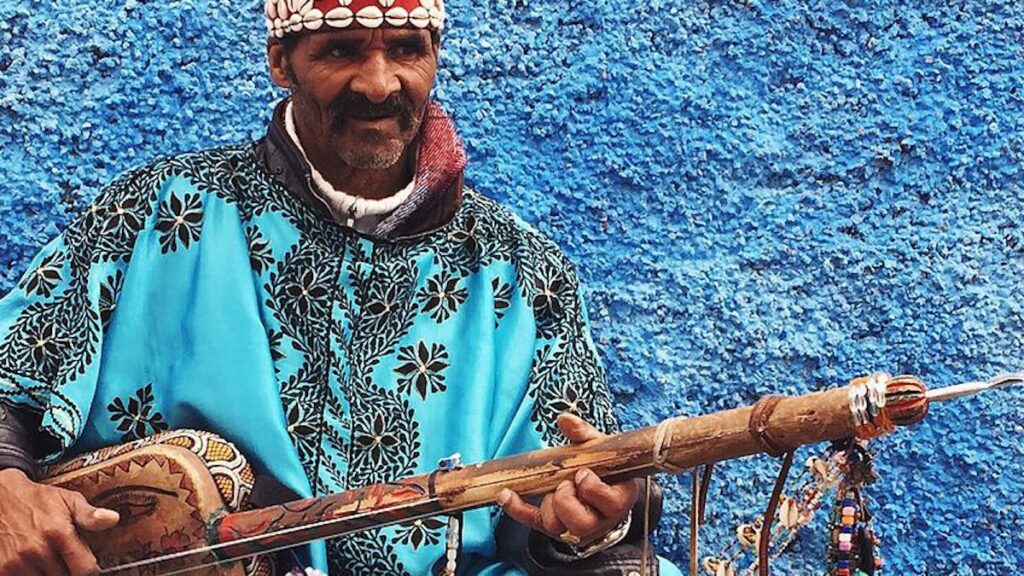
The central instrument is the guembri, also called the sintir or hajhuj: a three-stringed, skin-covered bass lute played by the maalem, the master musician. Its body is traditionally carved from a single piece of wood and covered with camel or goat skin; its neck is fitted with strings of gut, and a set of rattling metal rings is attached to the top of the neck to add a buzzing resonance. Its deep, resonant sound anchors the musical structure and guides the development of the performance. The maalem plays repeating bass figures, sings lead vocals, and signals changes in rhythm and in the sequence of ritual sections. Scholars have noted the resemblance of the guembri to West African plucked lutes, including the ngoni of the Sahel and the xalam of Senegambia, and have often treated it as evidence of an African musical heritage carried to Morocco by enslaved musicians, though direct lines of descent are difficult to prove and the instrument has been shaped by generations of Moroccan innovation (Becker, 2020; Kapchan, 2007).
The maalem is both a musician and a custodian of specialised knowledge transmitted through apprenticeship and community practice. To become a maalem is to acquire not only technical mastery of the instrument but also a deep knowledge of the ritual repertoire, the sequences of songs and colours, the properties of incense, and the obligations that bind the master to the community and to the spiritual entities invoked in the ceremony. Apprenticeship is traditionally long, and often takes place within a family or in the entourage of an established master. The authority of the maalem rests on this training, on lineage, and on a reputation for ritual effectiveness. Some famous masters, such as the late Mahmoud Guinia of Essaouira, have become widely known beyond Morocco, and their style, their ritual authority, and their collaborations with international musicians have shaped contemporary perceptions of the tradition.
5.2 The Qraqeb and the Tbel
The qraqeb are large iron castanets, usually played in pairs by the members of the ensemble, which produce the distinctive metallic rhythms of Gnawa music. Their interlocking patterns establish the pulse and contribute to the intensity of ritual performance. Played in unison and in call and response, they create a dense rhythmic texture against which the guembri and the voices move. The metallic sound of the qraqeb is itself invested with ritual meaning: iron is widely considered in Moroccan popular belief to repel malevolent spirits, and the sound of the castanets may be understood as part of the means by which the ritual environment is purified and protected.
The tbel is a large drum associated particularly with some rural Gnawa practices and with processions. Its powerful sound supports collective performance and communal gatherings, and it is prominent in the opening processions through which the Gnawa announce a ceremony and gather the community. The relation among the three instruments reflects a division of musical labour that is simultaneously a division of ritual roles: the maalem leads, the players of the qraqeb provide the rhythmic framework and the chorus, and the drum and other percussion extend the sound into the space of the procession.
5.3 Voice, Repetition, and Trance
Several features of Gnawa performance deserve emphasis. Call-and-response singing allows participants to interact with performers and reinforces collective participation: the chorus responds to the maalem’s lines in patterns that invite the audience to join in. Repetition and rhythmic intensification can produce states of heightened emotion and trance during certain ceremonies, a phenomenon that has fascinated musicologists and anthropologists. Gilbert Rouget (1985), in his comparative study of music and trance, argued that the relationship between music and possession is not one of simple causation, since trance is shaped by cultural expectations and by the specific religious frameworks within which it occurs; the Gnawa material supports this caution. The lyrics may invoke God, saints, ancestors, and spiritual entities, bringing together several dimensions of Gnawa religious life. Some texts retain words from African languages that few present-day performers can translate, a reminder that the transmission of a repertoire does not necessarily require the transmission of its linguistic meaning.
Finally, musical knowledge is transmitted orally, making performance an important vehicle for preserving historical and cultural knowledge. The repertoire does not exist in written form; it is learned by listening, by participating, and by repetition. This oral transmission is at once the strength and the vulnerability of the tradition. It has allowed the Gnawa to adapt the repertoire to new circumstances while retaining a core of ritual sequence, and it makes the tradition dependent on the continuity of apprenticeship and of community life. The loss of a maalem without a successor may mean the loss of knowledge that no archive can restore. This vulnerability is part of the rationale for the recognition of Gnawa as a heritage in need of safeguarding, though, as discussed in Section 8, the safeguarding agenda raises questions of its own.
6. The Lila: Ritual, Spirituality, and Healing
6.1 The Ceremony
The lila, literally associated with the night, is a central form of Gnawa ritual practice. In some settings, it is an extended ceremony combining music, chanting, dance, offerings, and spiritual invocation, lasting from dusk until dawn. It is typically organised by a family or an individual in connection with a vow, a celebration, an illness, or a request for spiritual assistance, and it is led by a maalem with the assistance of a ritual specialist, often a woman known as a moqaddema, who manages the incense, the colours, and the relationship with those who enter trance (Pâques, 1991; Hell, 1999). The ceremony usually begins with a procession and with the sacrifice of an animal, or with offerings, followed by a series of musical suites, each of which is dedicated to a particular group of spiritual entities and associated with a colour, a type of incense, and a style of dance.
The sequence moves through the invocation of the prophets, saints, and companions, including Sidi Bilal, towards the invocation of the mluk. The mluk (singular malk) are a category of spiritual entities understood within Gnawa cosmology, each associated with a colour, a rhythm, a perfume, and particular characteristics; they are often compared to the jinn of Moroccan popular belief, though the Gnawa understand them in their own terms. As the music for a given group of mluk begins, participants who feel an affinity with the entity may rise, cover themselves with cloth of the associated colour, and dance, sometimes passing into trance. The dancing may be intense and prolonged, and the other participants and musicians accompany and protect the dancer. The ceremony concludes at dawn with a return to invocations of God and the Prophet, and with the distribution of food and blessings.
6.2 Syncretism, Healing, and Community
Several features of the lila deserve analytical attention. First, Gnawa ritual draws upon African spiritual inheritances and Moroccan Islamic traditions, particularly Sufi ones, in a form of religious syncretism. The invocations of God, the Prophet, and the saints situate the ritual firmly in Moroccan Islam, and the lila is regularly framed by Muslim prayer and by the recitation of pious formulae. Yet the existence of the mluk, the use of colours and incense, the central role of the sacrificial animal, and the techniques of trance link the ceremony to broader traditions of spirit possession and healing found across Africa and the Middle East. Scholars differ in the weight they assign to each element: some stress the African continuities, others the Sufi and Moroccan frameworks, and most today emphasise the creative synthesis rather than any single source.
Second, the lila has a therapeutic purpose. Some participants seek relief from distress, spiritual affliction, or personal difficulties through music and ritual. In the Gnawa understanding, certain forms of illness, depression, or misfortune can be attributed to the influence of spiritual entities, and the ritual provides a means of identifying the entity concerned, of placating it, and of reintegrating the afflicted person into the community. Anthropologists have documented how Gnawa healers, in southern as well as in northern Morocco, establish their legitimacy and prestige as ‘professional’ healers who work with spirits, and how their practice coexists with, and sometimes complements, biomedical and other religious forms of healing. The anthropological literature treats these practices as meaningful in their own terms, and as culturally effective in providing social support and a framework for the expression of suffering.
Third, the ceremony is collective. It brings together musicians, ritual specialists, families, and participants in a shared social and spiritual setting, and it creates a temporary community that cuts across the boundaries of everyday social life. For a Black Moroccan community whose members had historically been denied full social recognition, the lila offered a space in which they were the possessors of ritual knowledge and authority, and in which people from all social backgrounds, including those who might otherwise despise them, came as supplicants to seek their help. This inversion of status is one of the most striking features of the ceremony, and it helps to explain how Gnawa culture, though rooted in marginality, acquired a degree of prestige.
Fourth, Gnawa ceremonies are not identical throughout Morocco. Urban and rural settings may differ in instruments, costumes, ritual structures, and devotional practices. The Gnawa of Marrakesh, Essaouira, and Fez, of the Saharan south-east, and of other regions have developed local variants, and the diversity of practice within the tradition should not be subsumed under a single model derived from the best-known urban centres. Research on the Gnawa of the south-east, for example, has drawn attention to differences in the organisation of the brotherhood and the style of ritual, a reminder that the Gnawa of Essaouira and Marrakesh, however visible, do not exhaust the tradition.
6.3 Interpreting the Lila
For students and scholars, an important methodological point arises. A lila should not automatically be labelled either a medical treatment or merely a theatrical performance. It has meanings that are religious, social, emotional, and cultural. It is therefore necessary to distinguish between the participants’ own spiritual interpretations and an external scholarly description of ritual. For the participants, the ceremony is an encounter with real spiritual forces; for the scholar, it is a form of ritual action whose social functions, psychological effects, and symbolic meanings can be analysed without necessarily endorsing or dismissing the participants’ beliefs. The respectful approach is to hold both perspectives in view: to take seriously what the ritual means to those who practise it, while using the tools of historical and social analysis to understand how it came to be and what it does. The same principle applies when the ritual is transposed to the concert stage. A performance of Gnawa music in a festival is not identical to a lila, and the differences between the two, in purpose, duration, and sacred character, are part of what the tradition’s custodians sometimes seek to explain to outsiders.
7. Gnawa and Ottoman Tripolitania: A Connected Saharan History
7.1 Why Compare?
The comparison between Morocco and Ottoman Tripolitania helps to clarify the wider geography of trans-Saharan slavery. It is important, however, to distinguish a shared historical system from a direct genealogical connection between particular communities. The trans-Saharan slave trade connected Morocco to wider North African circuits, including Ottoman Tripolitania, roughly corresponding to present-day Libya, which participated in Saharan and Mediterranean commercial networks. Yet these routes were not one unified system: their organisation, political authorities, and destinations changed over time (Austen, 2024; Boahen, 1962).
7.2 Western and Central Saharan Corridors
The western routes connected Saharan oases and Sahelian commercial centres, such as Timbuktu and Gao, to southern Morocco and to cities such as Marrakesh; Sijilmasa and the Tafilalt region were especially important in western trans-Saharan commerce. Enslaved Africans entering Morocco by these routes were absorbed into Moroccan households, military institutions, and other sectors of society, and the cultural tradition that eventually developed among them in Morocco was the Gnawa, a distinctive musical, spiritual, and communal formation.
The central routes, by contrast, connected Tripoli and Mediterranean markets to Fezzan, to the oasis of Ghadames, and to routes towards the central Sahara and the Lake Chad region, notably Bornu. Tripoli and Fezzan formed important links in central Saharan commercial networks, and Ghadames served as a major entrepôt. Enslaved Africans were transported through Libyan and central Saharan networks towards North African and Mediterranean destinations, including, through the Ottoman system, destinations in the wider Ottoman world (Boahen, 1962; Austen, 2024). Boahen’s (1962) study of the caravan trade in the nineteenth century, which emphasises the role of Tripoli, Fezzan, and Ghadames in the central routes, remains a useful point of departure for understanding the organisational differences between the western and central corridors, while Austen’s (2024) synthesis places them within the broader history of the trans-Saharan slave trade.
The two systems were related but distinct. Their connections shifted according to political power, the availability of caravan routes, regional demand, and the organisation of local trade. Enslaved persons could and did circulate among markets, and merchants, scholars, and pilgrims maintained connections across the Maghrib and between the Maghrib and Egypt, so that ideas, goods, and religious practices travelled along with people. But it would be a mistake to treat the western and central routes as a single machine delivering captives to a single destination.
7.3 Parallel Traditions, Not Identical Ones
African-descended communities in Libya and the wider Maghrib developed their own cultural and religious traditions, and these should not automatically be equated with Gnawa. Tunisia, for example, is home to the stambeli, a ritual and musical tradition of possession and healing associated with Black Tunisians, which shares important features with the Gnawa, including the use of a plucked bass lute, metal castanets, the invocation of Sidi Bilal, and the organisation of ceremonies around spirit entities (Jankowsky, 2010). Historians have documented the existence of a significant African-descended population in the regencies of the Ottoman Maghrib, whose experience of slavery, manumission, and religious organisation had similarities with those of their Moroccan counterparts (Montana, 2013). Similar traditions of spirit possession are found in other parts of North Africa and the Sahara. These parallels are real, and they suggest that comparable historical conditions, namely the enslavement of Africans, their incorporation into Islamic societies, and the need to create communities and rituals of belonging, produced comparable cultural responses.
Precisely because the parallels are real, they invite overinterpretation. The existence of slave-trading routes between Tripolitania and sub-Saharan Africa does not, by itself, prove that Gnawa communities in Morocco originated in Libya or passed through Ottoman Tripolitania. The more defensible conclusion is that Gnawa history belongs to a wider North African and Saharan history of forced migration, while its specific formation occurred in Moroccan social and religious settings. Where connections between Gnawa and other North African traditions exist, they must be demonstrated through evidence, whether linguistic, musical, historical, or ritual, and not inferred from geographical proximity or from the fact that the traditions look alike.
7.4 A Method for Comparative Study
This distinction between system and genealogy suggests a method for comparative work. First, the historian should reconstruct the commercial and political systems within which enslaved people moved, and should identify what is documented about the volumes, routes, and destinations. Second, the researcher should analyse the cultural formations that emerged in particular places, paying attention to local religious and social contexts. Third, the comparison should identify similarities and differences in the cultural forms, and should offer hypotheses about their causes, distinguishing clearly between hypotheses supported by evidence and those that remain speculative. A comparative map of the western routes linking the Sahel to Morocco and the central routes connecting Fezzan and Tripolitania to Saharan and Mediterranean markets, annotated with the movement of people, goods, religious traditions, and musical influences, can be a valuable analytical device, provided it keeps the line between documented connection and conjectured influence visible.
8. Gnawa in Contemporary Moroccan Society
8.1 From Marginality to Recognition
Gnawa culture has moved from a tradition associated with marginalised communities to a recognised component of Moroccan cultural heritage and an internationally celebrated musical form. For much of the twentieth century, Gnawa musicians were visible in the public life of Moroccan cities, performing in squares, in markets, and at saints’ festivals, and conducting ceremonies in private homes; yet their social status was low, and their ritual practice was regarded by some religious and secular elites with suspicion or condescension. The Protectorate period brought new forms of attention, both ethnographic and touristic, and after independence the Gnawa were gradually integrated into national narratives of cultural identity. A decisive shift came from the late twentieth century, when Moroccan and foreign musicians, intellectuals, and cultural entrepreneurs began to promote Gnawa music as an emblem of Moroccan creativity.
Foreign musicians were important in this process. The attraction of Gnawa music for jazz and rock musicians, among them the American pianist Randy Weston, who lived for a time in Tangier and who regarded Gnawa music as a living link between Africa and the Black musical traditions of the Americas, helped to create an international audience (Weston & Jenkins, 2010). Collaborations between Gnawa masters and jazz, blues, and rock musicians multiplied from the 1960s and 1970s onwards, and recordings in the 1990s brought the sound of the guembri to a global listenership. Moroccan popular groups, such as Nass El Ghiwane, drew on Gnawa rhythms and sensibilities to create a new, politically charged musical idiom that spoke to a generation of young Moroccans. These developments transformed the perception of the Gnawa both inside Morocco and abroad.
8.2 The Essaouira Festival and the Creative Economy
The Gnaoua and World Music Festival, launched in Essaouira in the late 1990s, has helped to introduce Gnawa music to international audiences and has encouraged collaborations with jazz, blues, and other musical traditions. The festival transformed Essaouira, a port town founded in the eighteenth century and long a centre of Gnawa life, into a pole of cultural tourism, attracting hundreds of thousands of visitors. It has provided performance opportunities and income for musicians, stimulated the local economy, and contributed to a revival of interest in the tradition among young Moroccans, some of whom had previously dismissed it as the music of an older generation.
Cultural diplomacy has been another dimension. Gnawa performances contribute to Morocco’s international cultural profile and demonstrate connections between North Africa and sub-Saharan Africa, a theme that resonates with Moroccan foreign policy orientations towards the African continent. Festivals, performances, recordings, and cultural tourism provide economic opportunities for musicians and local communities, and the policy discourse of the creative and cultural industries increasingly identifies Gnawa music as an asset with socio-economic development potential. Public recognition can also strengthen the visibility of Black Moroccan history and the cultural contributions of African-descended communities, and the success of Gnawa music has contributed to wider conversations about the place of Black Moroccans in the national narrative.
8.3 UNESCO Inscription
In 2019, Gnawa was inscribed on UNESCO’s Representative List of the Intangible Cultural Heritage of Humanity (UNESCO, 2019). The inscription recognised Gnawa as a living heritage that comprises music, brotherhood practices, religious expression, and therapeutic rituals, and it acknowledged the role of the maalems and of the communities in transmitting the tradition. For practitioners, the inscription is a form of public validation; it confers prestige, supports claims for state and institutional assistance, and offers a measure of protection against appropriation and distortion. It also commits the Moroccan state to developing safeguarding measures, such as documentation, support for the transmission of skills, and the involvement of communities in decisions about their heritage.
Yet inscription is a beginning rather than an end, and it leaves unresolved questions. The Convention under which the list is maintained places emphasis on the consent and participation of communities, but in practice the identification of ‘the community’ and the allocation of resources are complex processes. Scholars of heritage warn that the transformation of living practices into heritage can alter them, by prompting standardisation, by privileging forms that are legible to institutions and visitors, and by shifting authority from practitioners to experts and administrators (Smith, 2006; Brown, 2003). The inscription of Gnawa does not by itself address the economic precarity of many musicians, the stigma that may still attach to Black ancestry, or the tension between the ritual and the commercial uses of the music.
8.4 Commercialisation and Cultural Ownership
The international popularity of Gnawa music raises questions about who controls cultural heritage, who benefits economically, and how sacred practices are represented to tourists. Deborah Kapchan (2007) has shown how Gnawa trance music, once confined to the ritual context, has entered a global marketplace in which it is packaged, sold, and reinterpreted, producing new forms of fusion as well as new forms of dependence. Some masters have gained wide recognition and income from international collaborations; others remain outside these circuits. The commodification of trance, by moving elements of a sacred ceremony onto the stage, risks emptying them of their meaning, or at least changing it. Practitioners themselves hold divergent views: some welcome the opportunities, some defend the distinction between ritual and performance, and many do both, adapting their practice to context.
Questions of intellectual property and of the equitable sharing of benefits are also pressing. Orally transmitted repertoires, which are collectively owned and continually reworked, sit uneasily with legal frameworks designed around individual authorship and fixed works. Fusion projects that sample or adapt Gnawa material may generate income for the producers without returning anything to the community from which the material comes. These problems are not unique to Morocco, but they take a specific form in a case where the community in question has historically been marginalised, and where the history of exploitation gives particular weight to the demand for recognition and fair treatment.
8.5 Race, Recognition, and the Limits of Visibility
An important classroom and scholarly question is whether the global success of Gnawa music necessarily leads to greater recognition of the historical experiences of the communities that created it. Cultural visibility and social equality are related, but they are not the same thing (Becker, 2020). The enthusiasm for Gnawa music coexists, in Morocco as elsewhere, with continuing prejudice towards Black people, and Moroccan activists, scholars, and artists have drawn attention to the persistence of racial stereotypes and to the need for a franker public discussion of the history of slavery. The celebration of Gnawa can serve as an entry point to that discussion, but it can also serve as a substitute for it, allowing a society to honour the music while avoiding the history from which it arose.
The Moroccan constitutional order has, since 2011, formally acknowledged the plural components of national identity, including its African and Mediterranean tributaries, and recent public policy has increasingly emphasised the country’s African belonging. Within such a framework, the Gnawa tradition is naturally a resource: it demonstrates that the African dimension of Moroccan identity is not an external addition but an internal and historic component. The task for scholars and policymakers is to ensure that the recognition of this dimension goes beyond symbolism, and that it includes education about the history of slavery, support for the transmission of the tradition by those who hold it, and attention to the social and economic conditions of Black Moroccan communities.
9. Main Themes for Discussion and Teaching
The preceding analysis suggests a set of themes around which the study of Gnawa history can be organised, whether in the classroom or in further research.
The first theme is slavery and historical memory: how cultural traditions preserve histories that official narratives may neglect. The Gnawa case shows that performance can function as an archive, and it invites reflection on the relationship between oral and written sources. The second is African diaspora: how forced migration contributed to new identities in Morocco, and how the Mediterranean and Saharan diasporas of Africa compare with the better-known Atlantic one. The third is religion and cultural exchange: how African spiritual inheritances interact with Moroccan Islam and Sufism, and what the Gnawa lila reveals about the porosity of religious boundaries in popular practice.
The fourth theme is race and belonging: how Gnawa history should inform discussions of Black identity in Morocco, and how Moroccan society can acknowledge the legacy of slavery without reducing Black Moroccans to that legacy. The fifth is cultural heritage: what UNESCO recognition achieves, and what it leaves unresolved. The sixth is globalisation: whether international success protects traditions or transforms them for commercial consumption. The seventh is historical comparison: what similarities and differences emerge when Morocco is compared with Ottoman Tripolitania and with other North African societies, and how the distinction between shared systems and shared genealogies can be maintained.
These themes lend themselves to a series of questions for reflection. How did the trans-Saharan slave trade contribute to the emergence of Gnawa communities in Morocco? Why is it inaccurate to describe the Gnawa as originating from a single African ethnic group? How do music, ritual, and oral transmission preserve collective memory? What distinguishes Gnawa spiritual practices from purely recreational music? How does the history of the Gnawa complicate the distinction between North Africa and sub-Saharan Africa? What can the comparison with Ottoman Tripolitania tell us about the geography of trans-Saharan slavery? Does the international celebration of Gnawa music adequately acknowledge the history of enslavement and racial marginalisation? How can Morocco preserve Gnawa heritage while ensuring that practitioners retain authority over their cultural traditions?
A practical exercise may help to consolidate these points. Students might construct a comparative map showing the western trans-Saharan routes linking the Sahel to Morocco and the central routes connecting Fezzan and Tripolitania to Saharan and Mediterranean markets. They should annotate the map with the movement of people, goods, religious traditions, and musical influences, distinguishing documented historical connections from hypotheses about cultural origins. The exercise teaches the geography of the Sahara and the habit of intellectual honesty that the study of Gnawa history requires.
10. Conclusion
The history of the Gnawa provides an important perspective on Morocco’s place in African and Mediterranean history. The trans-Saharan slave trade brought people from diverse African societies into Morocco under coercive circumstances. Across generations, their descendants developed distinctive musical, spiritual, and communal practices that became part of the country’s cultural landscape. The guembri’s bass line, the iron rhythm of the qraqeb, and the all-night structure of the lila are not simply artistic forms; they are the means by which a community transmitted knowledge, honoured its dead, healed its afflicted, and asserted its dignity in a society that did not always grant it.
Gnawa history therefore involves both historical suffering and cultural creativity. It should neither romanticise slavery nor reduce Gnawa communities to the legacy of enslavement. The first error turns coercion into a story of cultural enrichment and forgets that the people concerned did not choose their journey; the second denies them agency and ignores the evidence of what they built. Their history demonstrates the agency of people who transformed experiences of displacement into enduring forms of identity, solidarity, and artistic expression. It also shows that cultures formed under conditions of inequality do not remain at the margins indefinitely: they enter the common heritage of the societies in which they arise, and in doing so, they change the meaning of that heritage.
The wider connection with Ottoman Tripolitania helps to situate Morocco within a larger Saharan system of commerce and forced migration, while reminding students that similar historical conditions produced distinct regional cultures. The Gnawa are not a Libyan or a Tunisian tradition transplanted to Morocco, any more than the stambeli is a Moroccan tradition transplanted to Tunis; they are local responses to a shared history, and their individuality deserves to be respected.
The present challenge is to match the celebration of Gnawa culture with a commitment to the communities that sustain it. Recognition by UNESCO, international festivals, and cultural diplomacy are welcome, but they do not in themselves guarantee social equality, fair economic returns, or the continuity of apprenticeship. A mature relationship to Gnawa heritage would acknowledge the history of slavery in public education, support practitioners’ authority over their own traditions, and understand that the African dimension of Moroccan identity is not an ornament but a foundation. In this sense, the study of the Gnawa is also a study of Morocco itself, of a society whose strength has long lain in its capacity to absorb, transform, and be transformed by the many peoples who have made it home.
References
Abun-Nasr, J. M. (1987). A history of the Maghrib in the Islamic period. Cambridge University Press.
Assmann, J. (2011). Cultural memory and early civilization: Writing, remembrance, and political imagination. Cambridge University Press.
Austen, R. A. (2024). Trans-Saharan slave trade. In Oxford research encyclopedia of African history. Oxford University Press. https://doi.org/10.1093/acrefore/9780190277734.013.838
Becker, C. J. (2020). Blackness in Morocco: Gnawa identity through music and visual culture. University of Minnesota Press. https://doi.org/10.5749/j.ctv1b0fvdg
Bennison, A. K. (2016). The Almoravid and Almohad empires. Edinburgh University Press.
Boahen, A. A. (1962). The caravan trade in the nineteenth century. The Journal of African History, 3(2), 349–359. https://doi.org/10.1017/S0021853700002906
Brown, M. F. (2003). Who owns native culture? Harvard University Press.
Chtatou, M. (2023, March 28). Salient aspects of Moroccan Judaism. Eurasia Review.
Chtatou, M. (2026, June 22). Amazigh: The proud guardians of an ancient culture. Eurasia Review. https://www.eurasiareview.com/22062026-amazigh-the-proud-guardians-of-an-ancient-culture-analysis/
Clifford, J. (1994). Diasporas. Cultural Anthropology, 9(3), 302–338. https://doi.org/10.1525/can.1994.9.3.02a00040
El Hamel, C. (2008). Constructing a diasporic identity: Tracing the origins of the Gnawa spiritual group in Morocco. The Journal of African History, 49(2), 241–260. https://doi.org/10.1017/S002185370800368X
El Hamel, C. (2013). Black Morocco: A history of slavery, race, and Islam. Cambridge University Press.
Ennaji, M. (2013). Slavery, the state, and Islam (S. Graebner, Trans.). Cambridge University Press.
Gilroy, P. (1993). The Black Atlantic: Modernity and double consciousness. Harvard University Press.
Hall, S. (1990). Cultural identity and diaspora. In J. Rutherford (Ed.), Identity: Community, culture, difference (pp. 222–237). Lawrence & Wishart.
Hell, B. (1999). Possession et chamanisme: Les maîtres du désordre. Flammarion.
Hunwick, J. O. (1999). Timbuktu and the Songhay Empire: Al-Sa’di’s Ta’rikh al-sudan down to 1613 and other contemporary documents. Brill.
Hunwick, J., & Troutt Powell, E. (2002). The African diaspora in the Mediterranean lands of Islam. Markus Wiener.
Jankowsky, R. C. (2010). Stambeli: Music, trance, and alterity in Tunisia. University of Chicago Press.
Kapchan, D. A. (2007). Traveling spirit masters: Moroccan Gnawa trance and music in the global marketplace. Wesleyan University Press.
Lapassade, G. (1976). Les gnaoua d’Essaouira: Les rites de possession des anciens esclaves noirs au Maghreb, hier et aujourd’hui. L’Homme et la Société, 39, 191–215.
Lovejoy, P. E. (2012). Transformations in slavery: A history of slavery in Africa (3rd ed.). Cambridge University Press.
Lydon, G. (2009). On trans-Saharan trails: Islamic law, trade networks, and cross-cultural exchange in nineteenth-century western Africa. Cambridge University Press.
Meyers, A. R. (1977). Class, ethnicity, and slavery: The origins of the Moroccan ‘Abid. The International Journal of African Historical Studies, 10(3), 427–442.
Miers, S., & Kopytoff, I. (Eds.). (1977). Slavery in Africa: Historical and anthropological perspectives. University of Wisconsin Press.
Montana, I. M. (2013). The abolition of slavery in Ottoman Tunisia. University Press of Florida.
Nora, P. (1989). Between memory and history: Les lieux de mémoire. Representations, 26, 7–24. https://doi.org/10.2307/2928520
Pâques, V. (1991). La religion des esclaves: Recherches sur la confrérie marocaine des Gnawa. Moretti & Vitali.
Rouget, G. (1985). Music and trance: A theory of the relations between music and possession. University of Chicago Press.
Safran, W. (1991). Diasporas in modern societies: Myths of homeland and return. Diaspora: A Journal of Transnational Studies, 1(1), 83–99. https://doi.org/10.1353/dsp.1991.0004
Smith, L. (2006). Uses of heritage. Routledge.
UNESCO. (2019). Gnawa. Representative List of the Intangible Cultural Heritage of Humanity. https://ich.unesco.org/en/RL/gnawa-01170
Weston, R., & Jenkins, W. (2010). African rhythms: The autobiography of Randy Weston. Duke University Press.
Westermarck, E. (1926). Ritual and belief in Morocco (Vols. 1–2). Macmillan.
Wright, J. (2007). The trans-Saharan slave trade. Routledge.

Dr. Mohamed Chtatou is a senior professor of business communication at the International University of Rabat -IUR- as well at Mohammed V University in Rabat. He is currently a political analyst with Moroccan, Gulf, French, Italian and British media on politics and culture in the Middle East, Islam and Islamism as well as terrorism.