What Do We Want from Generalizing the Teaching of English?
Ministerial Memorandum No. 23-030 on generalizing the teaching of English in lower secondary school, issued on May 23, 2023, was received with wide praise and a warm welcome from those concerned with education and the language of instruction. And no wonder: it heralds the move, not only to the language of science and knowledge, but from local languages (Arabic and French) to the language of the whole world. After more than forty years (since the 1970s, with a minister dedicated to Arabization, the Istiqlal member Azzedine Laraki) of comprehensive Arabization, during which Arabic was adopted as the language of instruction after it had been French since independence, Parliament adopted, at the end of July 2019, Framework Law No. 51.17 on the system of education, training and scientific research, whose Articles 2 and 31 resort to “linguistic alternation” to justify and push through the decision to teach scientific subjects in French, instead of the Arabic that had been chosen as the language of instruction for these subjects more than forty years earlier, as I noted. Today comes this memorandum, which decides to generalize the teaching of English in lower secondary school.
It is well known that the basis of development and progress today is knowledge (the knowledge economy), and that the tool of that knowledge is the language suited to acquiring, using and producing it. If Morocco is still floundering over the question of language, it means that it has not yet found, or has not wanted to find for ideological and political reasons, the tool for acquiring, using and producing the knowledge that is the condition of revival, of building development and of achieving progress and prosperity.
That is why the decision to generalize English teaching was praised and welcomed, as I wrote, on the grounds that English is today the ideal tool for acquiring knowledge (le savoir), using it and producing it. But what emerges from the content of this memorandum is that it does not aim to use the language for that purpose, that is, to acquire, use and produce knowledge, but only to generalize its teaching in lower secondary school, like its generalized teaching in upper secondary school since independence. English is therefore not planned as a tool for acquiring, using and producing knowledge, but only because it is among the “most widely used foreign languages in the world, as a means of communication, engagement and interaction with the knowledge society and of openness to different cultures and to the civilization of our time”, as the memorandum itself says, repeating the fifth paragraph of Article 5 of the Constitution, which the memorandum’s drafters quoted to justify its issue; and in view of its status “in society and its functional roles, as well as the future prospects it opens to young people in the fields of knowledge, science, technology, communication, cultural and civilizational openness and others”, as the memorandum puts it in its recitals. All this is, in truth, fine and desirable, but it will not make English a language for acquiring, using and producing knowledge, even though the memorandum spelled out what English offers in terms of “engagement and interaction with the knowledge society” and the horizons it opens “in the fields of knowledge, science and technology”. Why, on the memorandum’s own content, will English not be a tool for acquiring, using and producing knowledge?
Because English has always, since Morocco’s independence, been taught in upper secondary school. It was even a written and oral subject in the baccalaureate exam, which shows the good level at which it was taught, in addition to the good teaching conditions of that period compared with their decline today. Even so, it did not rise to the level of a language for acquiring, using and producing knowledge. Why?
Because it was never a language for imparting and teaching knowledge, only a language that is taught. That is why, despite the university departments devoted to English language and literature, it has had no notable presence in society, in the media, in culture or in the administration… And it seems this will be the role of English, in the best of cases, after its teaching is generalized in lower secondary school, or even across all stages of primary, lower secondary and upper secondary education: it will have no role in acquiring, using and producing knowledge. To take on that role, it must be a language of instruction and not merely a language that is taught. That requires it to replace French, in which scientific subjects are now taught in lower and upper secondary school under Framework Law No. 51.17 of July 2019. And why not make it a language of instruction even for the humanities, such as social studies and philosophy…, as French was before the 1970s? And for it to be a language for acquiring, using and producing knowledge, it must replace French not only as the language of instruction but also as the language used by administrations, public institutions, companies, banks, consultancies, notaries, the Palace and the ministries that work in French, such as Interior, Finance and the National Defense Administration… This requires opening university programs in English, not only in scientific disciplines such as mathematics, physics, medicine, pharmacy and engineering…, but also in law, economics, history, philosophy and sociology…, to supply administrations, national offices, companies, ministries and the education sector with competent staff able to work in English. In this way, after a period that may be estimated at two to three decades, the language will gain a presence in society, in the media, in culture and in every aspect of social, economic and political life…
So unless English becomes a language of instruction and a first foreign language, moving gradually to the status of an official language in practice rather than constitutionally, as French is today in Morocco, it will, if it is taught merely as a second foreign language, be just a luxury and superfluous language, neither necessary nor essential. In that case English would be taught for the sake of teaching it, and not for what it offers in qualifying the Moroccan citizen to possess knowledge, to put it to use and to be able to produce it. Thus what is merely a means (teaching) becomes an end, and the teaching of English stops at its teaching. This treatment of the means as an end is common in many state projects, decisions and laws, as in the elections we hold for the sake of holding them and not for democracy, which remains absent. That is what we did with Amazigh, which was made official for the sake of making it official, as a constitutional formality, and not so that it would be the language of the state and its institutions. The same goes for its teaching, which officially began in 2003 but has no trace in concrete reality, because the teaching of Amazigh was decided for the sake of teaching it and not so that Moroccans would master it, as a unified written and spoken language, in order to use it, in writing and speech, in state administrations and institutions. That explains the failure, or in truth the sabotage, of this teaching, which after twenty years still seems in practice not to have started.
It seems that the vague, rhetorical and preachy concepts and expressions, which can mean everything and nothing at all, used by the memorandum announcing English, such as “openness”, “linguistic pluralism” and “the new model of the quality Moroccan school”…, are a sign that this teaching of English may be no more than teaching for the sake of teaching and not for any other purpose. The use of such concepts and expressions, vague, rhetorical and preachy by nature, as I said, recurs in many Moroccan decisions and laws, as in draft Decree No. 2.21.448 (2021) on language engineering in school education, school training and higher education, which makes it easy to confuse, deliberately or not, the end and the means. This makes it hard to tell the application of the content of these decisions and laws from their non-application, since the two overlap.
Despite all this, we will stay positive, and hope that English will play this new role in the future, replacing French in all its educational, administrative, economic, media, cultural, legal and political roles and functions… If it came about, that would amount to a genuine liberating revolution. But the success of this revolution depends on a political will that makes the development of the Moroccan citizen and his qualification with useful, productive knowledge the supreme goal of state policy, and not the protection of one language for its religious load, like Arabic, nor the preservation of another because of the bond of “motherhood” that ties it to the Moroccan state, like French, which counts as the mother language of the Moroccan state after 1912. When I say that the success of this liberating revolution needs political will, it is because it is not easy to give up the mother language, which is French for the new Moroccan state created by the Frenchman Lyautey in 1912, nor to get rid of the “sacred ignorance” accumulated around the Arabic language. This move to English would therefore be a real liberating revolution, as I said, because it would free Moroccans from the confinement they have suffered since 1912, which turned them into hostages in the name of Arabic and French, preventing them from freely reaching the horizons of science, knowledge and development…
In normal conditions where a state holds its linguistic sovereignty, it uses its national and identity language (the language of the land and of history) as the first school language, then a first foreign language that is most often English, as in many Asian, European and South American countries. In Morocco’s case, the language of the land and of identity is Amazigh, and likewise Darija, which should have been the first school language had it been qualified and developed for that purpose. But France, and after it the independence state that succeeded it, fought it, excluded it and prevented any qualification and development. The result is that all the school languages in Morocco are foreign languages, including of course Arabic, which is a foreign language even for pupils in the Kingdom of Saudi Arabia. Since these school languages are foreign and neither national nor identity languages, the country’s interest called for choosing the best and most effective of these foreign languages, English, as the first school language, as African countries with a Francophone legacy like Morocco have done.
Despite more than half a century lost under the tutelage of Arabic and French, the decision to generalize English teaching remains a wise and right one. But, as I have already explained, on condition that English be used in future as a replacement for French in all the administrative, economic, media, cultural, legal and political functions… that French used to perform. That does not seem to be what the memorandum aims at, as I have already written. The memorandum set two hours a week for teaching English in the lower secondary levels. Leaving aside that two hours is an insufficient allotment, the question is: where will these two hours come from? Will they be added to the total weekly hours, wearing out the pupil and making things hard for him? Or will they be taken from other subjects? If so, which ones? If we want to make English the first school language replacing French, in all its roles and functions, the logical thing is for these two hours to be taken from the French hours, and even from the Arabic hours, while gradually starting to teach in English the scientific subjects that used to be taught in French. English cannot be expected to become the first school language without touching the school standing of French, and even of Arabic. Their time allotments must be reduced in favor of English, with a view to teaching French only as a language at the upper secondary stage, as English used to be treated. It would even be useful to direct the resources allocated to other foreign languages, such as French, towards strengthening the teaching of English as a functional language, since mastering it may spare one from mastering other foreign languages, given that among the world’s languages it stands today for the dollar, which is still a world currency: whoever holds it holds, as it were, all the other local currencies, because it lets its owner buy whatever those currencies can buy in the countries where they circulate, whereas those currencies cannot buy goods in other countries. The same goes for English: whoever masters it masters, as it were, all the world’s languages, because he can communicate with it in every country, and can also (and this is the goal sought from teaching English) read the latest scientific studies in molecular biology, quantum physics, astronomy, computing…
The memorandum provides for taking into account “preparing learners to enable them to master foreign languages at an early age”. Is there an earlier age to learn English than school age, when the pupil first enters school? That is why teaching English, and teaching in English, from primary school is the ideal pedagogical path to make learning English easier, with a view to its functional use for owning, practicing and producing knowledge. This requires reordering the priorities between French and English. And it depends, as I have already shown, on the state having the political will to rid itself of its mother language, which is French.
So far I have spoken of the purely educational side of teaching English in its relation to owning, using and producing knowledge. That does not mean overlooking the “logistical” side, especially the human resources on whose availability, in sufficient quality and number, the success of this project depends, particularly the female and male teachers. But if there is political will for English to take the place of French, in all its educational, administrative, economic, media, cultural, legal and political roles and functions…, the teacher factor is not a deterrent. Why? Because the success of this project may bear fruit only after a period of no less than twenty years, which may be enough to train and prepare the required number of teachers.
I know there is a ready objection that says teaching in English is not a magic ring that will make the state that adopts it resemble the United States in its scientific and technological progress, its economic prosperity and its military strength, the United States being a country that uses English as a language of instruction. This objection would be right if the aim of replacing French with English were for Morocco to be like the United States. That is not what we expect from English in Morocco. We expect only that it give pupils the conditions to acquire knowledge, use it well and be able to produce it. In that case we do not expect Morocco to be like the United States, but only like the African country of Rwanda. Why Rwanda? Because its case is similar to Morocco’s in its relationship with French. The language of instruction in that country was French before 2010. It then adopted English as the language of instruction. That did not turn it into the United States of Africa. But it gave it the conditions for acquiring, using and producing knowledge, conditions that allow it to reach a level of development and progress in the future, as many indicators show since its switch to English, though it need not be the level of the United States. It does not matter that this country may appear, for now and for well-known historical reasons, less developed than Morocco; what matters is the pace at which it has been developing since adopting English as the language of instruction, which is faster than the pace at which Morocco is developing.
On the other hand, Morocco’s adoption of English as a replacement for French has become urgently needed now that the knowledge and scientific performance and the communicative use of French have receded since the second half of the twentieth century, until, at the start of the twenty-first, it became an outdated language owing to the decline of its output and production. Consequently, if teaching in Arabic was an obstacle to the quality of school training, which forced officials to return to French starting with Framework Law No. 51.17 on the system of education, training and scientific research, that obstacle is now posed by the French language itself. So if the baccalaureate holder has to retrain himself in French, before French returns as the language of teaching science, in order to pursue his university studies in the scientific streams, the same thing will happen to the holder of a scientific degree in French, because he will have to retrain himself in English if he wants to complete his higher studies beyond the degree and hopes to be a researcher in his field.
Even Amazigh may benefit indirectly from the presence, spread and use of English in Morocco as a replacement for French. Why? Because the greatest historical enemy of Amazigh and the Imazighen is France. It is France that carried out the political Arabization of the state, which was a step and a condition of the identity and linguistic “sex change” (changing the Amazigh gender of Moroccans into an Arab one) carried out by the independence state. The absence of the hegemony of the French language would therefore be the absence of one of the sources of hostility and exclusion towards Amazigh.
Arabic version | French version
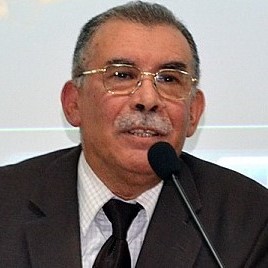
Mohamed Boudhan was an Amazigh writer, thinker, researcher and activist from the Rif, and publisher of the newspaper Tawiza. He was the author of many valuable books and articles on Amazigh identity. May he rest in peace.