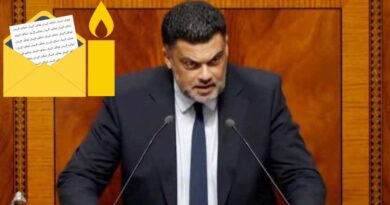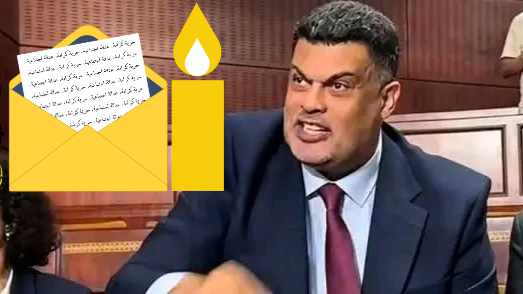
Leftist MP Omar Benjelloun sparks outrage over anti-Amazigh remarks in Parliament
Omar Benjelloun, a Member of Parliament for the Alliance of the Left in the House of Representatives, has committed a shameful blunder at the very start of his parliamentary term, delivering remarks marked by manifest hostility toward the Amazigh language.
Instead of questioning the obstacles hindering the status of Amazigh as an official language or the delays in its integration within state institutions at both the central and local levels, Mr. Benjelloun chose a regrettable path. He should have been offended by the fact that the very rhetoric he employed on the floor of Parliament today is the same discourse used to justify the institutional siege imposed on the Amazigh language from 1956 to the present day.
As a Moroccan citizen, it was his responsibility to defend the rehabilitation of the language of the land, the geographical space, and the daily life of the people. He ought to have compared it to the technical-administrative language that has benefited from affirmative action in administrative and institutional spheres for a century, despite remaining merely the language of official documents and records.
Unfortunately, he chose to launch a direct assault on the Amazigh language, as if it were the source of the social, economic, and political crises we currently face. Ignoring the genuine drivers of democratic, social, and economic progress, he attempted to make the Amazigh language an easy target for a few convoluted phrases, imagining that mere eloquence still suffices to dazzle an audience in the era of digital technology and artificial intelligence.
Mr. Omar Benjelloun must understand that his affiliation with the Left should be a catalyst for self-reconciliation, rather than a pretext for defending linguistic and identity-based alienation through a populist discourse that rings hollow in the Morocco of 2026.
He must also realize that the two billion dirhams allocated to the Amazigh language in the government program—which he views as a lavish expenditure and a waste—is, in our eyes, an undervaluation of the language. Yet, Amazigh remains the unifying foundation for all Moroccans and the essential identity of this land, this state, and its people, rising above all other affiliations.
Mr. Benjelloun should instead ask why the Moroccan state has not worked to ensure that the Amazigh language, despite being an official language, becomes a working language at the United Nations, alongside Arabic, as he himself pointed out.
It is deeply disheartening that in 2026, a public figure still exhibits such nostalgia for the era of unilingualism and linguistic hegemony—a scourge that has plagued the Amazigh language since the 1962 Constitution. It is shameful to see an MP claiming the mantle of progressivism while delivering such orthodox and fundamentalist rhetoric, still clinging to the illusions of an exclusive Arab nationalism.
Mr. Omar Benjelloun should have used his few minutes of floor time to denounce rampant structural corruption, the mechanisms needed to break away from the rent-seeking economy, and the collusion between power and money. He could have spoken about the conflicts of interest that drain the public treasury, or the fact that the generalization of the Amazigh language, which began in 2003, has not even reached a 46% integration rate in primary schools after 23 years. He should have demanded a comprehensive integration plan to place the Amazigh language at the heart of public and institutional life.
Alas, Mr. Benjelloun’s intervention proves that pockets of resistance hostile to the Amazigh language still exist, reactivating old reflexes whenever this issue is raised.
It would have been wiser for him to draw inspiration from the visionary speech of his colleague, the Honorable Nabila Jalal, who expressed a dignified position that brilliantly addressed the core of the Amazigh cause. He must understand that loud outbursts and lamentations are not synonymous with competence; if shouting were a mark of superiority, the rooster would be the master of the farmyard.
Finally, he must realize that the Amazigh language has remained alive despite centuries of attempts to erase it, ultimately imposing itself on those who wished it harm. The evolution of the Istiqlal party, from its past to its present, offers a valuable lesson in this regard. How many adversaries of the Amazigh language are today unable to publicly stand by their past positions? How many individuals or groups believed themselves to be giants yesterday by flaunting their hostility, only to find themselves bowing today before the power of its influence? Mr. Benjelloun should therefore be careful: by believing himself a giant today, he may well find himself a dwarf tomorrow.
Arabic version | French version