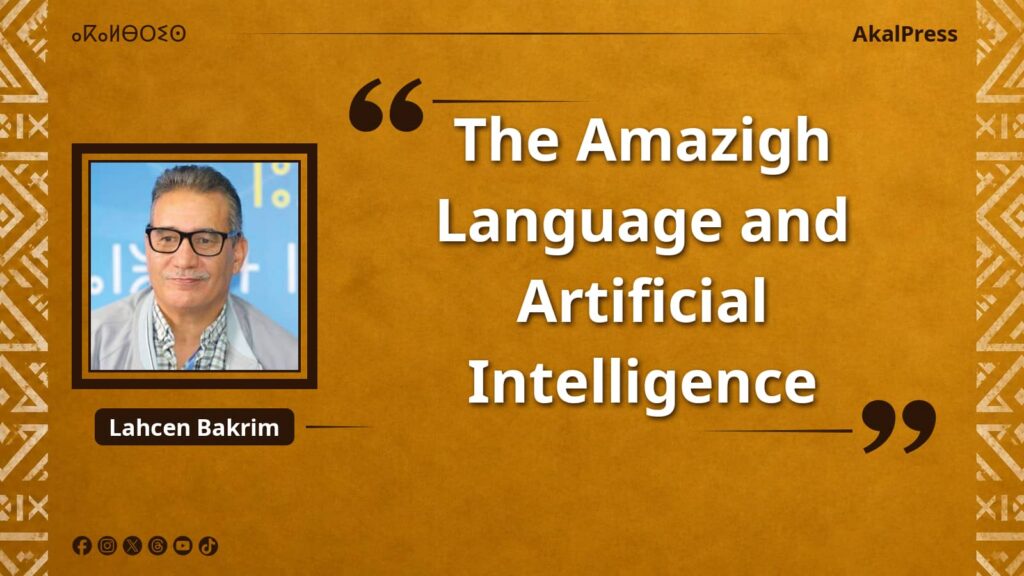
The Amazigh Language and Artificial Intelligence
Following a long historical trajectory from marginalization to constitutional recognition, the Amazigh language now faces new challenges as complex as those of past decades. Foremost among these issues are rapid digital transformations and the proliferation of artificial intelligence applications. This situation raises critical questions about the ability of relevant institutions to keep pace with these developments and protect Amazigh language and culture from the risks of digital marginalization.
This contribution follows my address during the third edition of the Said Achtouk University of Arts, held on Thursday, November 5, 2026, at the Faculty of Languages, Arts, and Humanities in Aït Melloul. Under the theme “The Art of the Rways and the Challenges of Artificial Intelligence,” I presented a critical reading of the path of the Amazigh language in Morocco, from the stages of marginalization and the struggle for recognition to the problems of officialization and the challenges imposed by the current technological revolution.
To understand what lies ahead for the Amazigh language today, it is necessary to examine the significant milestones of its history in Morocco, distinguishing several phases, each with its own political, cultural, and institutional context.
The first stage was characterized by the widespread marginalization of the Amazigh language and its exclusion from essential domains, including education, administration, and the media, despite its profound presence in Moroccan society as a language, culture, and authentic component of national identity.
The second phase is linked to the emergence of the Amazigh cultural movement, which conducted a civil, intellectual, and rights-based struggle for decades to achieve justice for the language. This fight aimed to restore its place in public policy through association work, cultural production, and institutional advocacy.
This period helped move the Amazigh issue from a circle of limited cultural demands to the heart of the public debate on identity, linguistic and cultural rights, and citizenship.
It is also imperative to reflect on the 2001 Ajdir speech, which constitutes a fundamental turning point in the official approach to the Amazigh language. King Mohammed VI launched a new institutional dynamic there, notably through the creation of the Royal Institute of Amazigh Culture.
I consider that this stage inaugurated a crucial transition, moving from the era of demanding recognition to that of institutional construction and the search for mechanisms to integrate the Amazigh language into various aspects of public life.
This process was reinforced by the constitutional recognition of the Amazigh language as an official language of the State in 2011, a historic achievement that opened new horizons for the project of linguistic and cultural equity.
However, a problem and a paradox remain regarding the distance between legal recognition and effective implementation. This concerns the capacity of public policies to transform constitutional gains into a concrete reality that citizens can perceive in schools, administration, justice, the media, and public services, as well as through an increase in the number of speakers within society.
Although the organic law establishing the stages for implementing the official character of the Amazigh language was promulgated after unjustified delays, it has not ended the debate over the pace of deployment and the limits of institutional commitment. The problem is no longer just related to the existence of legal texts, but to the genuine will to apply them and the mobilization of the necessary human, technical, and financial resources.
Despite the creation of a special fund to support the officialization of the Amazigh language and the new government’s announcement to increase financial allocations from one to two billion dirhams, this funding should not be measured by the amounts allocated alone. Its value lies in its actual impact on the use of the Amazigh language in institutions and public services. The problem here lies in the relationship between political will and executive will, as well as the capacity of institutions to move from declarations of intent and commitments to the realization of concrete results.
Artificial intelligence outpaces officialization and genuine equity
This focus on the new challenges imposed by digitization and artificial intelligence (AI) on Amazigh language and culture constitutes the core of current stakes. While the Amazigh language is still struggling to finalize its officialization, it finds itself facing a global technological revolution that is redefining modes of knowledge production, information circulation, and communication.
These mutations pose new problems, as the future of languages is no longer determined solely by their legal status or their presence in traditional institutions, but also by their ability to exist on digital platforms, search engines, machine translation applications, and AI systems.
What have we prepared for the digitization of the Amazigh language? This question goes beyond the simple provision of digital keyboards or fonts in Tifinagh characters. It encompasses the construction of digital linguistic resources, the production of reliable databases, the development of natural language processing tools, and the preservation of oral and written heritage to make it accessible to new generations.
The real danger lies in the chaos of artificial intelligence and the risks of manipulating Amazigh heritage. These risks can stem from an uncontrolled expansion of the use of AI tools, particularly when dealing with a language and culture that still require considerable efforts in terms of documentation and content production.
These risks manifest through the production of imprecise texts and translations, the dissemination of erroneous information about Amazigh history and culture, or the recomposition of heritage materials out of their original context, which could distort their content or weaken their credibility.
These issues are of particular importance for the art of the Rways, which constitutes one of the major expressions of Amazigh artistic and poetic memory in the Sus, given the richness of its oral and musical repertoire and its need for documentation, preservation, and intergenerational transmission.
On the other hand, artificial intelligence offers promising perspectives for digitizing old recordings, indexing audiovisual archives, transcribing poetic texts, and assisting in translation and research, provided these processes are subject to rigorous scientific and linguistic review and respect the rights of creators.
A second question arises: what are the means to overcome this digital chaos? The answer calls for a broader debate on the need to no longer consider digitization as a simple technical tool, but as a strategic undertaking linked to the future of the Amazigh language in the knowledge society.
The current challenge concerns not only the digital presence of the Amazigh language but also the quality of that presence, the credibility of the content produced, and the protection of linguistic and cultural specificities against any reduction or distortion.
This requires the involvement of academic, research, cultural, and media institutions in developing reliable Amazigh digital resources, encouraging scientific research in natural language processing, and valuing artistic and literary archives, particularly concerning the art of the Rways and oral heritage.
Will technology deliver the justice that public policy has neglected?
In conclusion, this reflection raises a fundamental paradox: while the battle for recognition and equity required decades of struggle, the digital revolution and artificial intelligence impose challenges at a much faster pace than institutional reforms.
If previous stages were linked to questions of constitutional recognition, legislation, and institutional integration, the current phase necessitates positioning the Amazigh language in the digital future. Thus, the cause is no longer limited to ensuring the language’s presence in schools or administration but extends to its presence in algorithms, databases, and AI systems, so that digital delay does not become a new form of marginalization.
Ultimately, this is a new struggle for knowledge, memory, and identity. It places institutions, researchers, and cultural actors before the responsibility of moving from defending the right to recognition toward guaranteeing the right to existence and development within the digital world.
Arabic version | French version
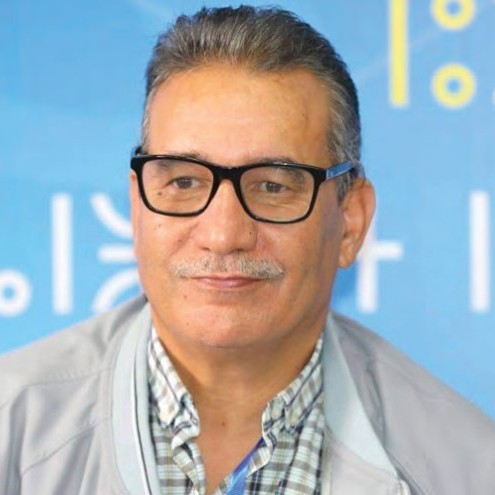
Moroccan journalist and writer, director of the Azul Press website and of the print newspaper Nabd Al Mujtamaa, known for his work on Amazigh media and on Amazigh language and culture.