To Those Who Want to Silence Dr. Mohamed El Faid
This is how the Muslim Brotherhood began in Egypt: they invested heavily in civil society and charitable networks to establish their dominance over civil society. After the Nasserist regime stifled political and social life and restricted community organizing, the Brotherhood gained freedom of movement and deployment with the rise of Anwar Sadat. Sadat actively encouraged them to weaken the Nasserist opposition against him. Once their control over civil society was secured—bolstered by substantial financial backing—the Muslim Brotherhood set out to restrict freedom of thought. They sidelined dissenting voices by accusing them of impiety, apostasy, or hostility toward Islam, and subsequently intimidated intellectuals, dragging them before the courts using Egypt’s hisbah law while the state passively observed in an effort to appease them. Ultimately, they assassinated Sadat—the very man who had released them from prison and opened the doors to political and social life for them—before co-opting the youth-led revolution during the so-called Arab Spring.
In Morocco, they failed to seize control of non-governmental organizations and civil society. Indeed, following independence in 1958, the Moroccan state enacted the royal decree (dahir) on public liberties to counter the project of the Istiqlal Party (across its right- and left-wing factions), which sought to replicate Egypt’s single-party model. Moroccan Islamists consequently retreated to social media, where they established their dominance. Lately, however, this virtual sphere has begun slipping from their grasp, driven by public figures and thinkers who expose the ideology and tactics of the Muslim Brotherhood and Salafists. In response, the latter tried to silence critics through excommunication and threats. When those methods failed, they turned to legal action, mirroring the strategy of the Muslim Brotherhood in Egypt. If they succeed, they will repeat the Egyptian scenario by radically Islamizing society, creating grave challenges for the state given that their intellectual and ideological agenda cannot be separated from their political ambitions. One need only recall the statement made by Justice and Development Party leader Hamidine regarding the monarchy during a conference at his party’s headquarters: “La monarchie, sous sa forme actuelle, constitue un obstacle au progrès, à l’évolution et au développement” (“The monarchy, in its current form, constitutes an obstacle to progress, evolution, and development”)—with heavy emphasis placed on the terms “evolution” and “development.” A video of this intervention is available online, and an article on the subject was published on Hespress on July 10, 2018, at 2:00 a.m. If this Islamist leader is considered a moderate, what can be expected from the radicals?
Note: Whether one agrees or disagrees with Mohamed El Faid on many issues, he remains a courageous man. He stood against the forces seeking to impose the Brotherhood’s ideology, Salafism, and “ISIS-style radicalization” on Moroccan society. That is precisely why they are seeking to silence him today.
Arabic version | French version
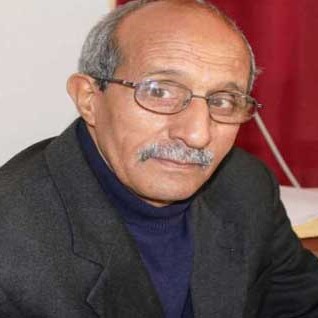
Amazigh researcher, critic and novelist, one of the leading contributors to the growth of Amazigh literary writing. His first book, “Muzya” (1994), is a collection of well-known tales from his home region in the south-east. Four short-story collections and a novel followed, and he translated the Russian writer Nikolai Gogol’s “The Overcoat” into Amazigh.