It’s hardly surprising that opinions differ on language policy or on how best to implement the official status of the Amazigh language. That’s the stuff of ordinary democratic debate. What is surprising is that, more than a decade after Tamazight was enshrined in the constitution, a discourse persists that denies its historical existence, downplays its legitimacy, or frames the demand for its constitutional rights as a plot against Arabic, Islam, or national unity. This raises a fundamental question: who is afraid of Amazigh identity? Is fear of a language thousands of years old a scientific position, or simply the expression of an ideological worldview that refuses to acknowledge the pluralism on which Morocco was built?
Morocco’s 2011 constitution settled this debate when Article 5 established Tamazight as an official language of the state and a shared heritage of all Moroccans, a status reinforced by Organic Law No. 26.16 on implementing its official character. Historical and linguistic research, for its part, leaves no room for doubt: Tamazight is not some contemporary political invention but a language deeply rooted in the history of North Africa, predating modern states by centuries, its existence attested by archaeological inscriptions and rigorous academic scholarship.
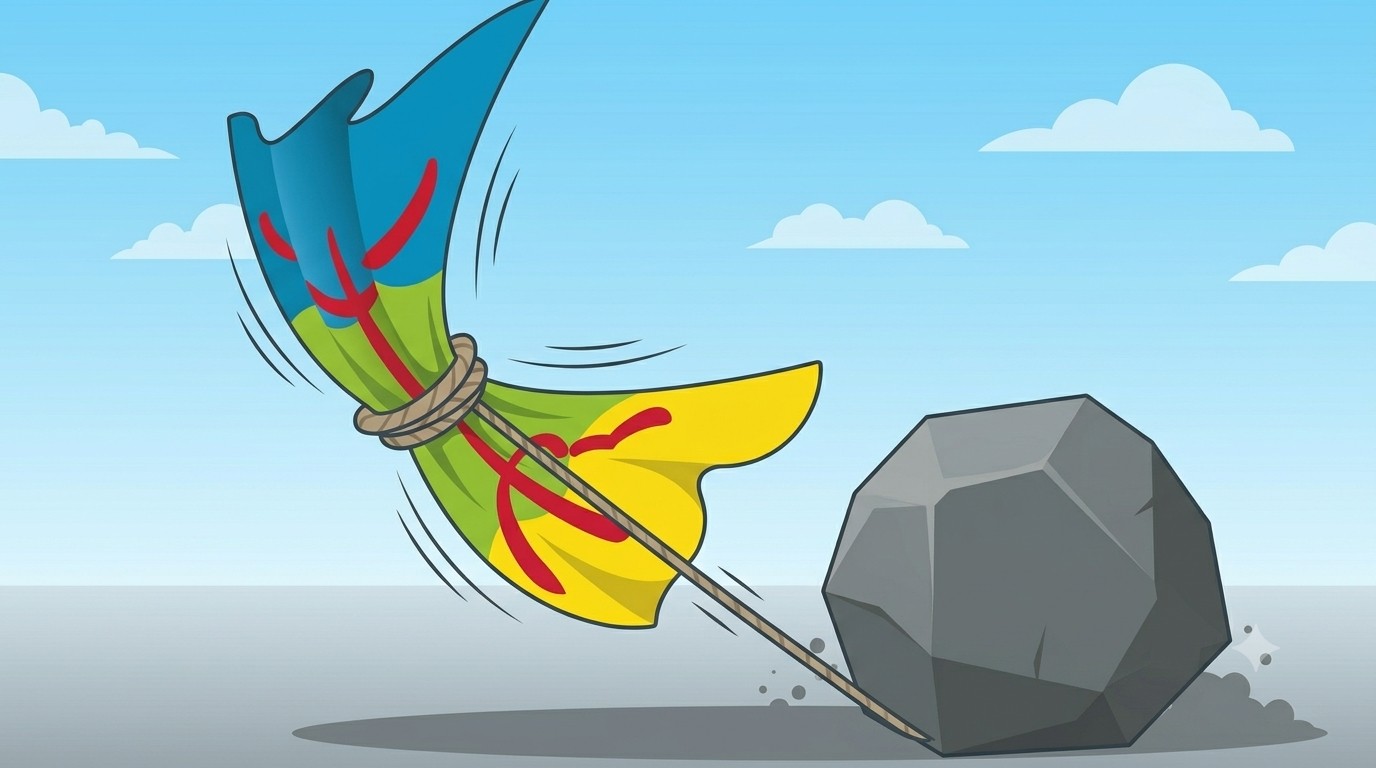
And yet, time and again, particularly on social media, voices emerge with claims that rest on no scientific basis whatsoever, built instead on provocation, incitement, and accusations of betrayal. The debate shifts from a matter of knowledge to a trial of identity, from dialogue over constitutional rights to a barrage of ready-made accusations — “separatism,” “racism,” even “Zionism.” These labels offer no scientific argument. Their purpose is to silence opponents rather than engage them, to discredit people rather than debate their ideas.
More regrettable still, some who espouse this discourse present themselves as professors, researchers, or intellectuals. But a researcher’s worth isn’t measured by their title — it’s measured by their fidelity to scientific method and research ethics. A university is not a space for reproducing prejudice; it is an institution built on evidence, critique, and pluralism. When someone with academic standing trades documentation for slogans and argument for accusations of treason, they hollow out knowledge of its substance and turn it into a tool serving an ideological agenda.
Just as striking is the fact that some of the voices most hostile to Amazigh identity have no track record of peer-reviewed work in history, linguistics, or anthropology — the very disciplines equipped to address these questions. Some of the figures leading this discourse have, according to established and publicly available facts, been linked to extremist positions or to controversies that drew widespread public criticism. None of this negates their right to speak. But it grants them no authority over history or national identity, either, and it does not turn their claims into scientific fact. Ideas should be judged on their merit and their evidence, not on the standing of those who voice them or the noise they generate online.
What’s more striking still is that this discourse doesn’t stop at defending Arabic — a position no one disputes — but goes further, denying Amazigh identity itself, as though respecting Arabic were only possible by excluding another language the constitution itself recognizes. That logic holds up under neither history, nor law, nor Islam. Arabic and Tamazight have never been rivals; they coexisted for centuries, and Amazigh people themselves have long been among Arabic’s most devoted custodians, producing some of the most eminent scholars of Islamic jurisprudence, hadith, and Quranic exegesis, and playing a central role in spreading Islam across Morocco, Andalusia, and the rest of Africa. Casting Tamazight as an enemy of Arabic is nothing more than an ideological construct with no historical grounding.
More surprising yet, some of these narratives attempt to claim Islam exclusively for Arab identity, even though the Quran itself describes linguistic diversity as one of God’s signs, and holds that the diversity of peoples and tribes exists so they may come to know one another, not so they may be set against each other. Nowhere in Islamic history has any people been required to abandon its language to become Muslim. Persians kept Persian, Turks kept Turkish, Kurds kept Kurdish, Malaysians kept their national languages — and Muslim scholars never saw any of this as a contradiction of faith.
Defending Tamazight is not about pitting one group against another, or one language against another. It is about defending the rule of law, the constitution that Moroccans voted for, and the principle of equality among the components of national identity. Tamazight is not a privilege granted to one group — it is a constitutional right and a shared civilizational heritage, as Morocco’s constitution itself makes clear.
The real question today is no longer whether Tamazight has a right to exist — history, science, and the constitution have already answered that. The real question is why some continue to deny what institutions and scientific research have already settled. Why does a debate over an official language keep turning into an occasion for hate speech and accusations of betrayal? Societies that respect themselves do not fear diversity — they see it as a source of strength. Fear of a venerable national language reveals nothing about that language’s weakness. It reveals the fragility of a discourse that cannot come to terms with the facts.
It’s time for public debate in Morocco to rise to the level of its constitution — to rest on scientific research rather than slogans, on documented evidence rather than accusation, on dialogue rather than incitement. Tamazight threatens no one. It is part of Morocco’s past and its future alike. And those who fear it are not, in truth, afraid of a language — they are afraid of acknowledging a pluralism that has been present on this land for thousands of years.
Al-Houcine Zebairi
References:
Constitution of the Kingdom of Morocco, 2011, Article 5.
Organic Law No. 26.16 on determining the stages for implementing the official status of Tamazight.
Mohammed Chafik, An Overview of Thirty-Three Centuries of Amazigh History.
Gabriel Camps, Les Berbères: Mémoire et identité.
Encyclopédie berbère, edited by Gabriel Camps.
Publications of the Royal Institute of Amazigh Culture (IRCAM).
UNESCO Universal Declaration on Cultural Diversity (2001).
United Nations Declaration on the Rights of Indigenous Peoples (2007).
Arabic version | French version