The Architecture Of The El Mansouri Government: Party Arithmetic, State Engineering And The Sovereign Core In Morocco’s Twelfth Legislature – Analysis
Key Takeaways:
On 16 October 2026, King Mohammed VI appointed Morocco’s first woman-led government under Fatima Ezzahra El Mansouri, comprising 32 members drawn from a four-party majority (PAM, Istiqlal, USFP, PPS) holding 207 of 395 seats after the 23 September elections that saw only 38.08 percent turnout.
The essay argues that the enlarged cabinet reflects three overlapping logics: coalition arithmetic that overcompensates the smaller parties through split portfolios and cross-party delegate ministers, administrative engineering that names priorities such as artificial intelligence and food sovereignty, and the preservation of unaltered sovereignty ministries outside partisan bargaining.
Continuity in Interior, Foreign Affairs, Justice, and Defence is presented as ensuring monarchical control, while the rapid dismissal of a delegate minister before investiture and low turnout underscore tests of coalition discipline and democratic legitimacy.
Introduction
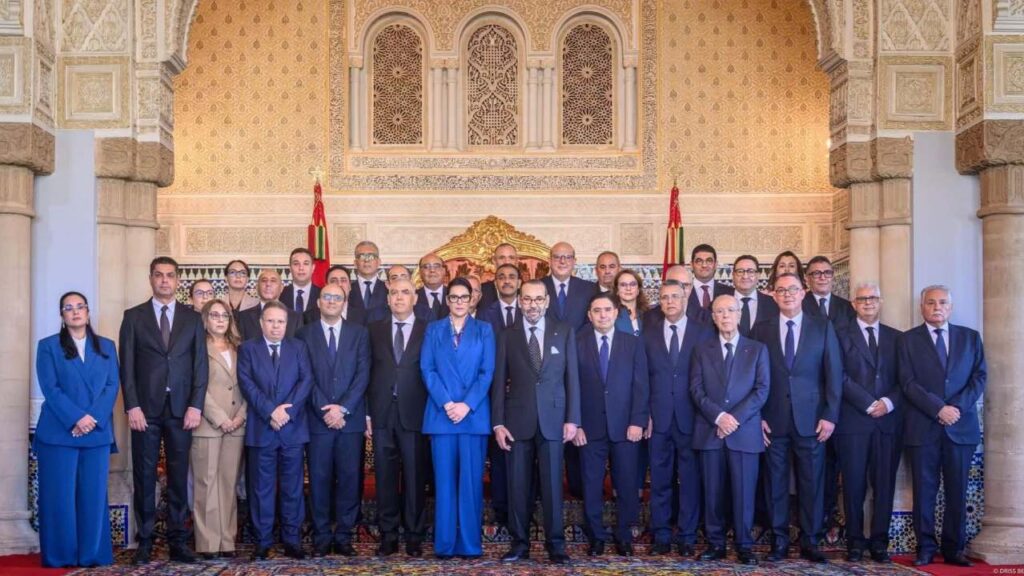
On 16 October 2026, King Mohammed VI appointed, at the Royal Palace in Rabat, the members of the first government in the Kingdom’s history to be headed by a woman, Fatima Ezzahra El Mansouri. The team has thirty-two members: the Head of Government, nineteen ministers, the Secretary General of the Government, and eleven delegate ministers (Le1, 2026; Le Desk, 2026b). The press and Moroccan academics immediately noted the “enlarged” character of this line-up and the proliferation of new or reconfigured portfolio titles (Le360, 2026; Oukerzaz, 2026). Hence the question that structures this essay: why this flowering of portfolios? Is it merely a matter of satisfying the different political tendencies of a composite majority, or is something else at work?
Our thesis is that the governmental architecture follows three superimposed logics, none of which suffices on its own to account for the outcome. The first is coalition arithmetic: a majority of 207 seats out of 395, spread across four parties, can be assembled and held together only by making each partner’s share visible, and the splitting of large departments, like the delegate ministries, serves as its currency of exchange. The second is administrative and doctrinal engineering: the portfolio titles (artificial intelligence, public performance, food sovereignty, preschool, school dropout) name priorities and claim to correct the overlaps of the previous team. The third is a logic of sovereignty: the core regalian ministries remain outside any partisan bargaining, so that the flowering is concentrated in the executive’s economic and social periphery. To these three layers is added a question of legitimacy, in a country where only 38.08% of registered voters went to the polls on 23 September (TelQuel, 2026a; Chtatou, 2026d).
The analysis rests on information available as of 19 October 2026, the day on which the Head of Government is due to present her programme to the two Chambers sitting jointly, a step that opens the investiture procedure (Le1, 2026; Kingdom of Morocco, 2011). It draws together electoral results, ministerial lists, party breakdowns published by the press—whose attributions sometimes diverge and are given here only as orders of magnitude—and the readings of Moroccan academics, and then draws on the literature on coalitions and portfolio allocation (Gamson, 1961; Laver & Shepsle, 1996; Warwick & Druckman, 2001), which the Moroccan case, a constitutional monarchy in which the King chairs the Council of Ministers, obliges us to qualify.
From the Ballot Box to the Coalition: A Constrained Sequence
The constitutional framework is well known. Article 47 of the 2011 Constitution entrusts the King with appointing the Head of Government from the party that came first in the elections to the House of Representatives, and then the ministers on the latter’s proposal; Article 87 provides for a government composed of the Head of Government, the ministers and, possibly, secretaries of state; Article 88 makes investiture conditional on a vote of confidence by the House on the programme; and Article 49 reserves to the Council of Ministers, chaired by the King, the strategic orientations of State policy (Kingdom of Morocco, 2011; Chtatou, 2026b). This framework sets a principle—electoral primacy in designating the executive—and a ceiling—the persistence of a royal centre of decision—between which every negotiation over portfolios takes place.
The ballot of 23 September 2026 produced a fragmented House. The PAM came first with 97 seats out of 395, ahead of the RNI (66), the Istiqlal (65), the PJD (54), the Popular Movement (29), the USFP (26), the PPS (19) and the Constitutional Union (17); turnout reached only 38.08% (TelQuel, 2026a). The RNI, the party of the outgoing head of government, lost thirty-six seats compared with 2021; the PAM advanced; and the PJD, ousted in 2021 at the time of the “return of the liberals to power” (Chtatou, 2021), made a strong comeback. No party came close to the absolute majority of 198 seats, and a PAM–Istiqlal tandem, at 162 seats, would have required a third partner (TelQuel, 2026a).
Appointed on 29 September, El Mansouri opened consultations the very next day, beginning with the RNI, before making official, on 12 October, a four-party agreement among the PAM, the Istiqlal, the USFP and the PPS, which totals 207 seats, nine more than the threshold (Bladi.net, 2026; El Mouden, 2026). The choice is heavy with meaning: it excludes the RNI, which had been the PAM’s ally in the outgoing majority, and brings together around the PAM the three historic components of the Koutla—the Istiqlal, the USFP and the PPS—the last two coming from the opposition (Bladi.net, 2026). It also leaves two heavyweight formations outside the majority: the liberal centre of the RNI and the PJD. The government is therefore not a rainbow in which all sensibilities would find themselves; it reflects a selection. The question of satisfying political tendencies must be put in these terms: which tendencies, and why those?
This selection has its own sociology. For Lahrichi (2026), the formation of a Moroccan government never proceeds from a single logic: it combines the representation of the majority, the continuity of the State, sectoral competence and the search for balances among centres of power. This reading joins a tradition of analysis that describes the Moroccan political system as a game of accommodations among a stable monarchical centre, parties whose autonomy is real but bounded, and territorial elites whose capacity for mediation conditions access to power (Waterbury, 1970; Tozy, 1999; Chtatou, 2026f).
Anatomy of an Enlarged Executive
First, the numbers. With thirty-two members, the El Mansouri government exceeds the first Akhannouch team, installed in 2021 with twenty-four ministers, and the thirty-member set that emerged from the October 2024 restructuring, which had introduced secretaries of state (Oukerzaz, 2026). Over the longer term, the El Othmani cabinet of 2017 had brought together thirty-nine ministers and secretaries of state from six parties (H24info, n.d.); it was cut back to twenty-four members in October 2019 (Finances News Hebdo, 2019). The jurist Azzedine Hannoun considers the 2026 enlargement to be “real, but measured”: it is due in large part to the shift from a three-party to a four-party majority, each component having to be represented, and to the desire not to multiply intermediate-rank formulas (Oukerzaz, 2026).
The hierarchical distribution is revealing. Of the thirty-two members, eleven are delegate ministers, two of them attached to the Head of Government (National Defence Administration; Relations with Parliament and Civil Society) and nine placed alongside full ministers (Le1, 2026). This time there is no secretary of state: the delegate-minister formula absorbs the function of the intermediate echelon that the 2024 reform had introduced. Seven women sit in the team, roughly 22% of its membership (Lahrichi, 2026), a proportion that contrasts with the symbolic weight of a woman’s appointment to head the executive.
One feature deserves emphasis at the outset: the proliferation is not uniform. It is concentrated in the economic and social sectors—Education (one minister, two delegates), Industry and Commerce, Agriculture and Fisheries, Tourism and Crafts, Planning and Housing, Family and Social Inclusion, Digital and Administrative Reform—whereas the Interior, Foreign Affairs, Justice, Habous and National Defence Administration are carried over unchanged, with the same incumbents (Finances News Hebdo, 2026; Oukerzaz, 2026). Only the General Secretariat of the Government changes hands within this core: Hassan Tariq, until now the King’s Ombudsman, succeeds Mohamed Hajoui (Le Desk, 2026b; Finances News Hebdo, 2026). The flowering is thus a phenomenon of the periphery.
First Reading: The Arithmetic of Portfolios
Classical coalition theory holds that parties obtain portfolios in proportion to their contribution in seats to the majority (Gamson, 1961). Later work has shown that proportionality is only approximate: portfolios are not all of equal value, and the salience of ministries weighs as much as their number (Laver & Shepsle, 1996; Warwick & Druckman, 2001). In a system where the distribution of posts is negotiated, multiplying ministries and subdividing large departments amounts to increasing the number of units of account available for the transaction: one ministry split in two supplies two currencies where it once offered one. The experience of 2019 confirms this: an observer recalled that, under proportional representation, parties are represented according to their electoral weight and that any reduction in posts weighs first on small parties, and an analyst noted that some secretaries of state had been appointed mainly to satisfy the majority (Finances News Hebdo, 2019).
Let us apply this grid to the 207-seat majority, divided as follows: PAM 97 (47%), Istiqlal 65 (31%), USFP 26 (13%), PPS 19 (9%). According to the party breakdown in Le Canard libéré (2026), which is not unanimously accepted but provides an order of magnitude, the PAM holds eleven posts (Head of Government included), the Istiqlal seven, the USFP five and the PPS three, the remainder going to unaffiliated profiles and to the sovereignty ministries. Reduced to partisan posts alone, these shares give roughly 42% to the PAM, 27% to the Istiqlal, 19% to the USFP and 12% to the PPS. The calculation is approximate, but the direction is clear: the two large partners receive slightly less than their weight in seats, the two small ones slightly more. This overcompensation is explained by the latter’s pivotal position: without the USFP, the majority falls to 181 seats; without the PPS, to 188; in both cases below the threshold of 198. Each of the small partners can therefore tip the coalition, and it is this blocking power, more than their arithmetic weight, that their share of portfolios reflects.
The break-up of Younes Sekkouri’s portfolio offers the clearest illustration. His ministry brought together, in practice, two departments, employment and vocational training (Médias24, 2022), to which economic inclusion was added. In 2026, these competences are distributed among four office-holders from three parties: Employment and Social Dialogue to Abderrahim Chahid (USFP); Industry, Commerce, Investment and Economic Inclusion to Ryad Mezzour (Istiqlal); National Education, Preschool, Vocational Training and Qualification to Nabil Benabdallah (PPS), alongside whom Vocational Training was entrusted to an Istiqlal delegate minister (Finances News Hebdo, 2026; Le Canard libéré, 2026; TelQuel, 2026b). This dispersal can be defended on administrative grounds; it also answers a partisan imperative: a single large ministry cannot be shared among three partners, whereas four ministries make it possible.
Even more significant is the practice of cross-party tandems. According to the press, several delegate ministers belong to a different party from their supervising minister: an Istiqlal member alongside a PPS minister, forming a “cross-party pairing” (TelQuel, 2026b); a USFP cadre, Kamal Hachoumi, alongside the same minister; Ahmed Mehdi Mezouari (USFP) alongside the PAM Minister of Agriculture, Khalid Hatimy; Rachid Hamouni (PPS) alongside the PAM Minister of Family, Najwa Koukouss (Le Canard libéré, 2026). The literature sees in this arrangement an instrument of mutual monitoring: the delegate minister from another party is his or her party’s eye within the department and limits the drift of the full minister (Thies, 2001). No public document attests to this intention among Moroccan negotiators, but the configuration is consistent with it: the number of delegate posts would then organise the reciprocal control of a majority with only nine seats to spare.
Partisan logic does not, however, exhaust the explanation. Lahrichi (2026) points out that the number of portfolios is a poor measure of a party’s weight: budgetary capacity, visibility and arbitration power differ from one ministry to another, and non-party office-holders sometimes occupy a department that falls to a party’s quota. The PAM, which keeps Finance, Justice, Agriculture, Higher Education, Territorial Planning (with the government spokesperson role) and Youth, Culture and Sports, controls budgetary arbitrations and a share of the public narrative. The Istiqlal receives a coherent set of infrastructure, industry, commerce, transport and tourism; the USFP and the PPS receive social sectors—health, employment, education, energy, social inclusion—where citizens experience daily the presence or absence of the State (Lahrichi, 2026). The left-wing partners thus receive the most visible portfolios, but also those most exposed to electoral sanction.
Second Reading: The Engineering of Titles
To reduce the flowering to a partisan transaction would be to overlook the administrative and doctrinal dimension of the line-up. Titles are not neutral. Associating public performance with Finance, under Fouzi Lekjaa, makes the evaluation of results an explicit criterion of government; inscribing food sovereignty in the Ministry of Agriculture links production to external vulnerabilities and climate change; creating a Ministry of Artificial Intelligence, Digital Transformation and Administrative Reform places technology at the heart of State modernisation (Lahrichi, 2026). Digital affairs previously fell under a mere delegate ministry (Finances News Hebdo, 2026).
The delegate ministries responsible for preschool, the fight against school dropout, vocational training or social inclusion follow the same logic: precisely naming certain fractures in order to make them visible and measurable (Lahrichi, 2026). The reorganisation of education, which brings National Education, Preschool and Vocational Training under one authority, leaves Higher Education apart and attaches sports to Youth and Culture (Finances News Hebdo, 2026). The disappearance of Communication from the title of the Ministry of Youth, Culture and Sports is read by Hannoun as a wish to leave the National Press Council latitude to regulate; he himself stresses the interpretive nature of this reading, since Communication covers not only the press but also cinema (Oukerzaz, 2026).
This engineering responds, secondly, to an ambition of coherence announced during the consultations: a press analysis reports that the new Head of Government’s philosophy aims at “less juxtaposition of departments, more coherence among public policies,” in contrast with the allocation of departments among the components of the previous three-party coalition (Article19.ma, 2026a). Here appears the central paradox of the architecture: it claims both to integrate policies and to multiply interfaces. Large ministries bring together policies that each have their own actors and temporalities; delegate ministers increase specialisation but multiply coordination points (Lahrichi, 2026). Hannoun warns that a new label is worth something only if accompanied by structures, resources and measurable objectives (Oukerzaz, 2026).
The calendar, finally, imposes its own rationality: the 2027 finance bill was due to be tabled before 20 October, in parallel with the presentation of the programme to Parliament (Oukerzaz, 2026). One may hypothesise that a team installed only days before these deadlines favours an architecture of delegate ministers, which does not require an immediate overhaul of administrations, over a recomposition of departments that would take months.
Third Reading: The Sovereign Core and the Monarchy
If the periphery flowers, the centre is frozen. The ministers of the Interior (Abdelouafi Laftit), Foreign Affairs (Nasser Bourita), Habous and Islamic Affairs (Ahmed Toufiq) and Justice (Abdellatif Ouahbi), as well as the delegate minister in charge of National Defence Administration (Abdeltif Loudyi), are all retained (Médias24, 2026; Finances News Hebdo, 2026). For Hannoun, this continuity ensures the continuity of State action (Oukerzaz, 2026); another analysis sees in it a “controlled transition,” which preserves the State’s strategic compass while changing the political engine through the opening to the left.
This duality is constitutive of the system. The Head of Government proposes; the King appoints and chairs the Council of Ministers, where strategic orientations are dealt with (Kingdom of Morocco, 2011). The category of “sovereignty ministries,” a matter of political usage rather than constitutional text, nonetheless structures the architecture: negotiable portfolios lie in the economy and social sectors, reserved portfolios in sovereignty. The resulting government should be read as a transformation within the political system, not as a transformation of the system itself (Chtatou, 2026b); Moroccan evolution proceeds by adapting the existing architecture rather than by rupture, what the Anglo-Saxon literature calls incremental democratisation (Chtatou, 2026f).
This two-speed architecture performs a function that arithmetic alone does not see: it neutralises the risks of fragmentation. The more the periphery is negotiated, the more stable the centre must be for the coalition to withstand frictions and incidents. One finds again, in updated form, the segmentation described by Waterbury (1970): an arbitral centre, and partisan segments that compete for resources without challenging the arbiter. One also finds mediation by notables, whom parties recruit for their family, land, associational or local capital and who convert that capital into votes (Chtatou, 2026a). The recruitment of ministers follows the same hybrid logic, political and technocratic, which is not an anomaly but a technique of government (Lahrichi, 2026).
Fourth Reading: Legitimacy, Abstention and Political Colouring
The fourth logic is that of legitimacy. A turnout of 38.08% does not allow us to conclude that abstention equals rejection of parties—it may reflect indifference, practical constraints, distrust or protest—but its scale constitutes a representation challenge for all formations (Chtatou, 2026b). The paradox of a strong monarchy and a Parliament whose capacity to embody popular preferences remains contested, where citizens express more confidence in State institutions than in parties and Parliament (Chtatou, 2026d), illuminates the choice of a government with a more political colouring.
Observers indeed note that, with the exception of a few profiles from the senior civil service or the business world, such as Ahmed Rahhou and Jalal Charaf, most members display an openly acknowledged party affiliation (Le360, 2026). Hannoun sees in this the return of figures from the Benkirane team—Nabil Benabdallah at Education, Charafat Afailal at Energy—and a wish to answer a reproach made to the previous executive, a deficit of political mediation; he adds that this orientation does not dispense with the requirement of effectiveness, the team to be judged on its results rather than its profiles (Oukerzaz, 2026).
The case of Fouzi Lekjaa illuminates another aspect of this logic. A delegate minister for the Budget who joined the PAM during the summer (Le Canard libéré, 2026) and president of the Royal Moroccan Football Federation, he reaches Finance at a time when commentators were evoking a “2030 World Cup government.” Football, having become an instrument of national image and soft power, has given its promoter a capital of collective emotion that ordinary technocrats do not accumulate (Chtatou, 2026c): by entrusting him with budgetary authority, the PAM converts that capital into a resource of government. This reading nevertheless calls for a government that is not reduced to that of the 2030 World Cup, but durably addresses social, economic and territorial challenges (Chtatou, 2026e).
There remains the generational and territorial dimension. The demand for merit, transparency and equal citizenship carried by young people, which the GenZ212 mobilisation made visible, weighs on the composition (Chtatou, 2025); the departments of employment, vocational training, youth and preschool are its named responses. By contrast, the shift from a “Morocco of centres” to a “Morocco of territories” (Chtatou, 2026e) is reflected only indirectly in the organisational chart: territorialisation rests essentially on the Ministry of National Territorial Planning, Urban Planning, Housing and City Policy, combined with the government spokesperson role.
The Costs of the Architecture: Coordination, Accountability and a First Incident
An architecture that multiplies portfolios also multiplies breaking points. The first incident occurred before the investiture: appointed on 16 October as delegate minister for Vocational Training, the Istiqlal member Madiha Khayr saw her duties end on 18 October, at the request of the Head of Government, accepted by the King in accordance with Article 47 (Le Desk, 2026a; Article19.ma, 2026b). The government spokesperson, Samir Belfkih, explained that the request stemmed from an assessment shared by the majority parties, after the circulation of personal information of a judicial and medical nature, without ruling on its content or authenticity. We do not go into the substance of this information, which is not publicly established and falls outside institutional analysis.
The episode sheds light on three points. First, the speed of the decision shows that the majority prefers to absorb an immediate reputational cost rather than let a controversy settle in on the eve of the investiture. Second, it reveals the tension between the logic of quota, in which the party proposes its personnel, and the logic of selection, in which the Head of Government answers for her team before the King and the House: Article 47 gives her a real lever. Finally, it raises a question of organisation: the reassignment of the vacant post, still to come at the time of writing, will constitute a first test of coalition discipline.
The structural risk goes beyond the incident. In a coalition, the classic dilemma is to claim successes collectively while individualising failures; as the 2031 deadline approaches, each partner will seek to preserve its identity (Lahrichi, 2026). Retrospective voting presupposes that the voter can link a performance to a responsible party, yet large cross-cutting ministries, shared competences and tandems blur attribution. The clarity of the decision chain thus becomes a condition of democratic accountability: a majority becomes a government, writes Lahrichi (2026), “when it ceases to be an addition of parties.” The 2017–2019 cycle is a reminder: a cabinet enlarged to placate six parties (H24info, n.d.) was cut back, after a royal call for greater competence, from thirty-nine to twenty-four members (Afrik.com, 2019; Finances News Hebdo, 2019).
Conclusion
Why this flowering of portfolios? It is neither a simple sharing of spoils among political tendencies nor a pure administrative rationalisation. It results from three logics that meet in a single organisational chart. First, arithmetic: a 207-seat majority in which each of the two small partners is pivotal leads to overcompensation in visible posts, supplied by the subdivisions of large departments (employment, training, economic inclusion) and by cross-party tandems, instruments of reciprocal control. Second, engineering: titles that name priorities and claim policy coherence. Third, sovereignty: a core that is carried over, making the negotiation of everything else bearable.
As to whether the aim is to satisfy political tendencies, the answer is yes, but selectively: neither the RNI, nor the PJD, nor the whole of the liberal right or political Islam is party to it. What the government satisfies is the combination of the PAM and the Koutla, and it does so by overcompensating the small partners. Artificial intelligence, food sovereignty or preschool are the discourse by which this arithmetic gives itself a public-policy justification. The two dimensions are not mutually exclusive; they reinforce each other: a new title can be, at once, a priority and the most economical way of creating a post.
These hypotheses are testable in the short term. Four indicators will allow us to decide: the programme presented on 19 October and the place it gives to the projects named by the titles; the 2027 finance act, which will show whether public performance and food sovereignty translate into budget lines; the decrees defining the powers of the delegate ministries; and, finally, the filling of the vacant Vocational Training post. If, in twelve months, the delegate ministries remain without their own directorates or budgets, the bargaining-currency hypothesis will prevail; if they have received structures and measurable objectives, the engineering hypothesis will be vindicated.
Beyond these tests, the issue is trust. Arithmetic builds a majority; only the effectiveness of public action builds trust, as Lahrichi (2026) sums it up. In a country where six in ten registered voters did not go to the polls, a government is worth not by the size of its organisational chart but by its capacity to reduce the distance between citizens and institutions (Chtatou, 2026b): it is by this yardstick that the El Mansouri team will be judged.
References
Afrik.com. (2019, October). Mohammed VI et son régime… minceur ! [Mohammed VI and his slimming diet…!]. Afrik.com. https://www.afrik.com/maroc-mohammed-vi-et-son-regime-minceur
Article19.ma. (2026a, October). Éclairage | Maroc : après l’ouverture du Parlement, les tractations se poursuivent autour du gouvernement El Mansouri [Spotlight | Morocco: After the opening of Parliament, talks continue around the El Mansouri government]. Article19.ma. https://article19.ma/accueil/archives/199522
Article19.ma. (2026b, October 18). Politique | Maroc : Madiha Khayr limogée 48 heures après sa nomination, le gouvernement évoque « des informations judiciaires et médicales » [Politics | Morocco: Madiha Khayr dismissed 48 hours after her appointment, government cites “judicial and medical information”]. Article19.ma. https://article19.ma/accueil/archives/199836
Bladi.net. (2026, October). Ils gouvernaient ensemble, mais El Mansouri forme sa nouvelle majorité sans Akhannouch [They governed together, but El Mansouri forms her new majority without Akhannouch]. Bladi.net. https://www.bladi.net/gouvernaient-ensemble-el-mansouri-forme-nouvelle-majorite-akhannouch,124336.html
Chtatou, M. (2021, September 17). The return of liberals to power in the Moroccan general elections. Fikra Forum, The Washington Institute for Near East Policy. https://www.washingtoninstitute.org/policy-analysis/return-liberals-power-moroccan-general-elections
Chtatou, M. (2025, October 7). Aspects of clientelism due to neo-tribalism in Moroccan political system: Preeminence of this state of affairs and current protests by GENZ212 group.
Chtatou, M. (2026a, September 13). The co-optation of notables by political parties in Moroccan elections: From traditional notability to the territorial fabrication of electoral power. Eurasia Review. https://www.eurasiareview.com/13092026-the-co-optation-of-notables-by-political-parties-in-moroccan-elections-analysis/
Chtatou, M. (2026b, October 11). Fatima Ezzahra El Mansouri and the changing architecture of political power in Morocco: Gender, establishment, political capital and the limits of executive transformation. Eurasia Review. https://www.eurasiareview.com/11102026-fatima-ezzahra-el-mansouri-and-the-changing-architecture-of-political-power-in-morocco-gender-establishment-political-capital-and-the-limits-of-executive-transformation-analysis/
Chtatou, M. (2026c, August). Fouzi Lekjaa and the “World Cup 2030 government”: From pitch to premiership. Morocco World News. https://www.moroccoworldnews.com/2026/08/333806/fouzi-lekjaa-and-the-world-cup-2030-government-from-pitch-to-premiership/
Chtatou, M. (2026d, September 3). The great rendezvous with abstention? The Moroccan legislative elections of September 23, 2026 and the crisis of political representation. Eurasia Review. https://www.eurasiareview.com/03092026-the-great-rendezvous-with-abstention-the-moroccan-legislative-elections-of-september-23-2026-and-the-crisis-of-political-representation-analysis/
Chtatou, M. (2026e, August 19). Morocco’s September legislative elections: The need for a competent, effective, and territorially just government. Eurasia Review. https://www.eurasiareview.com/19082026-moroccos-september-legislative-elections-the-need-for-a-competent-effective-and-territorially-just-government-analysis/
Chtatou, M. (2026f, May 27). The political process in Morocco: Monarchy, reform, and incremental democracy. Eurasia Review.
El Mouden, W. (2026, October). Gouvernement El Mansouri : le PAM écarte le RNI et se tourne vers la Koutla [El Mansouri government: The PAM sets aside the RNI and turns to the Koutla]. Le360. https://fr.le360.ma/politique/gouvernement-el-mansouri-le-pam-ecarte-le-rni-et-se-tourne-vers-la-koutla_YF6QWVFZCFFNZPB3K7XSVECTQA/
Finances News Hebdo. (2019, October 18). Nouveau gouvernement : pas de délai grâce [New government: No grace period]. Finances News Hebdo. https://fnh.ma/articles/nouveau-gouvernement-pas-de-delai-grace
Finances News Hebdo. (2026, October 16). Gouvernement El Mansouri : les grands changements du nouvel exécutif [El Mansouri government: The major changes of the new executive]. Finances News Hebdo. https://fnh.ma/articles/gouvernement-el-mansouri-les-grands-changements-du-nouvel-executif
Gamson, W. A. (1961). A theory of coalition formation. American Sociological Review, 26(3), 373–382.
H24info. (n.d.). Vidéos. Rétro 2017 : retour sur une année très politique [Videos. Retro 2017: A look back at a very political year]. H24info. https://h24info.ma/maroc/videos-retro-2017-retour-annee-tres-politique/
Hespress English. (2026, October 18). Morocco government breaks silence on Madiha Khayr’s dismissal. Hespress English. https://en.hespress.com/147581-morocco-government-breaks-silence-on-madiha-khayrs-dismissal.html
Hespress FR. (2019, October 12). Remaniement ministériel : prendre conscience du déficit au niveau des élites politiques [Cabinet reshuffle: Becoming aware of the deficit among political elites]. Hespress FR. https://fr.hespress.com/100886-100886.html
Hespress FR. (2026a, October). Cabinet El Mansouri : l’art de la transition maîtrisée [The El Mansouri cabinet: The art of controlled transition]. Hespress FR. https://fr.hespress.com/492812-cabinet-el-mansouri-lart-de-la-transition-maitrisee.html
Hespress FR. (2026b, September 30). Le RNI ouvre le cycle des consultations d’El Mansouri pour former la majorité [The RNI opens El Mansouri’s round of consultations to form the majority]. Hespress FR. https://fr.hespress.com/490588-le-rni-ouvre-le-cycle-des-consultations-del-mansouri-pour-former-la-majorite.html
Kingdom of Morocco. (2011). Constitution du Royaume du Maroc [Constitution of the Kingdom of Morocco]. Bulletin officiel du Royaume du Maroc.
Lahrichi, A. (2026, October 16). Gouvernement El Mansouri : entre arithmétique de la majorité et sociologie du pouvoir [El Mansouri government: Between majority arithmetic and the sociology of power]. EcoActu.ma. https://ecoactu.ma/gouvernement-arithmetique-majorite-sociologie-pouvoir/
Laver, M., & Shepsle, K. A. (1996). Making and breaking governments: Cabinets and legislatures in parliamentary democracies. Cambridge University Press.
Le1. (2026, October 16). Composition complète du gouvernement de Fatima Ezzahra El Mansouri [Full composition of the government of Fatima Ezzahra El Mansouri]. Le1.ma. https://le1.ma/composition-nouveau-gouvernement-maroc-2026/
Le360. (2026, October). Une équipe élargie, politique, rajeunie et renouvelée : ce qu’il faut retenir du nouveau gouvernement [An enlarged, political, rejuvenated and renewed team: What to remember about the new government]. Le360. https://fr.le360.ma/politique/une-equipe-elargie-politique-rajeunie-et-renouvelee-ce-quil-faut-retenir-du-nouveau-gouvernement_K7UG2766HFE2VISIZLQD5T5LDE/
Le Canard libéré. (2026, October 16). Politique : le nouveau gouvernement enfin nommé [Politics: The new government finally appointed]. Le Canard libéré. https://lecanardlibere.ma/a-la-une/politique-le-nouveau-gouvernement-enfin-nomme/
Le Desk. (2026a, October 18). Gouvernement El Mansouri : la ministre déléguée Madiha Khayr démise de ses fonctions [El Mansouri government: Delegate minister Madiha Khayr relieved of her duties]. Le Desk. https://ledesk.ma/2026/10/18/gouvernement-el-mansouri-la-ministre-delegue-madiha-khayr-demise-de-ses-fonctions/
Le Desk. (2026b, October 16). Le roi Mohammed VI nomme le gouvernement El Mansouri (liste) [King Mohammed VI appoints the El Mansouri government (list)]. Le Desk. http://ledesk.ma/2026/10/16/le-roi-mohammed-vi-nomme-le-gouvernement-el-mansouri-liste/
Médias24. (2022, August 4). Sekkouri change deux secrétaires généraux et 24 délégués régionaux de l’emploi et de la formation [Sekkouri replaces two secretaries general and 24 regional delegates for employment and training]. Médias24. https://medias24.com/2022/08/04/sekkouri-change-deux-secretaires-generaux-et-24-delegues-regionaux-de-lemploi-et-de-la-formation/
Médias24. (2026, October 16). Officiel. Voici la composition du gouvernement El Mansouri [Official. Here is the composition of the El Mansouri government]. Médias24. https://medias24.com/2026/10/16/officiel-voici-la-composition-du-gouvernement-el-mansouri-1780607/
Oukerzaz, H. (2026, October 18). Gouvernement El Mansouri : une équipe élargie, un cap à tenir [El Mansouri government: An enlarged team, a course to hold]. Hespress FR. https://fr.hespress.com/492927-gouvernement-el-mansouri-une-equipe-elargie-un-cap-a-tenir.html
TelQuel. (2026a, September 24). Législatives 2026 : le PAM en tête, le RNI décroche, le PJD revient [2026 legislative elections: PAM in the lead, RNI slips, PJD returns]. TelQuel. https://telquel.ma/instant-t/2026/09/24/legislatives-2026-le-pam-en-tete-le-rni-decroche-le-pjd-revient_2009540/
TelQuel. (2026b, October 16). Madiha Khayr, une istiqlalienne à la Formation professionnelle [Madiha Khayr, an Istiqlal member at Vocational Training]. TelQuel. https://telquel.ma/instant-t/2026/10/16/madiha-khayr-une-istiqlalienne-a-la-formation-professionnelle_2013594/
Thies, M. F. (2001). Keeping tabs on partners: The logic of delegation in coalition governments. American Journal of Political Science, 45(3), 580–598.
Tozy, M. (1999). Monarchie et islam politique au Maroc [Monarchy and political Islam in Morocco]. Presses de Sciences Po.
Warwick, P. V., & Druckman, J. N. (2001). Portfolio salience and the proportionality of payoffs in coalition governments. British Journal of Political Science, 31(4), 627–649.
Waterbury, J. (1970). The Commander of the Faithful: The Moroccan political elite—A study in segmented politics. Columbia University Press.