Science Settles It: 84% of Moroccans Are Genetically Amazigh, Debunking the Yemeni Origin Myth
New genetic research has reignited debate over unfounded narratives that trace the origins of Amazigh people in Morocco and North Africa to Yemen or other Arabist-inspired myths.
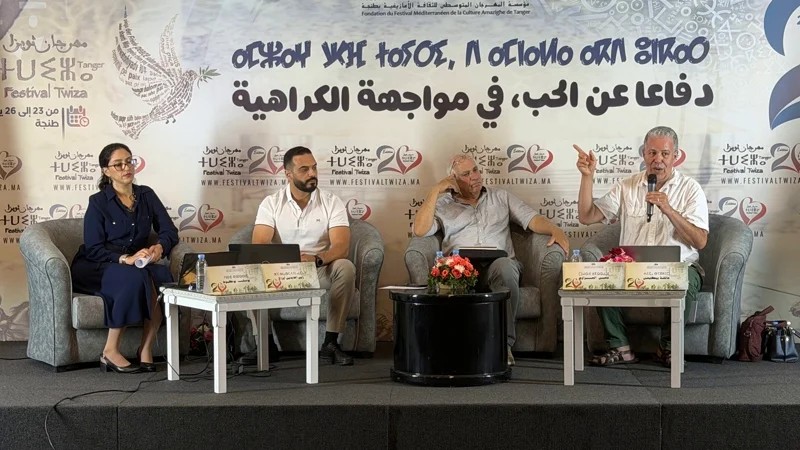
At a symposium titled “Morocco in the Mirror of New Archaeological Discoveries,” held as part of the 20th edition of the Tawiza cultural festival in Tangier, geneticist Aouragh Zineddine argued that science can now settle the question definitively. He pointed to comparisons of remains discovered on Socotra around 2024, which showed no genetic link to Yemen whatsoever.
The researcher highlighted a long, unbroken pattern of settlement in North Africa, citing Numidian remains from Sétif and others from the Canary Islands that carry the Amazigh E-M81 lineage—a marker he connects to the Mauretanian king Bogud, who reigned around 49 BCE. According to Zineddine, this evidence disproves theories tracing the Mauretanians to sub-Saharan origins. At the same time, he noted that the presence of migration and outside influences does not undermine the predominance of the local Amazigh component in the region’s genetic makeup.
Detailing the major paternal lineages found worldwide, he explained that E-M81 predominates among most Amazighs in North Africa, compared with E-M78 among Egyptians, E-M2 in sub-Saharan Africa, R1b in Europe, and J1 among most Arabs in the Middle East. He cautioned, however, that this classification reflects only the most common lineage in each region and does not imply absolute genetic purity.
He also addressed the role of maternal lineages in explaining differences among individuals who share the same paternal ancestry, citing a 2013 study by Bekada et al. that found roughly 84% of Moroccans belong to an Amazigh lineage—a finding he described as evidence of the local stock’s dominance in the population’s current makeup. He added that the E-Z5009 sub-lineage, derived from E-M81, links Amazighs from the Rif, the Atlas, and the Souss to a common ancestor he places around 300 BCE.
For his part, Youssef Boukbout, a researcher at the National Institute of Archaeology and Heritage Sciences in Rabat, noted that questions of identity remain unresolved across North Africa, from Libya to Mauritania. Part of the population still does not know its true origins, he said, while some embrace stories of Kuwaiti or Yemeni descent that are difficult to verify historically. He pointed out that no documented family tree in Morocco extends back more than three or four centuries, even as some claims of ancestry stretch back two thousand years—an assertion he considers historically impossible to substantiate.
Researchers describe the narrative of a Yemeni origin for the Amazigh people as historically unsubstantiated and lacking any scientific basis. Given that no documented Moroccan family tree extends beyond three or four centuries, Boukbout said, a claim of Yemeni ancestry going back two thousand years is “historically impossible.” Researchers argue that the persistence of this narrative, despite the spread of genetic analyses that contradict it, reflects the grip of a ready-made identity discourse that proves hard to abandon even in the face of scientific evidence.
Boukbout stressed that genetics offers a tool for resolving these questions away from populist rhetoric, pointing to the creation of a new laboratory near Tangier expected to draw strong interest from people eager to verify their origins through genetic testing.
Arabic version | French version