Moroccans call for the restoration of historic Amazigh names for cities, streets, and public spaces
The debate over the names of Morocco’s cities and public spaces is back in the spotlight. People who care about history, heritage and identity are calling for the original Amazigh names of towns, villages, rivers and mountains to be given back their due. They also want an end to the almost automatic use of names imported from the Middle East, for streets, squares and public buildings. With a civilizational heritage stretching back thousands of years, Morocco has no need to borrow its memory from beyond its borders.
Moroccan patriots argue that flooding cities with names unrelated to local history weakens younger generations’ attachment to their towns and their roots. It also pushes local figures and symbols aside in favor of imported references far removed from the Moroccan context. This is not about cutting ties with the outside world, they stress. The point is to keep openness from becoming a way to erase Morocco’s Amazigh identity, or an excuse to sideline names shaped by the country’s geography and history, names that bear the imprint of Amazigh civilization and its achievements over the centuries.
Essaouira is one example of how deep Amazigh names run in the history of Moroccan cities. Royal adviser André Azoulay has announced that he intends to work toward giving the city back its name, “Mogador.” He made the announcement at the opening of the first “Mogador Essaouira Dialogues” forum on Friday, November 20, 2026. In a video posted by the news site Al Dar on its Facebook page, Azoulay recalled the city’s oldest names, “Mogador” and “Amegdoul,” and stressed that “Mogador” was born in Morocco, not in Paris. This is no small matter, he insisted: it is not simply about changing a name on official documents, but about reclaiming a rich historical legacy found in old cultural and literary works. He also mentioned the American writer Paul Bowles, who used Essaouira and its old ramparts as a backdrop for some of his work.
Medieval geographers lend strong support to this view. The Andalusian geographer Abu Ubayd Abdallah ibn Abd al-Aziz al-Bakri (d. 487 AH) mentions the city by its Amazigh name, “Amegdoul,” in his Book of Routes and Realms (Kitab al-Masalik wa al-Mamalik), completed in 460 AH, or 1068 CE. Describing navigation along the Atlantic coast, he writes: “Ships sail from the coast of Noul to the Souss River in three days, then from the Souss River to the port of Amegdoul, a safe winter anchorage.” The name was thus in use more than nine and a half centuries ago, long before the present city was built under Sultan Mohammed ben Abdallah.
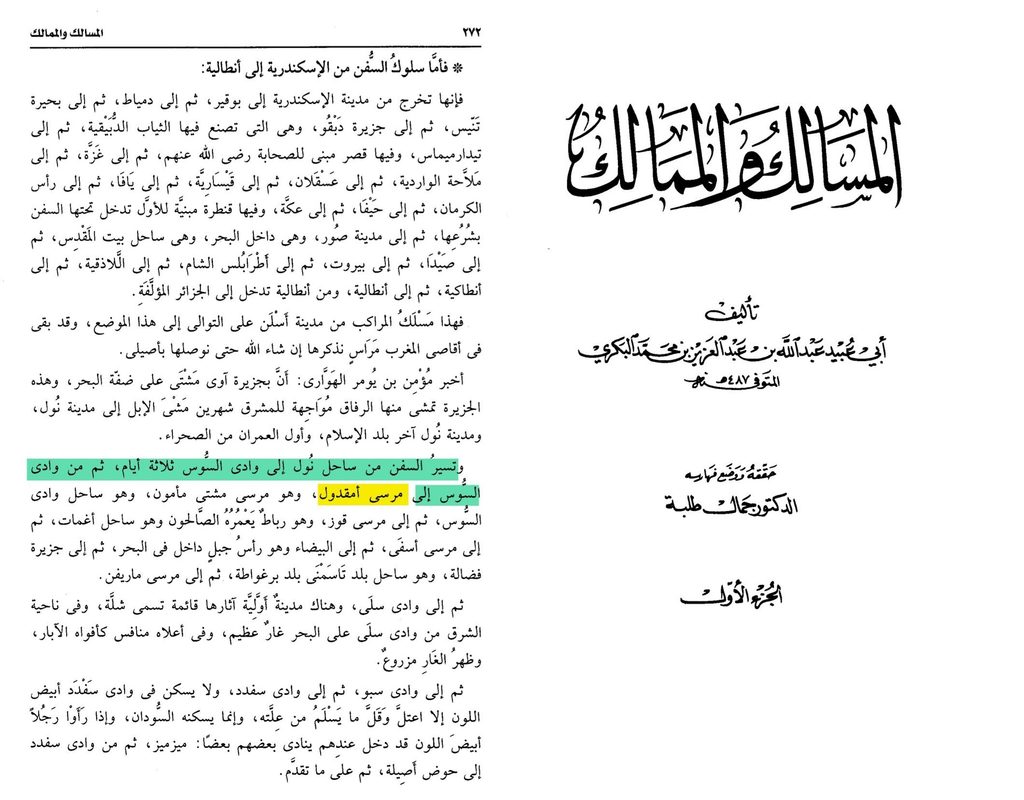
Opinions differ on the name’s origin and meaning. Some researchers link “Mogador” to the Amazigh form “Mogadir,” meaning “the walled one,” a reference to the walls and fortifications that marked the site. Others point to an explanation given by Mohamed Abihi, a professor of contemporary history at Mohammed V University in Rabat. He traces the name to the expression “Mou-Agdour,” which the Danish consul in Essaouira is said to have heard from local people in the 18th century. In Amazigh, “agdour” is a clay cooking pot, and the shape of the fortifications around the city may have inspired the name. Abihi says this explanation needs further checking and comparison, but considers it an important starting point for restoring the Amazigh dimension to the history of Essaouira and the surrounding Haha region.
The theory of a Phoenician origin for the name runs up against the archaeological evidence. Moroccan archaeologist Youssef Bokbot maintains, on the basis of excavations and archaeological studies, that Morocco was never a Phoenician colony and had no Phoenician cities, only Amazigh towns of local character that developed independently. The Phoenicians, he explains, built nothing in Morocco, and no Phoenician cemeteries pointing to large-scale settlement have been found there, which in archaeology is the decisive proof of long-term settlement. In a video statement, he also stresses that the archaeological finds show Lixus to be an Amazigh city. Even so, many still try, for ideological reasons, to play down the central Amazigh presence and its influence on the country’s history.
Abihi adds that historical sources, including al-Zayyani, link its history to the rule of Masmouda kings in Ihahan. Recent archaeological research in the Bizmoune cave and on Mogador Island has also produced scientific evidence of an ancient human and Amazigh presence in the area. Essaouira was never just a recently founded coastal town: since antiquity it has been tied to Atlantic trade networks and to the influence of ancient Amazigh kingdoms, among them that of Juba II, who set up a purple-dye works on “Tigzirt,” Essaouira’s island.
In the same vein, Abdellah Bouchtart considers restoring the original names of cities, villages, tribes, rivers and mountains a core goal of a party with an Amazigh frame of reference. He welcomed André Azoulay’s initiative and listed names that were altered or replaced under the policy of Arabization, including:
- Mourakouch ← Al-Maghrib (Morocco)
- Anfa ← Casablanca
- Tinjis ← Tangier
- Tamesna ← Rabat
- Tiṭṭawin ← Tetouan
- Targa ← Laayoune
- Feḍala ← Mohammedia
- Aït Oumlal ← Beni Mellal
- Mazighen (Mazagan) ← El Jadida
- Tama ← Dakhla
- Lixus ← Larache
- Aguelmim ← Guelmim
- Imteghren ← Ksar Es-Souk ← Errachidia
- Amegdoul / Mogador ← Essaouira
- Asif n Izem ← Oued Zem
- Askaoun ← Chaouen ← Chefchaouen
- Tazagourt ← Zagora
- Azila ← Asilah
- Ifni ← Sidi Ifni
- Chichaoun ← Chichaoua
- Iguelmamen ← Goulmima
- Imi Ougadir ← Foum El Hisn (later Foum El Hassan)
- Mast ← Massa
- Asif n Law ← Oued Laou
- Tagenza ← El Jebha
- Aghbalou ← Ghbala
- Aït Tamer ← Tamri
- Irsmouguen ← Rasmouka
- Ikhf n Iyir ← Akhfennir
- Tajdirt ← Jdiriya
- Aftas ← Aftissat
- Tagourt ← Lagouira
- Achtouken ← Chtouka Aït Baha
- Daw Wakal ← Doukkala
- Ichawin ← Chaouia
- Azaghar ← Gharb Plain
- Asays ← Saiss
- Iḥaḥan ← Haha
- Aït Boufrah ← Beni Boufrah
- Imsiwan ← Mesfioua
- Afifen ← Nfifa
- Intouga ← Mtouga
- Inzout ← Mzouda
- Imjjad ← Mejjat
- Iguenfisen ← Nfissa
- Wansifen ← Oum Er-Rbia
- Asif n Dra ← Oued Draa
Historians say thousands of place, tribal and river names were Arabized with no scientific or historical justification. They warn that this has deep consequences for collective memory, identity and national history.
Those calling for the names to be restored draw on international human rights law. In their view, moving the names of cities and places from the language of their inhabitants into another language is a practice mostly associated with colonial contexts, and one at odds with the spirit of the international human rights treaties Morocco has ratified. These include the International Covenant on Civil and Political Rights, whose Article 27 guarantees the right of communities to enjoy their own culture and use their own language. Likewise, the United Nations Declaration on the Rights of Indigenous Peoples, adopted by the General Assembly in 2007, enshrines in Article 13 the right of these peoples to designate and retain their own names for their communities, places and persons. The 2011 Constitution, which made Amazigh an official language of the state, reinforces these rights. On that basis, the Imazighen have every right to reclaim the original names of the Moroccan cities their ancestors built.
Advocates of this course are calling for a more balanced public policy on naming streets, squares and neighborhoods. It would give priority to national memory, to Moroccan historical figures and to the Amazigh and age-old names tied to each region’s history, while preserving the cultural diversity that sets the Kingdom apart. Cities mirror the history of their people, and the names of their streets and public spaces are not just signs or postal addresses: they are a living expression of memory, belonging and identity.
Arabic version | French version