Amazigh Teachers Protest in Rabat for Linguistic Justice and a Faster Rollout
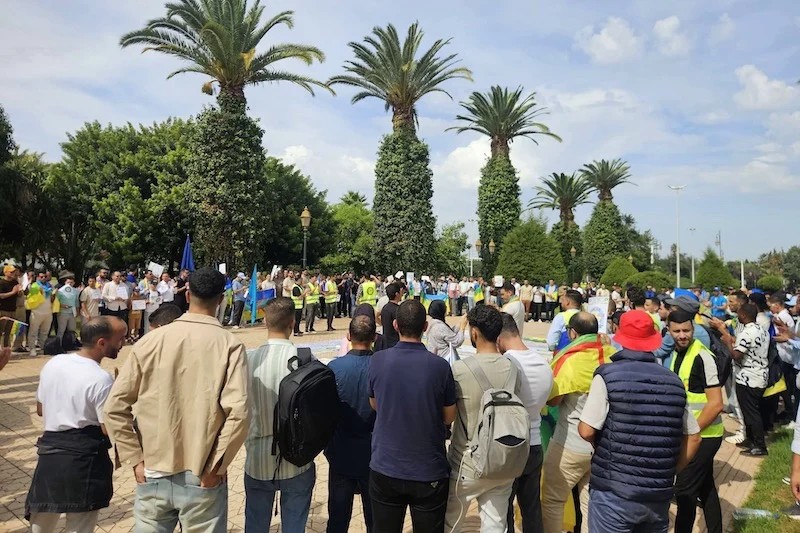
Teachers of the Amazigh language held a national sit-in on Sunday outside the central offices of the Ministry of National Education, Preschool and Sports in Rabat. The protest revives the debate over how Amazigh is taught in public schools, a program launched in 2003 that is still marked by shortcomings.
Organized by the National Coordination of Amazigh Language Teachers, together with several education unions and in the presence of civil society activists, the demonstration put forward a series of professional demands. Chief among them are an effective and fair rollout of the language, respect for the announced timetable and sufficient staffing. The Coordination also wants Amazigh taught in middle and high school, so that students can continue learning from one cycle to the next.
It is also calling for the number of classes per teacher to be cut from 8 to 4, for more weekly hours for the language, and for the necessary textbooks, teaching resources and classroom equipment. It demands training, supervision and inspection for specialist teachers, as well as equal access to the programs, projects and incentives available to other teaching staff. Finally, it asks for a clear regulatory framework for specialist teachers, covering timetables and the distribution of sessions and groups, and a dedicated room for the Amazigh teacher in every school, given the importance of the learning space.
In their speeches, representatives of the Coordination said the project to generalize Amazigh had been “born deformed” within the education system from the start, which in their view calls for urgent action to put it back on track. They argued that their demands go no further than what the law provides and that the program is marked by “blatant overreach and violations” of the rules governing it.
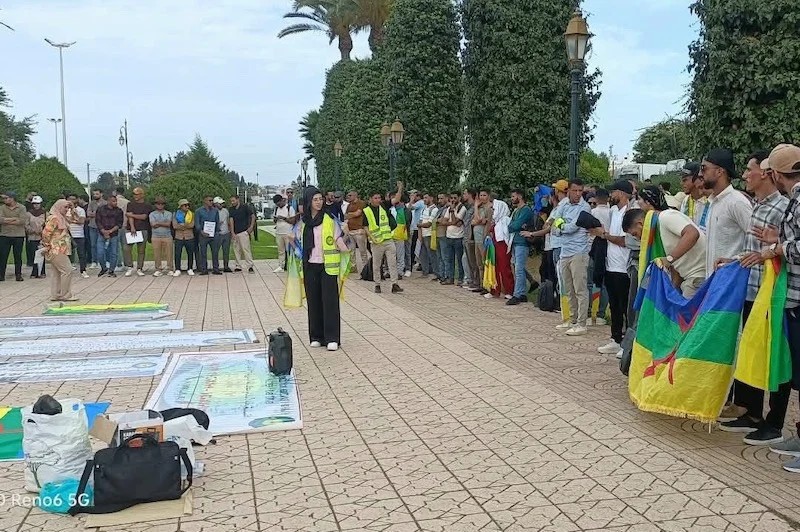
Protesters criticized measures such as “arbitrary redundancy declarations” and redeployments introduced by some regional academies and provincial directorates. They consider these decisions abusive, saying they strike at the heart of Amazigh teaching and undo gains made in recent years. Speakers also expressed surprise at the ministry’s shift toward “generalizing the teacher rather than the teaching of Amazigh.” Private schools are not required to teach this constitutional language, they noted, depriving some Moroccans of the right to learn it, while its exclusion from preschool education allows, in their view, “the spread of Arabization.”
Amina Waali, a member of the National Federation of Education (FNE), affiliated with the Democratic Labor Federation (FDT), criticized the ministerial circulars governing Amazigh teaching. In her view, the reality on the ground shows clear marginalization of the language compared with Arabic. She pointed to the absence of linguistic justice in the education system: Amazigh gets only 3 hours a week, against 12 for Arabic, which she said entrenches “discrimination and inequality in the treatment of the country’s two official languages.”
Waali added that the problem goes beyond unequal hours. Teachers are also overstretched by the number of groups assigned to them, two or more on average, which affects the quality of teaching. She urged the ministry to open recruitment and appoint new Amazigh teachers to fill the gap and ease the burden on current staff, rather than “relying on the current circulars, which have exposed clear shortcomings in the management of this program.”
Ali Daoudi, a member of the National Education Union affiliated with the Democratic Confederation of Labor (CDT), said the Amazigh question is “a sensitive national issue whose struggle is not yet complete.” In his view, Amazigh has not received real fairness even after its constitutional recognition, and the official handling of the issue still lacks genuine will to implement it. He added that the Amazigh teachers’ cause is an integral part of the broader struggle for education, calling for working-class struggles to unite in order to secure fairness and win all legitimate rights.
Arabic version | French version