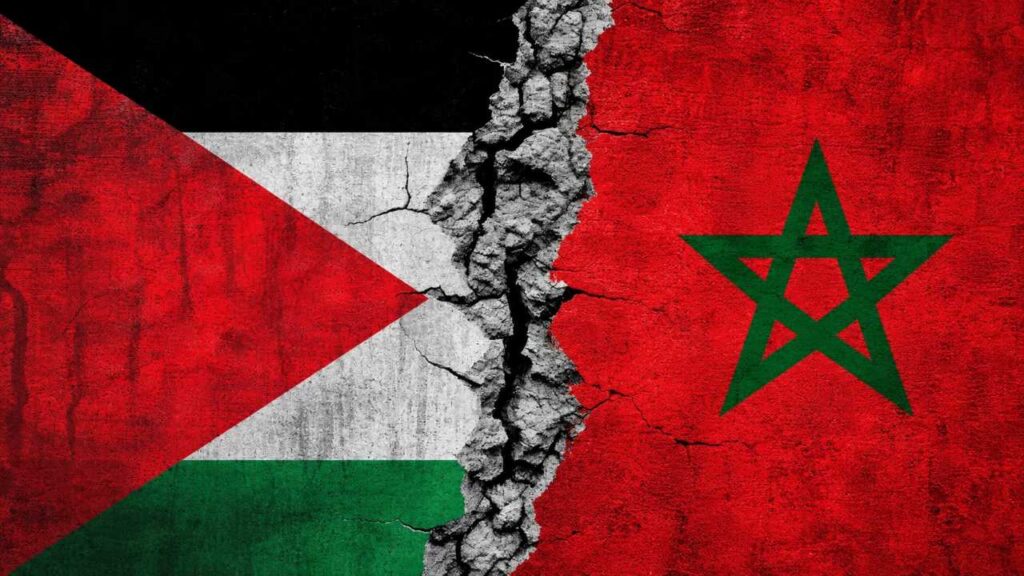
Chronology of Palestinian hostility toward Morocco’s territorial integrity
Palestinian positions hostile to Morocco’s territorial integrity:
1. The position of the leadership of the Popular Front for the Liberation of Palestine
1. The Popular Front for the Liberation of Palestine in Lebanon hosted El-Ouali Moustapha Sayed, the founder of the Polisario Front. This meeting led to several key outcomes:
The creation of a movement bearing the same name as the Palestinian front: the Popular Front for the Liberation of Saguia el-Hamra and Rio de Oro.
The adoption of the same leftist orientation as the Popular Front for the Liberation of Palestine.
The adoption of a flag nearly identical to the Palestinian flag, with the addition of a red crescent and star. This design was originally inspired by the flag of the Ottoman colonial power, from which the Algerian entity—itself an instrument of French colonialism—also derived its emblem. This illustrates the Palestinian role in the creation of the separatist Polisario Front.
2. George Habash delivered a speech on February 27, 1980, during a visit to Tindouf, in which he stated:
“O masses of our heroic Sahrawi people, in the name of the masses of our Palestinian people and in the name of the Palestinian revolution, I salute your struggle, your heroism, and your faith in your just cause. I also salute your battles against the treacherous puppet monarchical regime in Morocco. We have followed your heroic struggle against the puppet and traitor King Hassan, and we, within the Palestinian revolution, consider the puppet Hassan II to be as much our enemy as he is yours.”
3. The Popular Front for the Liberation of Palestine sent a delegation to the Tindouf camps on April 20, 2021, to support the Polisario Front. The delegation was led by Abu Ali Hilal, the Palestinian front’s deputy representative in Algeria, accompanied by Mohammed Alian and Abu Zubaydah, the general coordinator of the Palestinian Youth Organization. During this meeting, the Palestinian delegation compared Morocco to the Israeli occupation of Palestinian territories. They reiterated their unconditional support for the Polisario Front’s struggle and expressed their readiness to provide solidarity until independence. Upon arrival, members “chanted slogans calling for the victory of the Polisario Front and the freedom of the Sahara, labeling Morocco an occupying country.”
2. Palestinian involvement in the conflict and the toll on Moroccan victims
1. Palestinians participated alongside the Polisario Front in the war against Morocco in the Sahara. They provided military training in Tindouf and offered diplomatic support in international and regional forums.
2. Military support for the Polisario Front continues today in Tindouf from Hezbollah, Hamas, and Iran, particularly in the excavation of tunnels in the Moroccan Sahara. Consequently, Palestinian hands are stained with the blood of those who died for Morocco’s territorial integrity, alongside Algerians, Libyans, Egyptians, Syrians, Lebanese, and others.
3. Moroccan prisoners in Tindouf have recorded their testimonies—most notably the pilot Idriss Zaïdi in his book Escaping the Snake’s Mouth, pilot Ali Ottman in Prisoner of War, and pilot Ali Najib in 25 Years in the Jails of Tindouf. They recount frequent visits by Palestinians who went out of their way to humiliate Moroccan detainees, used the worst slurs to describe the Moroccan state, and proclaimed their total support for the Polisario Front.
3. Yasser Arafat, President of the State of Palestine, April 21, 1987
Yasser Arafat invited Mohamed Abdelaziz as a guest to the meeting of the Palestinian National Council in Algiers on April 21, 1987. He welcomed him warmly and invited him to address the assembly. During his speech, while Arafat applauded warmly and laughed, Abdelaziz declared: “The Sahrawi people suffer from Moroccan occupation exactly as the Palestinian people suffer from Israeli occupation.” Following this incident:
The Moroccan representative withdrew from the meeting.
Only hours after the incident, King Hassan II delivered a famous speech in Moroccan Arabic (Darija), in which he stated:
“We have given orders to all our representatives, whether official or unofficial, whether they represent political parties or other bodies, that if they attend an international ceremony and a Palestinian stands up to speak about Palestine, they must immediately leave the meeting.
And I say this, not as a threat, but as the conscience of Moroccans: if a Palestinian stands up to speak about Palestine and a Moroccan remains seated, then, to avenge the souls of our martyrs who were insulted and compared to Zionists, the door of his house will be smeared with that thing which shall not be named.”
4. The position of Mahmoud Abbas, President of the Palestinian Authority and Fatah
In September 2020, the Palestinian Fatah movement published a map of Morocco on its official website that excluded the Sahara, persisting in its official hostility toward Morocco’s territorial integrity and national unity.
In 2022, Mahmoud Abbas attended an Algerian military parade in Algiers, where he shook hands with the leader of the Polisario Front and seated him next to him on the podium as a mark of recognition.
5. The position of Kamil, member of the Palestinian National Council
Kamil, acting as a representative of the Palestinian National Council to the European Union, stated:
“I have the honor to defend the noble and upright cause of the Sahrawi people, who suffer, just like the Palestinian people, from tyranny, cruelty, apartheid, exile, forced displacement, and population transfer, and to defend the sanctity and justice of the Sahrawi people’s righteous cause.”
6. Hanan Ashrawi, July 28, 2015
Hanan Ashrawi, a member of the Palestine Liberation Organization, stated on July 28, 2015:
“Morocco occupies Western Sahara, the struggle of the Polisario Front is a just struggle, and the Sahrawi people are the twin of the Palestinian people in the struggle for liberation.”
7. The Palestinian Embassy in Algeria
The Palestinian Ambassador to Algeria told the media in November 2020 that he “supports the demands of the Polisario Front regarding its right to self-determination and the independence of its Sahrawi Arab state.”
When questioned by an Algerian newspaper about the position of the Palestinian Ambassador in Rabat, he further claimed that his country’s position on the Sahara issue is expressed by the Palestinian Ministry of Foreign Affairs, not by the embassy in Rabat.
The Palestinian Ambassador also makes a point of attending Polisario Front gatherings in Algeria and taking commemorative photos.
8. The Palestinian Embassy in Morocco
The Palestinian Embassy in Morocco has sought to maintain a vague and “gray” position on the Sahara issue, justifying Palestinian stances that are hostile to Morocco’s territorial integrity. In 2020, when questioned about statements made by the Minister of Youth and the Ambassador to Algeria, Jamal Choubaki claimed that “Moroccans misunderstood the position of the Palestinian Ambassador in Algeria and that only the Palestinian Ministry of Foreign Affairs is competent in this matter.”
9. Jibril Rajoub, Palestinian Minister of Youth and Sports, July 2023
Jibril Rajoub stated, while appearing as a guest on an Algerian television channel following the Palestinian team’s participation in the 15th Arab Games in Algeria:
“A referendum is the only solution to the Sahara issue to determine its affiliation with Morocco or Algeria, and not the Polisario Front. There is a symphony composed by the Americans and Israelis to integrate Israel into the Middle East and North Africa region to bypass the Palestinian cause, which has led to normalization in the Gulf and North Africa.
Likewise, relying on Israel, or even the United States, for the Sahara to become Moroccan cannot be a source of strength and never will be.” He added that “the Algerian position, which relies on a referendum and dialogue with brothers while excluding and distancing the enemies of Algeria and Morocco, is the correct option and approach.”
10. The Palestinian Ministry of Foreign Affairs
1. The Palestinian Minister of Foreign Affairs was recently questioned regarding statements made by the Minister of Youth and the Palestinian Ambassador to Algeria. He responded:
“The statements made by the Minister of Youth and the Palestinian Ambassador to Algeria represent only themselves; Palestine supports Morocco’s legitimate borders.” However, he failed to specify the nature of these borders. Does this refer to Morocco without its Moroccan Western Sahara, including it, or perhaps including its Moroccan Eastern Sahara and the northwestern territories annexed from Morocco during Ottoman and French colonial rule?
He further added that “the restoration of relations between Morocco and Israel constitutes a stab in the back for the Palestinian cause, the Islamic nation, the faith, and the Palestinian people, as well as a violation of Arab summit resolutions.”
2. The Palestinian Ministry of Foreign Affairs, on May 24, 2024, published a map of Morocco on its official website that excluded the Western Sahara.
Following a campaign by “Free Amazigh Moors” denouncing this hostility toward Morocco’s territorial and national integrity, the ministry eventually removed the map ten days later. However, instead of correcting it, they simply deleted it without providing any explanation or justification. This attitude suggests a posture of: “Either I publish a truncated map, or I publish nothing at all.” Such behavior is reminiscent of a spoiled child acting on a whim, without any accountability, within their Arab-Islamist backyard.
3. The Palestinian Ministry of Foreign Affairs also published a list of states it recognizes on its official website on May 24, 2024. This list included what it calls the “Sahrawi Arab Democratic Republic.”
Eleven: Khaled Mechaal in 2023
Khaled Mechaal took the liberty of undermining Moroccan sovereignty and the Moroccan people by addressing them directly via videoconference. This intervention was facilitated by his “Muslim Brotherhood” allies in the Justice and Development Party (PJD) and its ideological wing, the Unity and Reform Movement (MUR). The speech took place during a solidarity event for Palestinians organized at the Mohammed V Theater in Rabat, following the restoration of relations with Israel. He stated:
“The senior Moroccan leadership, embodied by the King, is involved in normalization.”
With these words, he attempted to exonerate the PJD—which had actually signed the agreement to restore relations with Israel—and to reclaim a lost political legitimacy in the eyes of the public at the expense of the state and Moroccan national and territorial unity.
He called on Moroccans to protest against the decision to restore ties with Israel, a decision that the PJD itself had initialed. Notably, Mechaal did not dare to deliver such a speech regarding other countries that have also normalized relations, such as Qatar, Egypt, the United Arab Emirates, Jordan, Oman, or Bahrain.
Twelve: Position of the Palestinian Youth Organization in 2021
1. The General Coordinator of the Palestinian Youth Organization, Mahmoud Abu Zubaydah, visited the Tindouf camps on April 20, 2021. During his visit, he asserted that “Morocco is an occupier, just like the Israeli occupation of Palestinian territories,” and declared his support for the Polisario Front’s struggle for independence.
2. The Palestinian Youth Organization issued a statement supporting the Polisario Front’s right to self-determination following the visit of its president, Mahmoud Abu Zubaydah, to Tindouf on April 20, 2021. The text denounced the UN’s perceived bias in favor of Morocco and supported the Polisario Front’s “quest for liberation,” thereby adopting the State of Palestine’s hostile stance toward Morocco and its citizens.
Thirteen: Palestinian Committee of Solidarity with the Sahrawi People in 2023
The president of the Palestinian Committee of Solidarity with the Sahrawi People, Mohamed Ahmed Madi, stated during a visit to Tindouf: “The independence of Palestine passes through the independence of Western Sahara from Moroccan occupation.”
He also established an official website to publicize his committee’s activities in support of the Polisario Front.
Fourteen: International Palestinian Movement for Peace in 2023
The president of the International Palestinian Movement for Peace, Hala Palestine, affirmed during a visit to Tindouf her “absolute solidarity with the Polisario Front,” while labeling Morocco an “occupier.”
Fifteen: Association for the Defense of the Rights of the Displaced
This association, based in Nazareth, Israel, raises the flag of the Polisario Front militia every year as a sign of solidarity. This gesture has been repeated since 1998 during marches organized by descendants of displaced persons, known as the “Return Marches for Palestinians of the Interior and the Diaspora.”
In light of this inventory of hostile and converging positions from various institutions of the State of Palestine and its civil society against Moroccan territorial integrity—unconditional support for the separatist Polisario Front that can no longer be masked by “taqiya” or facade diplomacy—Tamunt for Liberties declares:
It supports both the Palestinian and Israeli peoples from a humanitarian perspective, in accordance with international conventions and treaties, in the hope of ensuring that all have the right to live in security and stability on their land.
It calls on the United Nations to work toward establishing guarantees of mutual trust between the two parties to the conflict, so they may sit at the negotiating table and agree on a mutually acceptable solution under UN auspices. It is crucial to move away from those who have transformed this cause into a business interest they refuse to see resolved, even resorting to terrorism. This particularly concerns Arab nationalists who view the conflict through a racial lens (Arab vs. Hebrew/Zionist), Islamists who perceive it as a religious conflict (Islam vs. Jew/Sionist), and the left which analyzes it as an ideological clash (Socialism-Communism vs. Imperialist Capitalism).
It invites the political and civil institutions of the Palestinian people to revise their position on Morocco’s territorial and national unity. They must exit this zone of hostility by ceasing all military, diplomatic, and political support for the separatist Polisario Front militia, which threatens the security, stability, and permanence of Morocco.
It urges the Palestinian Authority to recognize the Moroccan sovereignty of Western Sahara, following the example of Israel and other partner and friendly nations, rather than remaining in the posture of a hostile state due to its opposition to Moroccan integrity.
It calls on the Moroccan state to suspend direct financial support to the Palestinian Authority and to reduce diplomatic relations to the strict humanitarian minimum until the Authority publicly and effectively revises its positions on the Kingdom’s territorial unity.
It encourages the state to strengthen and consolidate its relations with the State and people of Israel, and to build further partnerships in the scientific, military, agricultural, commercial, and economic fields.
It requests that the state block foreign powers that exploit the issue of Moroccan territorial integrity in their bilateral relations with Morocco while displaying contradictory positions within regional and international organizations, such as Egypt, Tunisia, and others.
It reaffirms that national and territorial unity is a red line, in both deeds and words, for all political, labor, and civil institutions. This is an area where citizen education and awareness must be exercised, rather than a tactic for ideological posturing aimed at expanding a popular base, restoring legitimacy, or spreading totalitarian thought destructive to historical borders, nations, languages, and cultures.
It invites the Moroccan people to make their vital and strategic causes the absolute priority, as these currently constitute the major obstacles to economic growth and human development. It is imperative to support those who support us and to oppose those who are hostile to us, according to the principle of reciprocity, rather than remaining locked in blind emotional support that borders on betrayal toward those who seek to divide our land.
It emphasizes that as a people, we are unwavering in our humanitarian solidarity with all just causes worldwide, including the Palestinian cause. However, we are uncompromising in the defense of our homeland’s national and territorial unity, to the point of regarding the enemies of our integrity as our own enemies, whoever and wherever they may be.
Arabic version | French version
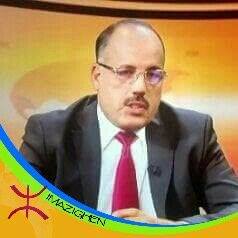
National coordinator of the preparatory committee for the planned Tamount Party for Freedoms, a party with an Amazigh frame of reference.