Why Don’t I Write in Amazigh When Mr. Himmich Writes in Arabic?
Having exhausted their traditional weapons—divisiveness, racism, hostility toward Islam, allegiance to colonialism, and the like—which they used to combat the Amazigh language and demonize its supporters, opponents of the cause have shifted tactics. Realizing that these rusty arguments could no longer halt the progress of Amazigh rights demands, they unleashed a new weapon: challenging Amazigh advocates to conduct their activism through writings in the Amazigh language rather than relying on Arabic. The aim of this challenge is to convince the public that if Amazigh activists themselves cannot write in their own language—which they relentlessly demand be made a mandatory subject in schools to establish it as a written language—it must simply be unsuitable for writing. Were this not the case, they claim, these activists would have proven it by writing their articles and analyses in Amazigh. According to this logic, how could these activists reasonably demand that other “Arab” Moroccans achieve what they themselves cannot: learning to write in a language they have not mastered in written form?
This approach to the written use of the Amazigh language stems from a simplistic view held by uncritical minds that fail to distinguish between the conditions governing oral language use and those governing written use. Mistakenly believing these conditions to be identical, they conclude that a language not commonly written by its population suffers from an intrinsic defect preventing it from achieving written status. They thus imagine that Amazigh is destined never to become a written language, claiming it inherently possesses the flaws causing this limitation. Because this is a popular misconception peddled by uneducated individuals, advocates for mandatory Amazigh education have rarely bothered to debate or refute it. However, when an intellectual, thinker, philosopher, novelist, and former minister arms himself with such simplistic reasoning to attack the Amazigh language and its advocates, it is deeply regrettable. Such an attitude undermines culture, thought, philosophy, literary creation, and the ministerial role itself, even before it harms Amazigh and its defenders.
Yet that is precisely what Mr. Bensalem Himmich did in an article published online on June 25, 2018. He claimed that the Amazigh activist Ahmed Assid “reaps the harvest while cursing the religion”—insinuating that he writes in Arabic while pretending to reject the language—and abandons “the implementation of the official status of Amazigh, which he constantly demands from morning till night.” Mr. Himmich concluded that “logic dictates he should lead by example by writing in the Tifinagh script himself,” before issuing this challenge: “Let our friend hasten to start writing articles in Tifinagh, and we will be the first to applaud him warmly if he succeeds […] But if he proves incapable of meeting this challenge, the fault and blame will rest entirely on him.”
The question posed by Mr. Himmich to challenge advocates of elevating the Amazigh language to a written language is as follows: why do they not write their articles in the Amazigh language rather than Arabic, in order to set an example and prove that this language is fit for written use? The answer to this question lies in the response to another simple question that we, in turn, ask Mr. Himmich: why does he write in Arabic himself? The answer is self-evident: because he studied and learned Arabic in school over many years, mastering its script, spelling, and grammar—bearing in mind, as Mr. Himmich knows all too well, that some study it for decades yet continue to make glaring mistakes. Following this logic, the answer to his first question regarding why advocates do not write in Amazigh becomes equally obvious: they do not write their articles in the Amazigh language because they were never taught it in school as Mr. Himmich was taught Arabic. Consequently, they have not mastered its script or its orthographic and grammatical rules. Therefore, like Mr. Himmich, they write in the languages they studied in the classroom for years—namely Arabic or French.
The matter of writing is therefore inseparable from schooling and formal education—a reality that holds true for all languages, not just the Amazigh language. While anyone can pick up the spoken form of a living language used in daily life in the street, at home, in the market, or at work, it is strictly impossible to learn its written form without going through the school system. The fundamental prerequisite for writing in the Amazigh language is thus teaching it in schools. Logic dictates that Mr. Himmich should examine the reasons behind the exclusion of the Amazigh language from the educational system, rather than wonder at the absence of written works among its defenders—an absence that is nothing more than the direct result of that very exclusion.
The sheer simplicity and obviousness of the answer to Mr. Himmich’s question are precisely what place it on the level of basic common sense and popular thinking, as noted earlier. Yet, whenever Amazigh identity is concerned, it is these simplistic, empirical notions, devoid of any scientific rigor, that hold sway among the majority of Moroccan intellectuals. Professor Himmich provides a striking example of this, embodying the dominance of lay discourse over rigorous scientific analysis whenever taking a stand on the Amazigh issue.
On the other hand, this simplistic question regarding writing in the Amazigh language reveals the deep disillusionment of the proponents of Arabization, who relied on the Arabized school system to engineer an identity shift among Moroccans who had preserved their Amazigh heritage and language. Since the school system was viewed as the ideal instrument to orchestrate this metamorphosis of Moroccans—transitioning them from their original Amazigh identity to a borrowed Arab identity—the planned disappearance of the Amazigh language was supposed to be a mere matter of time: the time it would take for every Amazigh child to cross the threshold of a school devoid of the Amazigh language and emerge fully “Arabized,” transformed in their national affiliation. However, events took a turn diametrically opposed to the forecasts of those strategizing the eradication of Amazigh identity. Instead of bringing about the extinction of the Amazigh language and identity—by transforming students into “Arabs” proud of their “Arabness,” their “language,” and their “noble genealogy”—the school system produced generations of Amazighs who use that very same Arabic language to defend their identity, demand its promotion, and insist on its rehabilitation. The advocates of Arabization, who expected Arabic to drive Amazigh-speaking students to disown their identity, reject it, and combat it, are dying of disappointment. Imagine their astonishment upon realizing that these students, now adults, use the Arabic language not to repudiate their Amazigh identity, but to embrace it firmly and campaign for its official recognition, its teaching, and its integration into state institutions. Thus, Amazigh activists turned the Arabic language—which the ideologues of Arabization relied upon to uproot them—into a weapon captured from the enemy during this battle of assimilation. They brilliantly mastered its use to defend Amazigh identity, thwart the proponents of Arabization, and defeat their plans aimed at severing Moroccans from their roots to turn them into “fake Arabs” stripped of their authenticity and identity dignity. This is what deeply unnerved these proponents of identity transformation: while they expected the Arabic language to shape alienated individuals in their own image, these individuals instead became conscious of their Amazigh identity, discovered it, cherished it, and attached themselves to it more than ever through that very same Arabic language. This completely reshuffled the deck and derailed the calculations of the champions of Arabization, striking them head-on with their own weapon and placing them under fire from their own guns.
Confronted with this setback, delivered by the very weapon meant to permanently extinguish Amazigh identity, they have resorted to an absurd and futile form of blackmail against activists advocating the teaching of the Amazigh language for its official written use: either they write in the Amazigh language, or their language is unfit for writing, claiming they fall into a glaring contradiction by demanding its institutional use while allegedly being incapable of drafting a short article in it. Imagine a hostile group cutting out a person’s tongue and then challenging them to speak, on pain of being labeled mute and incapable of expression. That is the true nature of the blackmail that Mr. Himmich and other Amazighophobic intellectuals attempt to exert on supporters of the Amazigh cause. After banning the Amazigh language from schools—an indispensable prerequisite for preparing any language for writing, as I have already explained—they demand that defenders of the cause write in that language, claiming that failing to do so proves it is flawed, ineffective, and unsuitable. How can anyone decently demand that a man whose tongue has been cut out speak, only to accuse him of being helpless and incapable of speech if he cannot?
Such is the reality of the question of writing in the Amazigh language, which Mr. Himmich uses in an attempt to blackmail activists for the Amazigh cause. As for the rest of his prose, it is nothing more than a tedious rehash of the Amazighophobic literature of the 1970s, which no longer sways even the most fierce opponents of Amazigh identity. His entire rhetoric feeds on the myth of the “Berber Dahir,” to which Mr. Himmich insisted on making explicit reference, thus reminding us that this decree forms the conscious and unconscious foundation of his analytical framework, judgment, and stance toward Amazigh identity.
Arabic version | French version
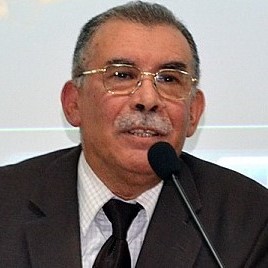
Mohamed Boudhan was an Amazigh writer, thinker, researcher and activist from the Rif, and publisher of the newspaper Tawiza. He was the author of many valuable books and articles on Amazigh identity. May he rest in peace.