Mohamed Mounib and the End of the “Berber Dahir” Myth
As is widely recognized, Mohamed Mounib’s life was defined by a wealth of significant works, achievements, invaluable contributions, and principled struggles. It would be an injustice to attempt to encapsulate such an exceptional personality in a mere few minutes. Therefore, in this eulogy, I will limit myself to recalling the one achievement that made him as famous as “a fire atop a mountain,” as the Arabic proverb goes: his book, The Berber Dahir: The Greatest Political Lie of Contemporary Morocco, for which I had the honor of writing the preface.
The younger generation within the Amazigh movement may not fully grasp the extent to which this work was a revolutionary event—a profound upheaval and a unique historical milestone—when it was first published in 2002. They may be unaware of its impact because they did not experience the political blackmail that the “Berber Dahir” once imposed on the Imazighen. Nor did they witness the encirclement, repression, and demonization of Amazigh identity—practices that have receded significantly since the publication of Mounib’s book. Before this work, the “Berber Dahir” served as a terrifying ogre used to intimidate the Amazigh people. It was brandished like a drawn sword to threaten anyone who expressed sympathy for Amazigh identity, defended it, or sought its formal recognition. Mohamed Mounib ended this blackmail, slew the ogre, and shattered the sword that had long hung over the necks of the Imazighen.
Using rigorous arguments, evidence, and primary documents, the book demonstrated that this “Berber Dahir” was a lie in the most literal sense. The gravity of this deception lay in how its inventors successfully anchored it as an absolute truth. It was believed not only by those hostile to Amazigh identity but by the Imazighen themselves, despite being the victims of the imposture. This was evident in how they used to respond to those who brandished the “Berber Dahir” boogeyman: they would argue that the Imazighen were innocent of the “sin” of the Dahir, that they played no part in its drafting or application, and that blame should rest solely with the French Protectorate authorities. By using this defense, the Imazighen were essentially confirming they did not doubt the myth’s existence; they were merely refusing to accept responsibility for it.
Consequently, they were double victims of this lie. They were accused of being Christianized by colonial powers and weaponized to undermine Islam and divide Morocco on racial lines, while simultaneously coming to believe that colonialism had indeed attempted to do so. In his book, Mounib proves that not only are the Imazighen innocent of these accusations, but that the colonial administration itself was “innocent” of creating the “Berber Dahir” myth. The myth has no basis in the actual decree of May 16, 1930, whose content and purpose differed entirely from the “Berber Dahir” narrative constructed by the Movimiento Nacional. While the actual decree of May 16, 1930, ceased to apply when the Protectorate ended and Morocco gained independence, the “Berber Dahir” myth only truly began to be implemented after independence. This was seen in the demonization of Amazigh identity and its association with colonialism, division, and anti-Islamic sentiment. Mounib’s book revealed that the “Berber Dahir” was neither French, nor colonial, nor Sultanian; rather, it was a “national” Dahir—fabricated by the instigators of the “Latif” prayers who would form the Movimiento Nacional. For them, this manufactured myth served as their official and historical birth certificate.
Once it is established that this “Berber Dahir” is nothing but a lie, invention, and falsification, the first consequence is that what is known as the “Movimiento Nacional” was built upon a foundation of lies, invention, and falsification. The second consequence is that “patriotism,” as a political and ideological concept born in Morocco in the 1930s under the impetus of this same “Movimiento Nacional” in reaction to its own “Berber Dahir,” was also founded on lies, invention, and falsification. It is a patriotism of lies, invention, and falsification. By exposing the reality of these elements of deception upon which the “Movimiento Nacional” was constructed and its alleged “patriotism” was based, Mohamed Mounib reveals the greatest swindle in Moroccan history: one that saw liars, fabricators, and forgers transformed into patriots and heroes, upheld as benchmarks of patriotism, sacrifice, and jihad, even though their “patriotism,” “jihad,” and “sacrifices” are nothing but pure deception, trickery, falsification, and invention.
There is no doubt that the disciples of these fake patriots—who perpetuate this same falsified and fallacious patriotism stemming from the “Berber Dahir” lie—are today feeling deep unease in the face of the shocking truths contained in Mohamed Mounib’s work. This explains why, since the book’s publication, they no longer commemorate the anniversary of their “Berber Dahir” as they had habitually done since independence, when they organized symposiums to showcase their imaginary “heroic acts” and devoted lengthy features in their newspapers to the glory of their deceitful defense of the nation and Islam against their “Berber Dahir.”
The book demonstrates that the motivation of the “nationalist” elite in inventing the “Berber Dahir” was neither opposition to colonialism, rejection of Protectorate policy, nor a protest against laws contrary to Sharia. As proof, colonialism officially entered Morocco in 1912 without ever facing opposition from these urban elites—the authors of the “Latif” prayer protests—who had, on the contrary, welcomed it with fervor and honors. Protectorate policy had already lasted 28 years without being contested by these elites, who benefited from and collaborated with it. Furthermore, hundreds of French laws of positivist inspiration, contrary to Islamic legislation, had been applied in Morocco since 1913 without sparking the slightest desire to defend Sharia among these city-dwelling families. In reality, the purpose of this myth was not to harm colonialism but to target Amazigh identity and the Amazigh people themselves, by claiming that France was using them as an instrument of division and a weapon against Islam. Through this lie, Amazigh identity became, in the collective imagination, synonymous with division, racism, colonialism, and proselytization, thus justifying its demonization and persecution in the name of fighting separatism.
Further proof that hostility toward Amazigh identity and the Amazigh people constitutes the only true Amazighophobic driver behind this “Berber Dahir” imposture lies in the very name given to the text: the “Berber Dahir.” They associated it with the term “Berber,” a foreign and pejorative designation. Yet, if the objective of this machination had truly been to protest against the occupation and its policies, it would have been entirely logical and natural to name the decree the “Colonial Dahir,” the “French Dahir,” the “Proselytizing Dahir,” the “Christian Dahir,” or even the “Racist Dahir.”
Furthermore, Mohamed Mounib’s book reveals a little-known fact: most of the “Latif” authors involved in creating the myth of the “Berber Dahir” benefited from the system of “individual protections.” At the time, this status meant that a foreign power treated the protégé as its own citizen, subject to its authority and laws, thereby placing them completely outside the sovereignty and jurisdiction of the Moroccan state. Consequently, the Makhzen could neither arrest a protégé who had committed a crime, search their home, nor force them to pay taxes in Morocco. Even the protectorate authorities could not prosecute these protégé authors of the “Latif” for inciting protests against the ruling power. International agreements only allowed complaints to be filed with the consulate of the protecting power, so that it would apply its own law rather than French or Moroccan law. All of this proves that these individuals had renounced their Moroccan nationality in favor of a foreign allegiance. Needless to say, the concept of “protégé,” in its political and legal sense at the time, was synonymous with treason and conspiring with a foreign power against Morocco.
In conclusion, these protégés were not merely devoid of patriotism; they were traitors acting against their own country. Paradoxically, through the invention of the “Berber Dahir,” they became symbols of nationalism. This is precisely what Mohamed Mounib’s book exposes and brings to light. The work achieves a true Copernican revolution regarding the supposed patriotism of the “Latif” authors. Whereas they had succeeded in convincing Moroccans that they were exemplary figures, the book provides irrefutable proof that they embodied a lack of national consciousness, not to say treason. It does justice not only to the slandered Amazigh people, but also to history itself by stripping away the lies that the “Latifians” had elevated into sacred dogmas. By revealing the truth and lifting the veil on the deception, this book is revolutionary in the sense Lenin meant: nothing is more revolutionary than the truth.
Thank you, great Mohamed Mounib, a noble and authentic man. You refused to depart before driving out those who oppressed us through slander. You left us only after delivering us from the treachery of liars and impostors, after separating truth from falsehood and reality from fabrication. You faded away only after sweeping aside those whose presence prevented our own. You rested only after freeing us from the nightmare that weighed upon us, slaying the monster that terrified us. You will go down in history as the one who marked the end of the “Berber Dahir” myth, the one who defeated it and put a definitive end to it.
(This article was originally an address delivered by the author at the tribute ceremony held on April 7, 2018, in Agadir in memory of the late Mohamed Mounib, author of the book “The Berber Dahir: The Biggest Political Lie in Contemporary Morocco,” who passed away on December 3, 2017.)
Arabic version | French version
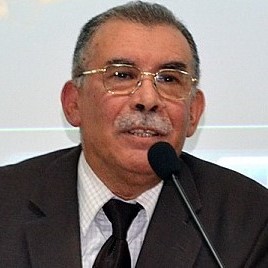
Mohamed Boudhan was an Amazigh writer, thinker, researcher and activist from the Rif, and publisher of the newspaper Tawiza. He was the author of many valuable books and articles on Amazigh identity. May he rest in peace.