Why I fly the Amazigh and Rif flags, but not the Moroccan flag
Many Moroccans reproach the protesters of the Rif Hirak, those showing solidarity with them in various Moroccan cities, and activists of the Amazigh Movement for the absence of the Moroccan national flag during their rallies. They also take issue with the prominent presence of the Amazigh flag and the historic flag of the Republic of the Rif, particularly in demonstrations held in the Rif region. Yet, many are well aware of exactly why the national flag is not carried during these marches and already know the answer to the question posed in this title. Nevertheless, driven by bad intentions, they deliberately dramatize the absence of the Moroccan flag to speculate on the nature of these protests and to demonize the participants. They suggest—and incite others to believe—that the absence of the national flag reflects a lack of patriotism. This reflection on the issue of flags is therefore not addressed to these malicious actors. It is intended exclusively for well-meaning Moroccans who, unfamiliar with the reality of the situation, might believe that flying any flag other than the Moroccan one is a call for secession from the homeland it embodies. It is for this reason that they often label the Amazigh and Rif flags as “separatist banners.”
We will examine this subject through several lenses: the distinction between nationality and identity; the Rif flag; the focus on economic integration at the expense of historical and identity integration; the reality versus the myth of separatism; the historical origins of these three flags; and finally, which of these flags actually warrants the “separatist” label.
Between nationality and identity
To ensure our debate is serious and objective, free from clichés and prejudice, we must distinguish between the concepts of nationality and identity as they relate to flags. Nationality is a legal bond between individuals and the state to which they belong as citizens. It is manifested and exercised through one’s status as a citizen of that state. Each country’s national flag represents its nationality and serves as its symbol. To acquire a state’s nationality is to acquire membership in that state, which is embodied in citizenship. For example, a foreign resident in Morocco is not a Moroccan citizen because they do not hold Moroccan nationality. However, if they acquire it by meeting the necessary requirements, they become a full Moroccan citizen. Nationality, therefore, is the credential of belonging to a specific state. All Moroccans hold Moroccan nationality; thus, they are all Moroccan citizens.
If this is the case, why do Amazigh Movement activists and Rif Hirak protesters not fly the Moroccan flag to express their belonging to the state of which they are nationals? Why not fly the symbol of that very connection?
The answer is quite simple: no one denies their belonging, nor does anyone contest their Moroccan nationality to the point that they would need to raise the flag to prove their status as citizens or to display it to those refusing to recognize them as such. A fitting illustration of this is the case of the late Abraham Serfaty. Throughout his exile, the Moroccan flag never left his side—starting from the moment Driss Basri stripped him of his Moroccan nationality and expelled him, denying his “Moroccanness” and claiming he was Brazilian. During that time, he constantly displayed the Moroccan flag. Why? To loudly and clearly reaffirm that he was a Moroccan citizen. Yet, before his nationality was revoked, Serfaty did not display or carry the Moroccan flag everywhere he went.
This explains the situation regarding nationality. As for identity—the understanding of which helps clarify why Imazighen do not fly the Moroccan flag and prefer other banners—it constitutes the bond between a people (rather than individuals, as with nationality) and a land (rather than a state, as with nationality) that serves as the permanent and ancestral homeland of that people. The identity of a people is thus manifested and exercised through their connection to the land or the home country, which precedes even their belonging to the state.
Since Moroccans are part of the peoples of North Africa—who form a single people despite being divided among several states where they remain the demographic backbone and the very pillar of the state’s existence—it follows that the collective identity of Moroccans is Amazigh. This identity should be understood in a territorial sense, rooted in the land and the homeland, rather than an ethnic one. Moroccans are part of the wider family of Amazigh peoples within Tamazgha, the Amazigh homeland. However, starting in 1912 and accelerating after 1956, a policy of political, ethnic, and ideological Arabization was implemented. This resulted in a wholesale shift in national belonging, rebranding Morocco as an Arab state and its people as an Arab people, often summarized by the term “Arab Maghreb.” For Moroccans who remain conscious of their heritage, raising the Amazigh flag expresses a refusal of this imposed identity shift. It is a rejection of the falsification of Morocco’s North African identity in favor of a usurped Arab one. Just as they do not feel the need to raise the national flag because no one contests their Moroccan nationality or their allegiance to the state, they display the Amazigh flag to signal to anyone who doubts Morocco’s heritage that they are Amazigh and that the country’s collective identity is Amazigh. This gesture is no different from that of the late Abraham Serfaty; after being stripped of his nationality, he brandished the Moroccan flag to proclaim to the world that he was Moroccan and not Brazilian. If the Moroccan state officially recognized that Morocco is an Amazigh country, with an Amazigh people and an Amazigh state, there would be no need to fly the Amazigh flag—indeed, there would be no need for its existence. This is why one does not see a specific pan-Arab flag flown by Saudis, Emiratis, or Kuwaitis: no one questions their Arab identity.
To claim that flying the Amazigh flag is a call for separatism that threatens national unity is the height of stupidity and ignorance. If this were truly an attempt at secession, who exactly would be separating from whom? Would the Amazigh Rif separate from the Amazigh Doukkala? Would Doukkala separate from the Amazigh Figuig? Would Figuig break away from the Amazigh city of Agadir, or Agadir from the Amazigh Casablanca? Would Casablanca separate from Amazigh Tangier, Tangier from Amazigh Marrakesh, or Marrakesh from Amazigh Smara? Given that Morocco is fundamentally Amazigh, from whom would the Amazigh people be seeking to separate?
Furthermore, the Amazigh flag is a symbol of identity not only for Morocco but for all the countries and peoples of North Africa. As previously mentioned, it is present in Algeria, Tunisia, Libya, Egypt (in the Siwa region), Mauritania, Mali, Niger, and the Canary Islands. It is not a separatist banner at all; rather, it is a rallying point that unites the various countries and peoples of North Africa. To label this symbol a flag of discord or separatism, as many do, reflects a profound and rank ignorance. If separatism is defined as the breaking away of parts from the whole to form autonomous entities, then it is the current national flags—such as those of Morocco, Algeria, Tunisia, or Libya—that actually embody this division. Each of these flags symbolizes the borders that isolate the Amazigh states of North Africa from one another. In contrast, the Amazigh flag, by its very uniqueness, transcends these borders to provide a common symbol for all these countries. It serves as a vehicle for connection and unity, rather than a tool for rupture or division.
The Rif Flag
While the unifying and rallying significance of the Amazigh flag remains clear and intelligible, the same cannot be said for the Rif flag. Recognizable by its six-pointed star, it served as the official emblem of the Republic of the Rif (1921–1926). Given that it was the flag of a republic whose authority extended over only a portion of Morocco, its exclusive appearance in the absence of the national flag is easily interpreted as a call for the creation of an independent political entity in the Rif, following in the footsteps of the republic it commemorates.
But does flying the Rif flag necessarily signify a desire for secession and nothing else? Why could it not simply be a tribute to the anti-colonial resistance led by the Riffians under that banner? Why not see it as a remembrance of the glories, heroes, and history of the Rif? Why not discern in it a tribute to the leader of that resistance and founder of the Republic of the Rif, Mohamed ben Abdelkrim El Khattabi (Moulay Mohand)?
If the deployment of the Rif flag appears more as a celebration of the region’s history, past achievements, and great men rather than a separatist demand, it is because this memory—due to its ties to the Republic of the Rif—remains marginalized, obscured, and subject to distorted or malicious interpretations. It is well-documented that the blockade surrounding the history of Mohamed ben Abdelkrim El Khattabi was accompanied, for nearly half a century, by an economic slump that kept the region in a deadly state of isolation. This is compounded by the memory of the criminal military campaign waged against the Rif in 1958–1959. Many Riffians perceive these actions as a form of vengeance for establishing the Republic of the Rif to confront colonizers, to whom the Makhzen had complacently abandoned the country.
Economic Development at the Cost of Continued Historical and Identity Marginalization
It must be acknowledged that under the reign of King Mohammed VI, many aspects of the relationship between the state and the Rif have evolved. The state’s interest in the region has manifested through investments, economic development, and infrastructure projects to break its isolation. This attention, which acts as an implicit recognition of the political marginalization the Rif previously endured, took on a reconciliatory dimension summarized by the phrase “reconciliation with the Rif.” However, the error lies in the fact that since the start of the new millennium, the state’s focus has been confined to material and economic aspects—as if man could live by bread alone—while neglecting the dimensions of identity, history, language, and collective memory. These elements have been neither rehabilitated nor valued during this process. Flying the Rif flag, much like the Amazigh flag, is a reaction to the lack of recognition for Riffian history, memory, identity, and language. To brandish this standard is to assert that memory and to challenge the blockade imposed upon it. If a genuine reconciliation with the history of the Rif and its anti-colonial struggle had been initiated—by properly integrating this history into school curricula, restoring Ajdir (the seat of the Republic of the Rif’s government) as a historical museum rather than leaving its ruins to decay as a form of symbolic spite, repatriating Moulay Mohand’s remains from Egypt to be buried in his capital, honoring the heroes of that epic, and declaring July 21 (the anniversary of the Battle of Annual) a national holiday—the need to fly the flag of the Republic of the Rif would vanish. When the causes disappear, the effects fade away. True reconciliation is not merely about building roads and airports or stimulating investment; it requires the liberation of Riffian history so it can become what it should have always been: a history belonging to all of Morocco and all Moroccans. It should be a source of shared national pride rather than a sidelined memory perceived as foreign. It is this very marginalization that has confined it to the Riffian people alone, who express their pride through the flag of their republic. Thus, if this flag represents a “separation,” it is the separation produced by political and ideological exclusion. This is the true “separatism,” and its source lies not with the Riffians, but with dogmatic Arabists obsessed with a fear of all things Amazigh.
The Reality of Separatism
It is curious to note that many Moroccan intellectuals and political leaders consistently link the Rif region to separatism. They readily apply this label to Rifans as if it were an indisputable truth, set in stone. I recall, for instance, the late Professor Mohamed Guessous—a leading intellectual figure—addressing a crowd of hundreds at the now-defunct Rif Cinema in Nador. Responding to speakers after a lecture on cultural diversity, he stated: “Yes, we are well aware that you want a Rifian republic.” If prominent intellectuals and politicians of the stature of the late Mohamed Guessous, who was a member of the political bureau of the Socialist Union of Popular Forces (USFP), held such a “separatist” view of the Rif, the general public can hardly be blamed for adopting the same stance and hurling the same accusations at Rifans. Repeated and hammered home, this accusation of separatism has become deeply embedded in the Moroccan political imagination. It is accompanied by charges of treason, demonization, the incitement of hatred, and hostility toward the people of the Rif. This has helped shape an “imaginary” separatism—a direct product of a preconceived political narrative. Because Rifans challenge these accusations and the accompanying slander and provocation by waving their Amazigh and Rifian flags, the proponents of this narrative use that very gesture as “proof” that their suspicions were correct. This is how an “imaginary” separatism, born of political fantasy, ultimately gives rise to a real one. This “reality” is then reflected in the range of security and political measures the state takes to counter this alleged “separatist” threat. A prime example is the accusations leveled by the government majority against the Rif Hirak, which served as the foundation for the prosecution’s indictment and the subsequent arrest of the movement’s activists. This is a well-known phenomenon in both sociology and international relations: your perception of the “Other,” even if contrary to reality, becomes factual through your concrete behavior based on that false representation. From that point on, you interpret their defensive reaction as evidence confirming your initial prejudice. The same logic applies to a state that, based on erroneous intelligence, believes its neighbor is about to attack and mass troops at the border. The neighbor responds in kind, mobilizing its own forces to protect its borders or even taking the initiative to strike first, following the principle that the best defense is a good offense. This behavior then provides the first state with the “proof” it needs to believe its neighbor always had hostile intentions. Thus, what began as a mere mental representation creates a concrete reality through tangible reactions. The exact same process occurs regarding the idea that Rifans are separatists. Because the state is convinced—based on its entrenched political imagination—that Rifans are separatists, it punishes them by marginalizing their region and ignoring their identity and history. The people of the Rif, seeing their identity and history banned and excluded, have no choice but to cling to them firmly as a defensive reflex, raising the Amazigh flag and the flag of the Rif to show pride in this heritage. In turn, those who accuse them of separatism see this cultural and historical attachment as further evidence validating their claims. This is how Rifans find themselves transformed into separatists: not because they are so in reality, but because the Moroccan political imagination manufactures their separatism.
The myth of separatism
As for genuine separatism—not the illusory kind forged in the political imagination, but a movement advocating the establishment of an independent political entity in the Rif separate from the motherland—it is an absurd myth that only the gullible could believe. What Riffian would choose to abandon Morocco—with its highways, modern universities, new hospitals, land and maritime wealth, and developed agriculture, a country that Riffians helped build alongside all other Moroccans through their labor, their taxes, and the sacrifice of their soldiers who defended its Sahara—just to isolate themselves in arid mountains that yield nothing but cannabis? In reality, such separatism is promoted and encouraged only by those who hold no affection for Riffians and wish to get rid of them in order to deprive them of Morocco’s wealth and keep a monopoly on it.
Admittedly, a group of Riffians—most of them activists in the Amazigh movement—is demanding autonomy for the Rif region, modeled on federal systems. Yet simply because this demand comes from Riffian Moroccans, who are viewed as separatists in the political imagination, it is immediately labeled separatist, even though autonomy within a federal state represents the pinnacle of genuine participatory democracy. Morocco itself has, in fact, declared its intention to grant autonomous status to the Sahara provinces. However, the Constitution avoided using the term “autonomy,” sidestepping the issue by referring instead to “advanced regionalization.” As for the Rif, it is clear that the regional boundaries drawn to implement this “advanced regionalization” were designed to dismantle the Rif as an entity endowed with human, geographical, historical, cultural, identity-based, and linguistic unity. That is precisely what drove the separation of Nador and Al Hoceima—an unjust decision toward the Rif that completely contradicts the foundations and principles of regionalization, especially when officials are fond of calling it “advanced.”
The historical origins of the three flags
Let us return to the issue of the flags and examine their historical origins to determine whether they carry a national or a separatist meaning.
As for the Amazigh flag, beyond being a symbol of unity bringing together all the countries of North Africa that share this same Amazigh identity—as explained earlier—it was designed by Imazighen from Algeria and Morocco. It is therefore a local and purely North African creation that expresses the collective identity of the region’s peoples. Consequently, it has no connection, either in its emergence or in its design, to any element foreign to North Africa, which rules out any claim that it is a separatist flag or a symbol of treason, colonialism, or foreign allegiance.
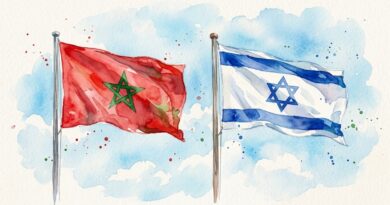
As for the flag of the Republic of the Rif, despite the ignorant claims labeling it separatist—on the grounds that it concerns a specific part of Morocco, the Rif, and did not symbolize the entire nation—it is an authentic Moroccan flag whose emergence and use predate the very existence of the Republic of the Rif. Indeed, its defining six-pointed star was not created by the Republic of the Rif in the early 20th century, but was known and used in Morocco as early as the 17th century as the distinctive emblem of the Makhzen’s banner. Given its widespread presence across the country, this star was regarded as a purely local and Moroccan product. It appeared consistently in gold and silverwork, jewelry, tattoo patterns, carpet designs, and numerous engravings and ceramics. That is why it is found minted on Moroccan currency even after the establishment of the French protectorate, just as it remained at the center of the official Makhzen flag until November 17, 1915. Moreover, the 1924 edition of the French dictionary Nouveau Petit Larousse illustré features an illustration of the Moroccan flag showing its red color and its six-pointed star in the center. Thus, Mohammed ben Abdelkrim El Khattabi’s choice to adopt a flag bearing this six-pointed star for the Republic of the Rif falls within the continuity of the use of this historic Moroccan symbol and reflects his desire to preserve an authentic Moroccan tradition.
As for our current national flag, with its five-pointed star, it was entirely foreign to Morocco, its people, and their history prior to November 1915. Moroccans had never known or used a flag adorned with a five-pointed star. Thus, while this new flag—which appeared in 1915—is today our national symbol, demanding our pride and our duty to protect and defend it, the truth is that it is a colonial product, chosen and imposed by Marshal Lyautey. The latter promulgated the Dahir of November 17, 1915, in the name of Sultan Moulay Youssef, decreeing that the Moroccan flag would henceforth bear a five-pointed star to distinguish it, replacing the six-pointed star that had been known and used until then. The justification provided in the Dahir to legitimize this modification claimed that “the flag of our holy ancestors resembles certain flags, notably those used for maritime signals.” This was clearly a fallacious and unconvincing pretext. Why, then, did Lyautey suppress the six-pointed star to impose the five-pointed one? Few realize—and many are unaware—that Lyautey was an anti-Semite, steeped in the culture of his era and country. At the start of the 20th century, anti-Semitism was a widespread ideology across Europe, in popular, political, and cultural circles alike, eventually paving the way for the Holocaust orchestrated by Nazism as the pinnacle of this hatred. Knowing that the six-pointed star is a sacred symbol for Jews, and harboring hatred toward them as such, Lyautey used his power as Resident-General in Morocco to eliminate this symbol, which he detested due to its association with Judaism. This is the true motivation behind Lyautey’s decision to replace the six-pointed star, which was historically rooted in Morocco, with the five-pointed star—a decision driven essentially by racist motives linked to anti-Semitism. Certainly, Lyautey could have justified this decision not through that absurd pretext of resemblance to maritime signals, but by the similarity between the symbol on the Moroccan flag and the symbol of Judaism; however, he refrained from doing so for fear of revealing his racist attitude toward Jews. The worst of the justifications invoked to legitimize the five-pointed star introduced by Lyautey remains the common trope claiming that its five points represent the five pillars of Islam. This is a most absurd argument, for it implies that Moroccans did not understand or know Islam before the arrival of Lyautey, who supposedly revealed the religion to them by placing an Islamic symbol on their national flag as proof of their faith. It would also suggest that they were not Muslims when their flag bore a six-pointed star. Furthermore, if Lyautey’s real concern had been to integrate an Islamic symbol into the Moroccan flag, he would not have chosen the five-pointed star, but rather the crescent moon, the universal symbol of Islam. Indeed, it was the crescent that appeared on the flag of the Republic of the Rif, through which Mohamed ben Abdelkrim El Khattabi intended to emphasize the Islamic character of that state.
We thus see that our current national flag, which we must respect and take pride in, has a foreign French colonial origin, imposed by the occupier Lyautey.
Consequently, which of these three flags truly possesses a separatist character?
In light of the historical evidence regarding these three emblems, which one is truly separatist or anti-national? Is it the Amazigh flag or the Rif flag—both of which are labeled as “separatist” by those ignorant of their history—or is it the Moroccan flag? If we accept that flags symbolize states and nations as geographical entities rather than ethnic lineages, why would the Amazigh flag be considered separatist when it represents the identity of North Africa, the very region to which Morocco belongs? Why would the Rif flag be separatist when, adorned with its six-pointed star, it is a historically authentic Moroccan flag, as previously explained? The argument that it is a separatist flag because it represented a republic that supposedly split the Rif from the rest of Morocco is invalid. The reason is simple: at that time, the rest of the country, outside the Rif, was under French occupation. This is why Abdelkrim El Khattabi established a republic in the liberated part of Morocco: the Rif. One could only speak of separatism if Morocco had been a free and independent country and El Khattabi had then chosen to secede. Furthermore, the idea that he sought secession by choosing a flag other than the national emblem is baseless. Besides the fact that the flag of the Republic of the Rif was an authentic Moroccan emblem featuring the six-pointed star, it was unthinkable and unacceptable for El Khattabi to use the new flag of his enemy, Lyautey, as Dr. Ali El Idrissi detailed in an interview with the online newspaper “Lakome2” on May 1, 2017. He was at war with Lyautey; how could he have adopted his enemy’s colors and fought in his name? It is worth noting that the current flag was not yet known to most Moroccans, who were accustomed to the six-pointed star—the very symbol El Khattabi preserved on the banner of the Republic of the Rif.
So, which of these three flags actually possesses the characteristics of a separatist and anti-national emblem? It is the current national flag, because it is, on one hand, foreign to the nation and disconnected from it, lacking deep historical roots in this country. On the other hand, it is a colonial product designed and imposed by the French occupation. I must reiterate, however, that this does not change the fact that it has become our national flag today, and we must respect, cherish, and defend it.
Since this flag has foreign colonial origins, it is difficult to understand why the post-independence state did not take the initiative to abolish it and replace it with another. They could have returned to the original six-pointed star of the pre-protectorate Moroccan flag or created an entirely new national symbol. To be sure, it is not necessary to erase every colonial legacy; otherwise, we would have to demolish schools, destroy railways, repeal the Penal Code and the Code of Obligations and Contracts, or close the hospitals and various public institutions established under French rule. But the question of the national flag is different. First, replacing it with an authentically national symbol would involve no loss of practical utility and would cost neither time nor money, unlike infrastructure or administrative systems. Second, the flag expresses the national sovereignty recovered in 1956. Consequently, the state should not have continued using an emblem that symbolized the loss of its sovereignty and independence, as it was imposed by those who had seized them. Adopting a new flag would have signaled that reclaimed sovereignty. Yet, the post-independence state rushed to repeal the Dahir of May 16, 1930 (the so-called “Berber Dahir”) regarding Amazigh customs—which are, in fact, authentic Moroccan traditions—and to ban the teaching of the Amazigh language, which is equally authentic. In contrast, it kept Lyautey’s flag, an imported colonial emblem. This demonstrates that it was not the colonial legacy itself that the post-independence state fought, but only the part of that legacy linked to Amazigh identity.
This is why, when analyzing the concepts of “patriotism,” “national,” “separatism,” “foreign dependence,” or “threats to national unity,” and confronting them with the flags raised during protests, we discover a very different reality—one where the tables are turned on the accuser.
Arabic version | French version

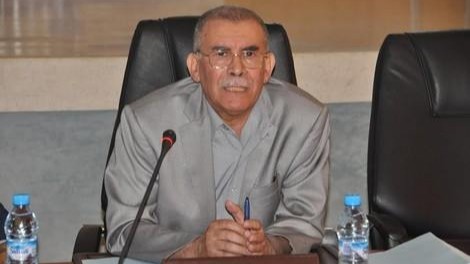
Mohamed Boudhan was an Amazigh writer, thinker, researcher and activist from the Rif, and publisher of the newspaper Tawiza. He was the author of many valuable books and articles on Amazigh identity. May he rest in peace.