A new excavation season at Oued Beht, in Morocco’s northwestern province of Khémisset, has reopened the question of where the societies of western North Africa stood in the early history of the Mediterranean basin. An international team of archaeologists has uncovered a defensive ditch and earthen rampart built between 3,500 and 4,000 years ago — the oldest large-scale earthen defensive works so far documented in North Africa outside the Nile basin.
The findings were announced in a joint statement by Morocco’s National Institute of Archaeological Sciences and Heritage (INSAP), Italy’s National Research Council (CNR) and the University of Cambridge. Results from the third field season (2023) of the Oued Beht Archaeological Project (OBAP) have been published in the journal Libyan Studies.
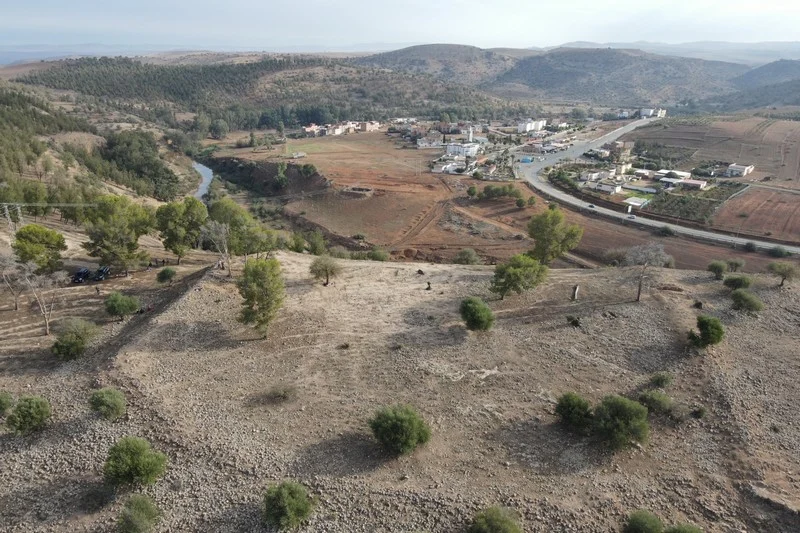
The site sits on high ground overlooking a permanent watercourse. It first drew international scientific attention in 2022, when the team revealed an archaeological spread of 9 to 10 hectares dating to the late fourth and early third millennia BCE. The evidence points to a late Neolithic community that combined barley, wheat and pulse cultivation with animal husbandry, and produced polished stone axes and carefully decorated pottery on a scale then unusual in the region — an indication, for the researchers, of a structured society maintaining seaborne links with southern Iberia.
The 2023 season set out to resolve a puzzle almost a century old. Since the 1930s, when the French archaeologist Armand Ruhlmann first visited the site’s southern edge, the visible stone alignments had been cautiously read as a barred spur (éperon barré), with neither their date nor their true nature ever established. In his doctoral thesis (1986-1991), which examined the polished stone axes recovered from the site, Youssef Bokbot assigned the fortifications to the metal ages without deciding between the Chalcolithic and the Bronze Age.
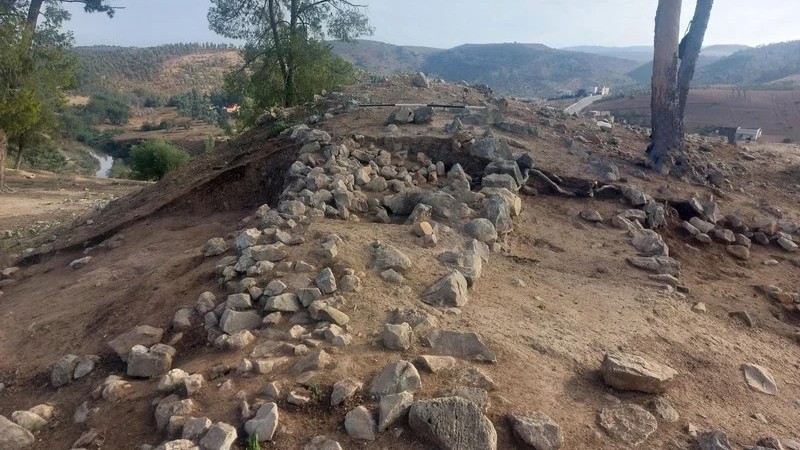
Seventeen new radiocarbon analyses, combined with fine-grained excavation of part of the imposing structure the team named “Wall B1”, have now clarified the sequence of construction phases. Beneath the visible stone masonry lay the remains of an earlier phase built in clay and mudbrick, which radiocarbon dating confirms belongs to the start of the second millennium BCE. A deep ditch and the first elements of an earthen rampart, dug and raised between the early and middle second millennium BCE, belong to the same phase.
The massive stone wall still standing today was erected on this older earthen base during the Middle Ages, as part of a wide-ranging rebuilding and reinforcement campaign carried out between the eleventh and thirteenth centuries. Ditch, earthen rampart and stone wall work together to seal off the high, naturally defended southern approach between the river and the small side valley.
Commenting on the results, the study’s lead authors — Moroccan, British and Italian archaeologists — note that the site kept its secrets for nearly a century while in plain view, and that the radiocarbon dates leave no room for interpretation: societies in western North Africa were organising collective earthworks on a scale “never previously documented”, making this a chapter of ancient Mediterranean history in its own right rather than a peripheral detail.
The scale of the defensive system — a ditch cut across the high ground and an earthen rampart running along the southern edge — reflects organised planning and sustained collective labour, signs of a society with a high degree of organisation and complexity. Whether the primary aim was protecting the site, controlling movement or asserting authority, the researchers see a decisive shift in settlement strategy: after a Neolithic occupation concentrated in the exposed northern sector, the centre of gravity moved in the second millennium BCE towards the narrow, more readily defensible southern strip.
The timing was not an isolated development. Across the Mediterranean, in southern Iberia, the Argaric civilisation was taking shape, known for its fortified settlements, metallurgical advances and emerging social hierarchy.
The directors of the Oued Beht programme conclude that North Africa was never an isolated margin of its Mediterranean surroundings: its societies stood at the heart of the dynamics of interaction, competition and social change that shaped Iberia and the central Mediterranean in the Bronze Age.
Youssef Bokbot, who has directed the project since founding it in 2005, says the results were expected from the outset and were only ever a “matter of time”, adding that the site “has no equivalent in Africa”.
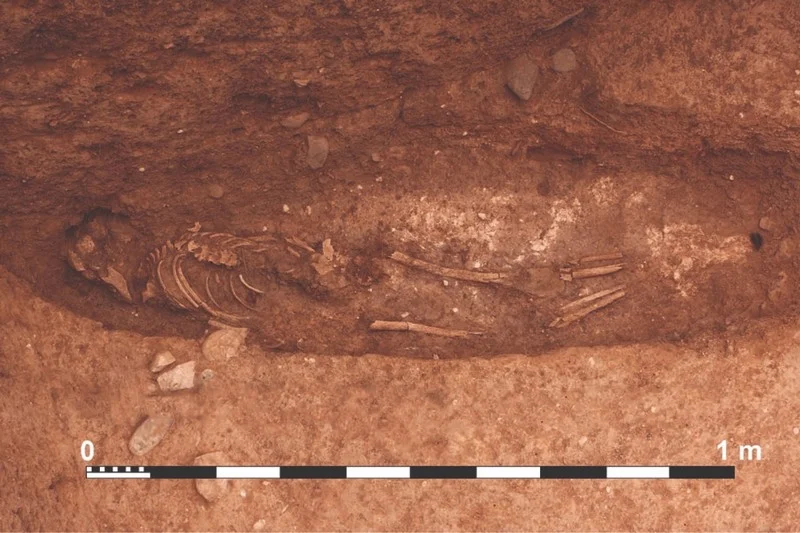
Fieldwork also showed that the high ground saw significant activity again several centuries later. Alongside the reinforcement of the old earthen rampart by the stone wall, a village or small farm was established on a neighbouring hill, with a previously unknown cemetery lying between the two. Archaeological soundings at the far north of the site — carried out after residents reported human bones appearing during recent construction work — confirmed the presence of burials, one of them radiocarbon-dated to the thirteenth century. The evidence opens a rare window onto rural communities in medieval Morocco, whose material traces remain scarce, and calls for further research to establish the full extent of the cemetery.
Elsewhere on the site, excavation in levels dated to the late fourth millennium BCE produced polished stone axes from undisturbed layers — a first through controlled scientific excavation rather than surface collection — along with more than 1,900 pottery fragments in an area of no more than 25 square metres.
Taken together, this accumulated evidence suggests Oued Beht is not a single-period site but a complete archaeological landscape, occupied by successive societies over five millennia: from the earliest farmers to Bronze Age builders and on to medieval villagers. The project’s directors stress that each season reveals “a new depth” to the region, and that understanding how central this mountainous strip was to the region’s deep history and its trans-Mediterranean connections is only beginning.
Fieldwork is conducted by the Oued Beht Archaeological Project under the supervision of the National Institute of Archaeological Sciences and Heritage, in partnership with Italy’s National Research Council and the University of Cambridge, with support from international scientific institutions and in close coordination with Morocco’s Ministry of Youth, Culture and Communication and with local authorities and communities. The study was published on 7 September 2026 in Libyan Studies, issued by the British Institute for Libyan and Northern African Studies in collaboration with Cambridge University Press, under the title “Expanding Oued Beht: Final Neolithic, Bronze Age, medieval and later discoveries from excavation and survey in 2023”, by Youssef Bokbot, Giulio Lucarini, Toby Wilkinson and their team.
Source: Amaḍal Amazigh
Arabic version | French version