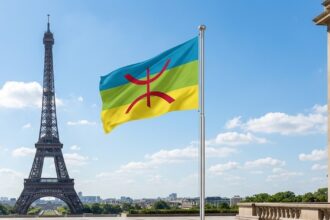

“Tamunt for Freedoms,” an Amazigh-oriented party whose founding file is the subject of an appeal by the Interior Ministry, has called on voters to cast blank ballots in the coming legislative elections. The stance places the relationship between Amazigh identity claims and Morocco’s institutions of political mediation back at the centre of debate.
In a statement, the party ties that call to a boycott of what it describes as the state’s “Arabist institutions.” The existing parties, it argues, lack constitutionality, national grounding and “identity legitimacy,” and work to entrench what it terms “our identity colonisation” by replacing the original identity with an imported one.
The text rejects public policies aimed, in its words, at “integrating the Amazigh language and the Amazigh people into the Arab state,” and denounces the exclusion and discrimination it says state institutions produce. The country, it concludes, is not an “electoral receptacle” but “the original historical space of the Amazigh-Moorish nation.”
The party also criticises what it calls “electoral exploitation,” built on seasonal promises, the instrumentalisation of poverty and need, the purchase of loyalties and appeals to religion and group affiliation. In its view, this produces a formal kind of representation that drains popular legitimacy of its substance.
Setting out the reasoning behind its call, the statement argues that a blank ballot preserves the national turnout rate — which it describes as the most closely scrutinised measure domestically, internationally and at the United Nations — as the foundation of popular legitimacy for the system of the “Agellid” institution. The party regards that institution as a “historic political value” of its Amazigh-Moorish civilisational project and calls for its structures to be rebuilt on an Amazigh identity basis.
This formula — taking part in the ballot while stripping the paper of any party choice — sets Tamunt’s position apart from outright calls for a boycott: it formally maintains participation while withdrawing confidence from the existing party offering.
On institutional matters, “Tamunt for Freedoms” calls for the formation of a national government and a constitutional revision leading to a “constitutional declaration” of the state of the Amazigh-Moorish nation, with a federal parliamentary system and national institutions. It asks that the “Agellid” institution become a unifying framework, and that democratic and social management of public affairs serve as the basis for distributing national wealth across both people and territory.
The party further advocates extending autonomy to every region, with full powers over the management of their own affairs, and redrawing regional boundaries according to a criterion of “territorial complementarity”: each region should have access to the sea, the plains, the mountains and the oases, be linked to its economic hub, and build human integration on citizenship rather than tribal affiliation.
On religious affairs, the statement calls for a constitutional declaration making the religious field the exclusive prerogative of the Commandery of the Faithful, managed under what it terms “a secularism that protects religion”: a unified authority and fatwa, spiritual security, freedom of belief, protection of religion from political exploitation, and independence for religious institutions from state power and party rivalries.
Economically, the party advocates a “democratic, social and solidarity-based economy,” placing cultural, social and environmental considerations at the service of growth, with the aim of a productive and equitable national economy that links growth to social development, territorial justice and environmental protection.
The statement closes with a call to open a public debate on what it terms “the liberating national and identity-based constitutional transition,” bringing together political, civic, academic and human-rights actors. The present moment, it argues, requires moving beyond the logic of extending confidence to the parties in place.
The position comes in the middle of the electoral season, while the party’s own founding file remains pending before the appeal lodged by the Interior Ministry.
Arabic version | French version