The Novel “The Return” by Maimoun Amsbrid
The writer Maimoun Amsbrid published in May 2023 a novel in Amazigh titled “The Return, Memoirs of ‘Badi’”. The author tells the events of the story in the first person, which makes the reader believe, with not the slightest doubt, that he is the one concerned in those events, even if it is imaginary creation. And only in the last seven lines of page 150, the last, does he inform and explain to us that when he went forward, together with the mosque’s imam, to carry the deceased, called “Badi” in his lifetime, one of the inhabitants of the town of “Taghzout” (located in Driouch province), to the place of washing to prepare him for the prayer at the mosque and then burial, he found under a pillow in his house this story, set down on a bundle of sheets that “Badi” had written in Amazigh as it is spoken. The author reviewed them and corrected their writing according to the spelling rules of Amazigh writing within the limits of his knowledge of these rules.
“Badi” recounts that he was born in “Taghzout”. He spent ten years memorizing the Qur’an and then having others memorize it, before emigrating to Algeria to work on the estates of French settlers. After Algeria’s independence he returned to “Taghzout”. Then he would emigrate to Belgium to work there. A few years after marrying the daughter of his father’s friend, yielding to the latter’s wish, he would move his family to Belgium, under “family reunification”. After fifty years spent abroad, he would decide, with his wife “Hammout”, to go back and settle permanently in “Taghzout”. Hence the novel’s title: “The Return”.
After the final return to “Taghzout”, a new life will begin, in the autumn of life, both for “Badi” and “Hammout” in their psychological condition and for the town of “Taghzout” itself, which will return to its former agricultural prosperity thanks to “Tafsut”, “Badi” and “Hammout”’s granddaughter, who was born, lived and studied abroad the science of biological agriculture (bio), which aims to preserve the environment, save water and not exhaust the soil, and which she will apply in “Taghzout” alongside her husband “Massin”, a son of the area who finished his university studies and found no job. “Badi” saw in the marriage of “Tafsut” and “Massin” a marriage with “Taghzout”, because thanks to this marriage “Taghzout” would go on living after his death (106).
In his memoirs “Badi” recounts not only his geographical migration from “Taghzout” to Belgium, but his intellectual, doctrinal and identity migration that led him to embrace the leftist nationalist discourse, then the hard-line Islamist discourse, then the Shia discourse with the rising star of Khomeini… All of it in order to reach the truth, the truth of himself and who he is.
After years of settling in Belgium, Moroccan emigrants of another kind began arriving there, emigrants who did not come to work. Among them were students who came to study, and among them were those who claimed to be “leftists” and “opponents” who had fled the regime and come to Belgium seeking asylum. These emigrants, of this new kind, began sitting with and mixing with the group of workers to which “Badi” belongs. He will realize that their talk is a kind of discourse “new and different, revolving around ‘big’ and ‘distant’ matters that have no relation to our life in Belgium or in ‘Taghzout’” (page 23). This led him to buy a radio tuned to the station “Voice of the Arabs” so as to listen to that discourse at its source. Thus “Badi” would adopt, with other Moroccan workers, this nationalist discourse that the leftists and Arabists were promoting, so that he and his companions from “Taghzout”, when they gathered among themselves, no longer talked about their town and the condition of its inhabitants, but chewed over (that is how “Badi” wrote it in his memoirs, page 24) what they heard from the students and the asylum-seeking “leftists”, and what the radio “Voice of the Arabs” repeats of talk about: “the Arab nation”, “Arab unity”, “the Arab people”, “world Zionism”, “imperialism”, “reaction”… This discourse, as “Badi” admits, “made us bigger than ourselves, carried us to open and broad heavens, where our healing from all our deep wounds would lie” (page 24). And by repeating the nationalists’ discourse and listening to it constantly, there appeared among the adherents of this discourse from Taghzout a “new” Arabic that is not the “Arabic” of the Qur’anic school where “Badi” studied and taught, which was seen as the Amazigh of the mosque (page 25), but an Arabic that draws its vocabulary from the dictionary of “Voice of the Arabs” and the nationalists’ discourse.
After twenty years of work in Belgium, many factories began to close, with workers being granted unemployment benefits. These workers then spent most of their time at home. It was then that another kind of emigrants, from various countries, in Pakistani dress, began contacting them and taking them out to pray with them in “garages” they had set up for that purpose. And when they are sure these recruits have become theirs, they ask them to take on delivering the message (page 28). The people in Pakistani dress knew how to recruit “Badi” at the most opportune time: his children’s problems were worsening day by day (arrest and prison, drug dealing, public drunkenness…), his wife had become unbearable… And given his knowledge of Arabic, learned at the Qur’anic school when he memorized the Qur’an and had others memorize it, the people in Pakistani dress chose him to be a “translator” to deliver what they call the “Message” (page 30). They “delivered” the Message first to Muslim neighborhoods in Belgium, then in a second stage to the Muslims of other European countries, then in a third stage they took “Badi” to Pakistan and Bangladesh, the two countries from which the first people of the “Tabligh” set out (page 30).
With his enthusiastic engagement in the current of the “Tabligh” Jamaat, “Badi” no longer cared about the concerns of his small family, but his concern focused on the big family that is the “Islamic Ummah”. He says: “I fled from myself to ourselves, from the house to the world, from the family to the Ummah. I began to feel like someone who had been shackled and shed his chains, like someone whose sight a veil had covered and then lifted. I no longer cared who among my children was studying and who had dropped out, who of them had gone to prison or come out. But I watched my wife and daughters: what they wore and how they wore it, because women’s dress is one of the preoccupations of the people of the Tabligh” (page 30).
After the followers of the “Tabligh” Jamaat multiplied, schools of thought and disputes appeared among them over the type of dress (Pakistani, Afghan, Saudi…), the shape of the beard and the way of treating the “unbelievers”, the children of the European countries where they lived. “Badi” says: “In ‘Taghzout’, when we quarreled, if it happened, it was over land. Now the quarrel is over the beard” (page 32). Even in summer, when “Badi” visited “Taghzout”, he spread there the discourse of the people of the “Tabligh” about the “Ummah”, the “permitted”, the “forbidden”, “true Islam”, “unbelief”, “innovation”, the “Sunna”, “we”, “they”… And he succeeded in that to the point that the “doctrinal” disputes among the town’s inhabitants, over dress, the veil, the way of reciting the Qur’an and burying the dead, whether television is forbidden or permitted…, exceeded those known in the countries of emigration (page 33).
With the success of the Iranian revolution led by Khomeini, the latter will have a strong and deep influence on “Badi” concerning his doctrinal positions and choices. He saw in him the model of the true Muslim, and in his Shia doctrine true Islam. It brought about a real upheaval in his personality. “Badi” says of Khomeini: “Since I saw him (on television) I was no longer myself: everything I had lived, everything I had seen, everything I had known, everything I had been convinced of in Belgium… all of it melted like a piece of ice under the rays of the sun” (page 34). He embraced Khomeini’s doctrine and turned into a Shia hostile to the Sunnis, and he and a group of other Shias opened a mosque for prayer for followers of “Ahl al-Bayt” (page 38), that is, followers of the Shia doctrine that Khomeini represents. What he had arrived at, by reading some books on the Shia, about the truth of this doctrine did not suffice him, and he wanted to draw from the original source of Shiism, so he traveled to Najaf and Karbala in Iraq and then “Qom” in Iran (page 39).
Little by little Khomeini will turn, in “Badi”’s eyes, into a dictator and tyrant. But he outdoes other tyrants in that he exercises his tyranny in the name of heaven, he says (page 41). And so he and the members of his group will give up Shia affiliation and their pledge of allegiance to Khomeini without any of them telling the others.
After receiving his retirement letter, he began reviewing stages of his life, pausing at the “Taghzout” stage when it was the “Ummah”, before the “Ummah” of the leftists and the Islamists replaced it (pages 45–46). The countries of emigration have become a rival wife to “Taghzout”: many children of Taghzout’s emigrants belong to them more than they belong to “Taghzout”. In truth, they belong neither to this one nor to those (page 47). Thus the new generation of emigrants’ children know no belonging to the land, because they feel a belonging to heaven, which they regard as the true belonging. You see them rushing to defend Islam and Muslims in any country where these face treatment they regard, from their point of view, as improper. “Badi” says: we have come to “watch, in broadcast videos, the son of Haddou slaughtering a man he considers an unbeliever… and Abdel, Moustapha and Simo (these are their names before they called themselves Abu Ubayda, Abu Yasser, Abu Jaber) roughing up girls and women for not wearing the veil” (page 49). “And besides those who joined the fronts of fighting the ‘unbelievers’, there are those who stayed in the countries of ‘unbelieving’ Europe, waging jihad by using themselves as a bomb, or running over passers-by with a car, or attacking them with a knife…” (page 49). These young men do it because they do not feel they belong to this land. They were born in it and raised in it, but when they become men and women, doors are closed in their faces. This is the aspect exploited by those who recruit these young men (page 49). With them the Europeans are no longer “Nazarenes” (iroumiyen) but have become “unbelievers” (page 51).
As soon as he settles in “Taghzout”, “Badi” will buy, at the request of “Hammout”, two pairs of ewes and goats and some chickens (page 67) to begin farming the land and raising some poultry. That is why the first year of “Badi” and “Hammout”’s stay in “Taghzout” was a year of learning anew contact with life in all its aspects (page 70).
After “Badi” got to know the young “Massin”, who came to “Taghzout” from the city where his family lives, which owns land adjoining “Badi”’s, the latter will agree to join “Badi”’s project, which consists of farming plots of land to bring them back to life as far as possible. After a year and a half, those plots were all vegetables and fruit, so that “Badi” no longer bought from the weekly market anything except what farming does not provide (page 81).
In the summer of the second year of “Badi” and “his wife”’s settling in “Taghzout”, “Tafsut”, their granddaughter, will come to spend the holiday with her grandfather and grandmother. She belongs to the third generation, holding a diploma in biological agriculture (page 82). She too will choose to settle permanently in the town, and will marry the young “Massin”, and turn the farm into a laboratory (page 123) for experiments in “alternative farming” that aims to improve the land’s yield with the least strain on the soil and the greatest possible water saving by adopting drip irrigation, excluding any non-natural substances such as fertilizers and pesticides. Even the energy needed to draw irrigation water from the wells comes from solar panels, as clean and natural energy. Through Massin’s work and “Tafsut”’s guidance, “Taghzout” turned into a green paradise (page 90). The town thus became known for its natural (organic) products, visited by people from the city and neighboring villages, besides emigrants from abroad who flock to it in summer to buy its seasonal vegetables and fruit (page 135). And because of the high demand for “Taghzout”’s farm products, the “Taghzout Cooperative” was set up to employ the area’s young people (page 123) to raise production. This was an incentive for life to return to “Taghzout” after the cooperative’s young people and those who joined them from other villages settled there, married and had children, and life returned to “Taghzout” with all its social and natural aspects (page 137). As the town’s repopulation continues, “Badi” will call for restoring and repairing the mosque and the shrine as parts of the identity of “Taghzout”. And at “Tafsut”’s wish, her grandmother “Hammout” will give lessons in authentic traditional cookery to the village’s girls, concentrating on recipes for dishes that have disappeared or are on the way to disappearing, such as recipes for preparing 12 kinds of food from barley grain alone, depending on whether it is green or dry, when of these recipes only the one for making bread is still known (page 136). Thus “Taghzout” will turn into a school to which its children come to learn life, identity and authenticity (page 144). Like the mythical phoenix that rises from the ashes, “Taghzout” has come back from its ashes after burning, as “Badi” commented (page 144).
We may treat the content of this novel according to its direct apparent meaning, without interpretation or search for a supposed hidden meaning. What confirms this direct apparent meaning is that the author, Maimoun Amsbrid, is himself a son of “Taghzout”, and himself works and lives in Belgium. He therefore has field knowledge of the conditions of emigrant workers, especially those belonging to his village like “Badi”. The novel “The Return” would then be an “autobiography” of the emigrant “Badi”, no more and no less.
But the emphasis in this novel, prominent and striking, on the alienation and brainwashing “Badi” underwent, which made it easy for ideological and doctrinal currents with no link to “Taghzout”, its culture, language and identity, or the concerns and preoccupations of its inhabitants, to recruit him, and made him a soldier who defends them loyally, strives to promote their ideas and doctrines and travels to distant countries to spread and serve them, may suggest that “Taghzout” does not mean only that rural town known in Driouch province, but may mean the Amazigh identity springing from the land of “Taghzout”; indeed it may even mean all of Morocco, with the Amazigh culture, language and identity it carries. This identity awareness appears clearly in “Badi” when he explains why he chose to write his autobiography in the tongue of “Taghzout”, saying: “We, the people of ‘Taghzout’, do not write about ourselves. And when we write we use the languages of others… Thus we erase our traces, or turn, by writing in foreign languages, into others. I did not want to write in the languages of others. I said to myself: why not write my life in our language to protect it from disappearing, because it will be bound (tied) to my language, the language of ‘Taghzout’. […] In the tongue of ‘Taghzout’, the human being, the language and the land become one. The absence of one element leads to the absence of the other two. There is no ‘Taghzout’ without its language, and no human being without his language and his land” (page 148). It is clear that those who did not write about themselves in their language, or used the languages of others for this writing, are not only the inhabitants of “Taghzout”, but all the Imazighen throughout Morocco, indeed throughout North Africa. Which may confirm that the “return” to “Taghzout”, after half a century of alienation and false consciousness, may symbolize the return of the Imazighen, who are the Moroccans as far as Morocco is concerned, to their Amazigh identity, culturally, in identity terms and in language. Consequently “Badi”’s call to the Taghzoutis to use the tongue of “Taghzout” for writing, as he did in recording his autobiography, is a call to these Imazighen to use their Amazigh language to write themselves about themselves. Let us not forget that the name “Taghzout” is a geographical name known and used in all regions of Morocco, and in Algeria too, given to many towns and villages, and it is Amazigh in form, even if we suppose its root may have other linguistic origins. Moreover, all the Moroccans who appeared in videos cutting off heads in areas of Syria controlled by “ISIS”, and all those of them who carried out truck-ramming and knife attacks in the streets of European countries, as the novel says, do not belong to the Rifian “Taghzout”, but are Moroccans (or Algerians) from various Moroccan regions, which may mean that “Taghzout” is Amazigh Morocco. When “Badi” arrived in “Taghzout” after the final return, he found it with “its features worn away by the sun, wind and rain since its children left it, and no longer tended it with care or leveled its gullies that had dug into its surface” (page 59). Is this not what happened to Morocco’s collective Amazigh identity since many of its children abandoned it, disowned it and no longer tend it with care and defend it, preferring false foreign identities in its place, until it almost wore away and vanished under various factors of identity erosion?
If we adopt this reading, the “return to ‘Taghzout’”, after fifty years of wandering among various ideologies and religious and doctrinal currents, is not merely “Badi”’s return to the Rifian land of “Taghzout”, but may mean the return of all those who resemble “Badi” in their alienation and adoption of false foreign ideologies, identities and causes, having abandoned their true original identity and given up the causes of the country they belong to, (a return) to their Amazigh identity that springs from this Moroccan land that “Taghzout” represents. “Badi” says, explaining this wandering and this return: “I was like the child who lost his mother at a wedding, and began tracking mothers made of words and not of earth (the land). I run after them and grab them by the collar. And when they turn their faces I find them ogresses, so I flee from them and go into myself. A mother of words will never be like the mother-earth. The earth does not lie because it does not speak” (page 61). What “Badi” lived through, after abandoning his mother (his true identity) that springs from the land of “Taghzout” and replacing her with mothers of words (the various discourses of nationalists, Shias, Islamists…), is the same as what Moroccans live who have turned from their Amazigh gender to another, foreign one, and have come to claim they are not Amazigh after being steeped in the Arabist discourse, in both its nationalist and Islamic versions. Just as the discourse of the people of the Tabligh, with which “Badi” was steeped, and which represented for him, in his experience of alienation, the whole truth, was what distanced him from “Taghzout”, believing, as this discourse had convinced him, that the farther he went from it the closer he came to the truth that the Ummah represents as against the “lie” that “Taghzout” represents (page 67), so the Arabist discourse, nationalist and Islamic, pushes its Moroccan adherents to go to extremes in disowning their Amazigh identity to the point of fighting it, believing that this is the proof they are no longer Amazigh.
And if “Badi” saw in “Massin”, an activist in associations defending the Amazigh language and identity, the person best suited to “Taghzout” (page 80), it is because, when he asked him at their first meeting the reason for his visit to “Taghzout”, he answered: “In recent years we have begun to care about who we are, we have begun to ask: who are we? Why are we not ourselves? Why are we others, although our language is not theirs, our land is not theirs, and our way of life is not their way of life?” (pages 75–76).
And if the return to “Taghzout” is a return, in identity, culture and language, to Amazigh after regaining sound awareness and shedding false awareness, that does not mean a return to a backward-looking identity, not keeping pace with development and renewal. We saw that the agricultural revival of “Taghzout” relied on the latest techniques of “alternative farming”, under the supervision of a specialist scientist in agronomy, the engineer “Tafsut”. And even when the shrine was restored, a “house of culture and education” was set up in it where the town’s young people gather to discuss issues of concern to the village’s affairs and to learn a range of skills and knowledge. The name of the “shrine” is no longer “Amrabed” but “House of Culture and Development” (page 131). Turning the shrine into a house of culture is a kind of new modernist treatment of old customs and beliefs. This is what “Massin” meant when he explained that there are associations working to preserve Amazigh and the Amazigh way of life, but not as a dead archive, as a renewed life (page 95). Even the concern to unify the Amazigh language is present in the novel, when “Badi” says that “Taghzout”, having become a tourist pole for the various Taghzouti emigrants, helped turn the tower of Babel (page 145), with its many tongues (emigrants speaking German, French, Italian, Flemish, Spanish, Moroccan Darija…), into a single tongue, the Amazigh tongue, which the visitors were obliged to use, helped by the few expressions they had learned from their parents or grandparents in the case of the third-generation emigrants’ children, like “Tafsut” who belongs to this third generation.
Still within this other possible meaning of the novel, we may read in the care for the mosque and the shrine, turned into a “house of culture and development”, a manifestation of what some call “Moroccan Islam”, which is in truth nothing but “Amazigh Islam”, that is, religiosity as the Imazighen practiced it from the spread of Islam in Morocco until 1956. This religiosity also appears in the practice of prayer, as “Badi” says that only, in “Taghzout” and before emigration to Europe, the elderly and the “tolba” prayed in the mosque. The others either did not pray at all or prayed in their homes (page 21). And this raised no remarks or created no problem between those who pray and those who do not.
I know it is tempting to object that this possible reading of the meaning of “The Return” expresses what the author of these lines would like the novel to say, and not what it actually says. But what are we to do with the correspondence, which almost pokes the eye out, between “Badi”’s return, after an ideological and identity-related straying that he lived through for half a century, to “Taghzout”, with the revival of this town that accompanied it, like the phoenix, from its ashes after it almost burned, as he described the process of that revival, and what the defenders of Amazigh call for: the return of the strayed and lost Moroccans, in identity and ideology, to their collective Amazigh identity of Morocco and of Moroccans, with what this requires of reviving the Amazigh language by working to spread it among Moroccans through its compulsory unified teaching?
Although events, in their sequence, coherence and surprises, are an essential and important element of novel writing, what gives these events beauty, suspense and more realism is the way they are woven and written, since a novel is not merely a report of events that took place, but art, creation, a production of beauty, and the arousal of feelings of elevation, contentment and admiration. This is what we feel and perceive as we read “Badi”’s memoirs, without having any other option, because it is the author who imposes this feeling and perception on us.
If we know that written production in Amazigh is still at its beginnings, practiced by “resisters” and “activists” obsessed with love of Amazigh, and in the absence of school learning of Amazigh writing, then anyone who writes a text in Amazigh is in truth a writer ahead of his time, that is, of Amazigh’s school time. And whoever writes a novel will be a creative writer, an inspired genius. This holds for Maimoun Amsbrid and other pioneers of the Amazigh novel. Without school-provided Amazigh equipment, they create, through their passion for Amazigh, this equipment through novel writing. The absence of teaching Amazigh (I mean serious and real teaching, not the formal, false kind) is what keeps Amazigh written production from having yet left the “transitional stage” from orality to writing, with all that accompanies this of experimentation and continued presence of the oral in many Amazigh writings that differ from that oral only in being set down in letters and not uttered in sounds. “But when we read the writer Maimoun Amsbrid, we form the impression, indeed the conviction, that his writings are neither a ‘beginning’ nor a ‘transitional stage’ of Amazigh from orality to writing, but a writing that makes Amazigh appear as though it were a language in which writing has been practiced for centuries, a complete and accomplished language, able to express all situations, events, feelings and ideas steeped in abstraction, a language no different from languages that have produced a rich and refined cultural and literary heritage. […] And the Amazigh in which he writes represents the inimitable simple: it is easy because it is a known and current Amazigh, but at the same time difficult because nobody, it seems, other than Amsbrid is able to use it in writing with the same splendid and admirable style.” This is what I wrote (click here) in October 2015 about a group of his narrative texts (he published these stories in 2023 under the title “The Black Water”) and poetic ones.
To bring the reader closer to this beautiful and admirable style in which Maimoun Amsbrid writes, I translate into Arabic, below, excerpts from the novel, as expressive samples of the author’s narrative style, with the “betrayal” of the original Amazigh text that such transposition entails, from which no translation is free:
— When “Badi” arrived in Belgium for the first time, what first drew his attention, as a striking difference between the inhabitants of this country and those of “Taghzout”, was that the former are governed by the “clock” whereas the latter are governed by the “sun”. The author says, through “Badi”, to express this difference in the perception of time: “The inhabitants of this country do not do their tasks according to the sun’s position in the sky: even if the day is short (as in winter), the ‘clock’ forces it to be long. They subtract from the night and add to the day, like someone who subtracts from the width to add to the length! At late hours of the night you find them filling the metro tunnels: these going down, those getting on, swarming like ants in their galleries. Nobody cares about the other, nobody looks at the other, nobody knows the other” (page 9). “In ‘Taghzout’, life is not divided into compartments as in Belgium: a compartment for work, a compartment for music, a compartment for play… What is divided in Belgium is an integrated unity in ‘Taghzout’” (page 10).
— At his first meeting with the nationalists, the author says, through “Badi”, in a vivid description of them: “They speak with conviction and with burning, their eyes ablaze as if there were fire in them, and in their throats bitterness and insistence” (page 23).
— Speaking of the jihadists and extremists, he says of them, in an expression that sums up what they aspire to achieve: “They do not consider themselves sons of the earth, but sons of heaven. The earth has become too narrow for them, so that they wish to ascend to heaven or bring heaven down to earth so that this heaven be their earth, an earth not made of dust: the earth of the true religion, where people are no longer the same people, living by themselves and for themselves” (page 48).
— “Badi”, as he contemplated the lamb growing up and the pea plant growing, noticed that people, once they no longer practice farming, see of life (of what is alive) only its end, that is, what is ripe and ready for consumption, and do not see how it reached ripeness. The author expressed it by saying: “In Belgium, the sheep is not life (what is alive), it is merely a mass of meat. The pea is not a plant that grows, it is only food. In Belgium, eyes see only the last stage of the serial of life. In ‘Taghzout’ we see life from its beginning to its end” (page 70).
— On the occasion of preparing the wedding of “Tafsut” and “Massin”, the author says through “Badi”, comparing today’s wedding with weddings of years past: “Nothing has destroyed the authentic traditional wedding like the innovation of the caterer (traiteur)” (page 92). “Today’s wedding is run by people (he means the waiters) like ‘makhzen men’, in their clothes that do not resemble those of the wedding’s hosts, their speech dry and their faces blank like prison guards. The guests wait for when the food will be served so they can eat and leave. That is today’s wedding […] In recent years the ‘chant’ (nashid) was added, practiced by those who claim to be the real Muslims, who banned dancing and singing and put in their place the religious ‘nashid’, performed by singers who come from outside ‘Taghzout’, in Afghan dress” (pages 93–94). “That is how our wedding was before we became other than what we are, before today’s children turned it into an exhibition of foods, […] the wedding returned to sitting, eating and talking, with words that vanish like foam as soon as they leave the lips. Since we abandoned the authentic traditional wedding, we have dried up the spring of art, and we own nothing: we left our goods and began to borrow from others” (page 99). “…today’s wedding is an exhibition of foods, handed out by waiters who do not speak, who know none of those present and are known by none of them, in uniform dress like that of the makhzen’s men, with quick steps like the soldiers of a makhzen ‘mehalla’ like the one the makhzen used to send to punish rebellious tribes. This new ‘mehalla’ they call ‘traiteur’ has destroyed the solidarity that was the hallmark of the traditional wedding, silenced the throats (the singing throats), hushed the tambourines, seated the dancers, and chokes the breath of the men in their chests. […] We just sit, eat, listen to voices coming from a machine that speaks (playing recorded songs), or to a ‘praise’ foreign to us that they call ‘nashid’ (religious), as if we were at a funeral” (page 101).
— In his description of the tambourine beats during the wedding held in the authentic traditional way, without a caterer or ‘nashid’, the author says through “Badi”: “The tambourine beats of the elderly women were deep, strong and full as though they came not from the tambourine itself but from the depths of the earth; we did not hear them only with the ear, but with our whole being” (page 100).
— Describing the carob tree standing tall despite the lack of rain, he says: “The carob tree butting the sky with its spreading leaves as if mocking the drought” (page 143).
— Speaking of the choice of the inhabitants of “Taghzout” who left it to be brought back to it at their death to be buried there, he says: “Wherever a Taghzouti dies, far from ‘Taghzout’, his family carries his body to be buried in its cemetery. This is what makes the cemeteries of ‘Taghzout’ stay ‘alive’ while everything around them is ‘dead’. ‘Taghzout’ is empty of its inhabitants but its cemeteries are full. The houses of ‘Taghzout’ collapse, but its cemeteries stand. The sons of ‘Taghzout’ cannot live in it alive, but they come back to live in it dead” (page 60).
I said above that whoever writes a text in Amazigh is in truth a writer ahead of his time, that is, of Amazigh’s school time. And I say that whoever reads a text in Amazigh is likewise ahead of that same school time, because writing and reading are one school process, even if someone who learned to read and write may not write and merely practices reading. The first Amazigh writings appeared in the 1970s. And after half a century there is still no accumulation of Amazigh written production. Why? Because of the lack of readers of these productions, meaning there is no demand for them. And why? Because of the absence, again, of Amazigh from school. That is why the number of readers of Amazigh texts remains a handful of “resisters” and “activists”, like the “resisters” and “activists” who practice writing. This is an impasse for Amazigh: to move to the written stage, there must be readers following Amazigh written production. And for both to be achieved, Amazigh must be taught so that it continues its reproduction through written use, since its oral use has become unable to ensure its reproduction across generations as it did for tens of centuries. Yet this teaching (I mean serious and real teaching, not the formal, false kind) is absent. Which prolongs the absence of writing and reading Amazigh outside of “resistance” and “activism”.
Even firm will, with the act of “resistance” and “activism”, love for Amazigh and attachment to it that it expresses, strongly present among Amazigh writers and readers, cannot change much of Amazigh’s deteriorated reality, as long as it cannot impose its teaching in the proper and required form. What we forget when we ask, starting from a sincere “voluntarism”, the lovers of Amazigh to use it orally and in writing in all situations and contexts as needed, is that we are not “free” to speak Amazigh, write it and read it. There is a state that prevents us from practicing that speaking, writing and reading. And this ban is not exercised by this state directly, as by repressing whoever speaks, writes or reads Amazigh. It shows in the fact that the state’s institutions do not use Amazigh, which means that a citizen who goes to one of these institutions, such as a police station, a gendarmerie post or a court…, to settle some of his business and uses Amazigh in communicating with the officials of this institution, may find his interests, for which he came to that institution, blocked because those employees do not understand what he says if they are Darija speakers. Which forces him to use Darija or French. This citizen has then been prevented from using his language, simply because he cannot get what he came for by using Amazigh. The same holds for writing: whoever drafts a request in Amazigh addressed to a municipality to obtain some permit will not receive an answer, whether refusal or approval. His interests will thus be blocked, which will deter him from the written use of Amazigh for administrative purposes. He will have been prevented from this use without anyone intervening to enforce the ban. Here too, what is missing to lift this “ban” is teaching Amazigh so that it is a language used by the state’s institutions, spoken, written and read by the staff of these institutions after they have studied it for enough years to master speaking, writing and reading it.
As an example of this indirect ban on using Amazigh and writing in it, there is this very article. Neither the state nor anyone else prevented me from writing it in Amazigh, especially since it concerns Amazigh itself. So why did I not write it in Amazigh? Let us pass over the fact that I did not study it at school and therefore do not know how to write it correctly and soundly, and settle for this: if I write it in Amazigh, without anyone intervening to stop me, the question arises of where it will be published (not all platforms agree to publish Amazigh texts) and who will read it. The answer is: it will be read by a handful of “resisters” and “activists” of firm will. So we stay in the circle of “voluntarism”, which cannot greatly change the situation in Amazigh’s favor in the face of the state’s existence. What Amazigh needs today is not the strong will of its lovers and defenders, despite how important that is, but the will of the state. This is Amazigh’s vicious circle: there are no readers I can address with Amazigh writing, which pushes me to write in Arabic about Amazigh itself. The result is that Amazigh writings, such as the novel, remain without critical follow-up in the Amazigh language itself, which does not help develop and expand Amazigh written production. And invoking the state, regarding the question of writing and reading Amazigh, means that the subject of Amazigh is, at its depth, a political subject, tied to the absence of political will in the state for a serious, real and unified teaching of Amazigh, so that it does not remain only the language of the “resisters” and “activists” who defend it, but the language of the state, which itself takes on defending it and imposing it through its institutions and administrations.
Arabic version | French version
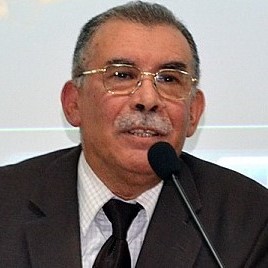
Mohamed Boudhan was an Amazigh writer, thinker, researcher and activist from the Rif, and publisher of the newspaper Tawiza. He was the author of many valuable books and articles on Amazigh identity. May he rest in peace.