Who Is Addressed by the Constitutionalization of Amazigh?
This question may seem comical, even “stupid”, given the self-evident fact that the Constitution, with its general and binding rules, like all other legal rules, addresses all those who enjoy legal capacity, headed by the state, which is the first to be bound by the Constitution and to enforce it. But if we know that the constitutional official status of Amazigh has still not been implemented in a way that makes the Amazigh language “also” an official language of the state, as paragraph 3 of Article 5 of the July 2011 Constitution states, the question becomes reasonable and serious. If the state is the first concerned with applying the Constitution and enforcing its application, it follows that the effect of this application will appear within its institutions, which are the manifestation of its presence and existence, and through which it works and exercises its constitutional powers. Yet the effect of Amazigh’s official status, as a binding constitutional matter, does not exist in these institutions, as if the state were neither concerned nor bound at all by this constitutional matter. Hence the pertinence of the question: who is addressed by the constitutionalization of Amazigh?
If the state does not commit to carrying out the text of the Constitution that affirms that “Amazigh is also an official language of the state”, that may mean it does not consider itself the one addressed by this text. Who, then, will be the addressee? Given the party that was demanding constitutional official status from the state, the Amazigh movement, and given the foot-dragging that still continues in implementing this status since July 2011, the date the new Constitution containing Amazigh’s official status came into force, the addressee may not be the state, as I noted, but those who were demanding from this state the constitutionalization of Amazigh. Here the state is not the one addressed by the Constitution, as I said, but the one addressing by it those who demanded Amazigh’s official status. It was therefore enough for it to “speak to them” through the Constitution to tell them it had met their demands, which relieves it of any responsibility to carry out the constitutional provision. The result is that this absence of Amazigh from state institutions, ignoring a constitutional order, means one thing only: that this state approved the constitutional official status of Amazigh not in order to abide by it and make it abided by within its institutions, but to sell, at home and abroad, that it “responded” to the demand for constitutionalizing Amazigh, which the Constitution now states. And it does not matter afterwards that this constitutionalization is absent from the state’s institutions. That is why, if the Constitution says that “Amazigh is also an official language of the state”, the state’s institutions say that it is not also an official language of the state. There is a theoretical Constitution stating the official status of the Amazigh language, and a practical Constitution denying this official status so that the exclusion of Amazigh as a language of the state and its institutions continues. The first is addressed to those who were demanding the constitutional official status of Amazigh, and means nothing for the state and its institutions. The second is addressed to this state and its institutions so that Amazigh not be integrated into their official documents as an official language of the state.
What, then, is the purpose of a constitutional official status for Amazigh addressed to the Amazigh movement and not concerning the state and its institutions? Is the purpose that it play the role of a pacifier (tétine) that distracts, silences and lulls, as the real pacifier does that is resorted to in order to silence, distract and lull infants who annoy with their crying and screaming? Given the foot-dragging in the serious and real implementation of Amazigh’s constitutional official status so that it be the language of the state and its institutions, this obstructed official status combines all the functions of the real pacifier, for it “sucks up” Amazigh demands after having met, apparently, that is, constitutionally, what was regarded as their ceiling. In doing so it silences these demands, lulls their holders and distracts them from them by sucking the empty pacifier. It does resemble the empty pacifier because it has become empty of any real implementation that would give this official status a real, full existence and not empty like the pacifier. And it performs a function like the pacifier’s because it has created a state of waiting that may stretch to an indefinite time, so that this waiting becomes the purpose of the official status and its substitute, that is, waiting for the sake of waiting. And that is one of the functions of the real pacifier when the infant sucks its emptiness as a substitute for real nourishing milk.
And if waiting for the implementation of certain laws and decisions delays their application and operation, that does not lead to the death of their beneficiaries. As an example, we note that the organic law on strikes, whose status as a right every Moroccan constitution since the 1962 Constitution has stated, has still not been issued. And if the wait for this law for more than fifty-eight years (we are in 2021) obstructs workers’ exercise of one of their constitutional rights, this waiting does not result in their death and ruin. Whereas the longer the wait for the real implementation of Amazigh’s official status, so that it be used as an official language of the state, the more this contributes to its death and the “death” of its users, since its oral use alone no longer suffices to preserve it and reproduce it. The result is that every delay in the real implementation of Amazigh’s official status amounts to speeding up the process of killing it. And the causal link between the real official implementation of Amazigh and its preservation and reproduction shows in the necessity of compulsory, unified teaching of the Amazigh language so that it can be used as an official language, oral and written, of the state, used in its institutions and official documents. This teaching is what lets it complete its cycle of school reproduction, which guarantees its survival and spread. The real implementation of the official status of Amazigh thus requires its compulsory, unified teaching, which is necessary for its school reproduction, in turn necessary to protect it from death and extinction.
That is why, if the promotion of Amazigh has seen undeniable progress, as shown by the media, the use of Tifinagh on the fronts of official institutions, the start of revising some school history curricula, and its growing symbolic presence in the public space…, it has seen no progress in what is most important and necessary for its survival, continuity and spread: its compulsory, unified teaching. Without this teaching, everything accomplished for Amazigh is as though it had not yet been accomplished. This foot-dragging in teaching Amazigh, in the serious, compulsory and unified form, shows that Amazigh’s constitutional official status was a pacifier, in the sense I explained, to prolong the wait that gradually kills Amazigh as a kind of mercy killing of it (euthanasie).
And taking a look at decree No. 2.20.600 issued on September 8, 2020, on the composition of the permanent ministerial committee charged with following up and evaluating the implementation of the official character of Amazigh in application of Article 34 of organic law No. 26.16, made up, as Article 1 of this decree states, of the government authority in charge of human rights; the government authority in charge of the Interior; the government authority in charge of Foreign Affairs; the government authority in charge of Justice; the government authority in charge of Habous and Islamic Affairs; the government authority in charge of Economy, Finance and Administration Reform; the government authority in charge of National Education, Vocational Training, Higher Education and Scientific Research; the government authority in charge of Culture, Youth and Sports, in addition to the head of government as chair of this committee, (taking a look) we will notice that it is made up of the same government authorities that are dragging their feet on the real official implementation of Amazigh, as shown by the fact that they have done nothing regarding the use of Amazigh as an official language of the state, and even refused its mere symbolic use as a language of the state, as shown by excluding its script from the national identity card (see the article: “On the Pretext for Excluding Amazigh from the National Card Project”, by clicking here) and from coins and banknotes, with the blessing of these government authorities, their parties and their parliamentarians. And the height of absurdity is that paragraph 3 of Article 2 of this decree provides that this committee is to “follow up and evaluate the carrying out of the action plans and sectoral programs relating to implementing the official character of Amazigh, and work to ensure respect for the deadlines set for them”. How can whoever caused the obstruction of implementing Amazigh’s official status monitor the carrying out of this implementation? That means the wolf is charged with guarding the poor sheep. It is a literal application of the principle: “its protector is its thief”, as the Egyptians say. This committee, given its government components, which have revealed on many occasions their opposition to Amazigh, is in truth a “barbarian committee”. And here the question arises: how can a “barbarian” committee, that is, foreign to Amazigh, in the Greek sense of the word “barbarian” (see the article: “When the Imazighen Turn Into Barbarians Hostile to Their Amazighness”, by clicking here), care for Amazigh and promote it? Indeed how can such a committee, belonging to a government that does not hide its practical opposition to Amazigh, monitor the extent of this government’s respect for the decisions on implementing Amazigh’s official status? That is, how can the barbarians defend Amazigh and the Imazighen when what made them barbarians is their rejection of their Amazighness and their disowning of it?
And what is striking is that this committee is empty not only of elements belonging to the Amazigh movement, but even of a representative of the Royal Institute of Amazigh Culture, whether this institute still exists and performs its tasks normally, or as one of the two institutions of the National Council of Languages and Moroccan Culture under Article 10 of organic law No. 04.16. Why this absence of any Amazigh element? Because the committee, as I explained, is barbarian, that is, foreign to Amazigh and does not belong to its cultural, linguistic and identity space.
We conclude from the foregoing that the constitutionalization of Amazigh is addressed to the Imazighen as a mere pacifier, as I explained before, and addressed to the barbarians as constitutional provisions carried out in a barbarian form and not an Amazigh one. This explains why the committee following up the carrying out of implementing Amazigh’s official status is a barbarian committee and not an Amazigh one, as it should have been.
And the astonishing paradox in the matter of constitutionalizing Amazigh is that this constitutionalization was supposed, and was expected, to protect Amazigh from the death that threatens it, after providing it the conditions of life, growth and continuity of survival. But the absence of any serious and real implementation of this constitutionalization has made of it an instrument of mercy killing of Amazigh, that is, a killing that arouses neither anger nor protest because it is a “mercy killing” carried out gently and without violence.
What is the solution to get Amazigh out of the circle of barbarian solutions that will bring it only a merciful death, to begin dealing with it through real Amazigh solutions that preserve its life and continuity of survival?
During this discussion I deliberately spoke of the “state” as responsible for implementing or not implementing Amazigh’s official status, and not of the government, parliament or parties, except incidentally and secondarily. And if I concentrated on the state, it was to show, although it is self-evident and clear, that the solution is always political, consisting of a decision by the state, that is, a decision issued by the highest authority in the country requiring a serious and real teaching of Amazigh in preparation for its use, serious and real as well, as an official language of the state. But what will push the highest authority to make this decision?
This is what we will discuss in another article.
Arabic version | French version
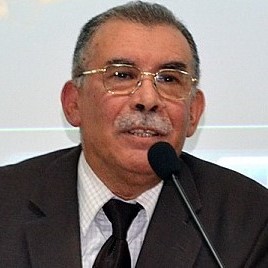
Mohamed Boudhan was an Amazigh writer, thinker, researcher and activist from the Rif, and publisher of the newspaper Tawiza. He was the author of many valuable books and articles on Amazigh identity. May he rest in peace.