What will the Amazigh gain from Morocco’s normalization with Israel?
While the vast majority of Amazigh activists and members of the Amazigh movement welcomed Morocco’s decision to normalize relations with Israel—a call they had, in fact, been making for a long time—this in no way implies that the Amazigh cause draws any direct benefit from this rapprochement. In reality, any potential gain for Amazigh identity from this normalization is conflated with that of the state that made the decision. However, when one observes that this state acts as an “Arab” entity, refusing to recognize Amazigh identity as the foundation of its national identity, and that it sealed this agreement through this “Arab” prism, it is logically impossible to see the move as a victory for the Amazigh cause. On the contrary, Amazigh identity emerges as the loser in a process that politically and symbolically strengthens its primary adversary: the “Arab” state.
As for the allegation that Amazigh activists profit from normalization out of hostility toward Arabs—a recurring theme in the “Amazighophobic” rhetoric of its detractors, whether Islamist or leftist—it is supposedly based on the simplistic principle that “the enemy of my enemy is my friend.” This thesis is entirely driven by a prefabricated conspiracy theory, systematically invoked to explain anything related to Amazigh identity and Israel. The fundamental error of this populist and conspiratorial reasoning lies in a misunderstanding of the “enemy’s” identity. If we accept that Amazigh activists are in conflict with “Arabs,” these are not the true Arabs of the Middle East who are in conflict with Israel, but rather those who usurp that identity: the “barbarians” of Morocco. This term refers to those Moroccans of Amazigh origin who deny their roots to transform themselves into strangers to their own culture, thus returning to the original Greek meaning of the word “barbarian” (see the article: “When Amazighs turn into barbarians hostile to their own identity”). They are the true adversaries of Amazigh identity, for they work day and night to strip away the identity of the remaining Amazigh populations to Arabize them and transform them, in their own image, into “false Arabs” whose legitimacy is not even recognized by authentic Arabs. The latter, by contrast, are our friends and partners with whom we share religious, cultural, linguistic, and historical ties; we respect their Arab identity just as they respect our Amazigh identity. We have no dispute with them, for it is not they who dispossessed us of our culture, forcibly Arabized us, or fought against Amazigh identity, unlike the local “barbarians.”
Furthermore, even assuming Israel perceives the Amazigh movement’s support for normalization as a gesture of friendship, can one seriously imagine that Israel would reciprocate by using its influence to defend Amazigh identity within Morocco or on the international stage? To believe such a thing would reflect a completely naive and amateur understanding of the nature of international relations and, more specifically, the internal logic of the Hebrew state. Claiming otherwise only serves to fuel the rhetoric of those who oppose the Amazigh cause and seek to demonize it by constructing a fantasy association with Zionism.
Israel, as a state, officially conducts diplomacy only with other states, not with sub-state entities such as associations, parties, or ideological movements. This is why the decision to establish official relations with Israel was made by the King on behalf of the Moroccan state, in his capacity as the supreme representative of the nation according to the Constitution. Similarly, the cooperation agreement between the two countries was signed on December 22, 2020, in the presence of the Sovereign, by the state’s second-highest official, Head of Government Saâd Dine El Otmani. Every stage of this relationship has been built in the name of the sovereign institutions of Morocco and Israel. Certainly, outside this official framework, relations of cooperation and friendship can exist between citizens, associations, or political parties of the two countries within the private civil sphere, without state intervention—a reality that existed long before official normalization. It is precisely within this civil and private framework that the ties between certain Moroccan Amazigh activists or associations and Israeli citizens or civil society organizations are situated.
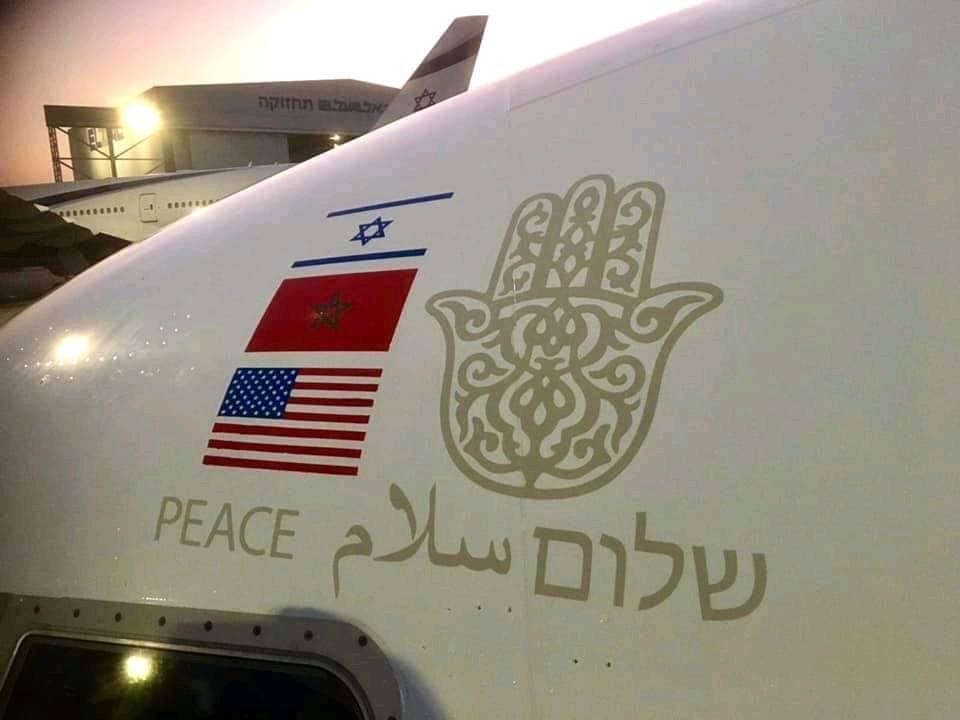
Within the framework of official relations between the State of Morocco and the State of Israel, Amazigh identity finds neither place nor presence. Israel deals with Morocco based on the official identity the latter projects, and it is in the name of this affiliation that the agreements linking the two countries were signed. Indeed, we observed that in the room where the cooperation agreement between Morocco and Israel was signed under the King’s supervision, a painting representing the Sovereign’s “Cherifian lineage” was prominently displayed. Whether intentional or fortuitous, this carries a strong symbolic—if not constitutional—weight regarding the “Arabo-centric” identity of the state. This reality compels Israel to deal with Morocco as an Arab state, completely ignoring the Amazigh dimension. If it were to take Amazigh identity into account in these exchanges, Israel would be seen as interfering in Morocco’s internal affairs. For this reason, it was neither expected nor requested that Israel include the word “Peace” in the Amazigh language on the plane that carried its delegation to Morocco, alongside the inscriptions in Arabic and Hebrew.
On the other hand, Israel’s own interests dictate that it ignore the country’s Amazigh identity, even if taking a clear stance in favor of that identity would not necessarily upset or anger Morocco. Why is this? Because as long as its adversaries are Arab countries, the more Arab states normalize relations with it, the more it benefits. This allows Israel to present itself as a state of peace and harmony, which is precisely what it seeks through the Arab normalization process. Consequently, it is in Israel’s interest for Morocco to be perceived as one of these normalizing Arab countries, rather than as a “non-Arab” (ajam) state, such as an Amazigh one.
Furthermore, Israel’s self-interest leads it to prefer Arab identity over Amazigh identity. If Israel had to choose, for example, between an Arab Morocco and an Amazigh Morocco, it would opt for the former. Why? Because Israel knows with certainty—thanks to its deep understanding of Arabs, their nature, characteristics, mentality, divisions, and psychology—that the presence of Arabs guarantees its own interests and superiority more than any other people. Imagine if the Middle Eastern Arab countries that refused to recognize Israel’s existence and called for its destruction had been, for instance, Turks, Persians, or Afghans rather than Arabs. Would Israel have been able to achieve such a crushing victory over them, seize their lands, and surpass them militarily, scientifically, and economically? It is for this reason that Israel prefers its enemy to be Arab, so it can remain stronger and defeat them in every battle or confrontation. For the very same reason, it prefers an Arab identity for Morocco rather than an Amazigh one.
In this regard, Israel is acting exactly as France did when it occupied Morocco in 1912. France knew, through accumulated intelligence reports and anthropological studies, that Morocco was an Amazigh country and that the Amazigh language was used by more than 85% of the population—which did not mean that the minority using Darija was of Arab origin. Consequently, had France decided to declare Morocco an Amazigh state and dealt with it as a protectorate on the basis of its Amazigh identity, it would have faced no opposition or rejection, as Morocco’s Amazigh character was self-evident at the time. Yet, France chose to treat it as an Arab state. In fact, it was France that first created this “Arab state” in Morocco. Why? Because it knew an Arab state would protect its interests far better than an Amazigh state would. This has indeed been proven and confirmed. Today, French interests in Morocco enjoy the full care and protection of the Arab state that France itself established. For example, the French language still insolently asserts itself in Morocco as the true de facto official language, while Arabic only enjoys that status in the text of the Constitution. Had France supported an Amazigh Morocco and officialized its Amazigh state during the protectorate, would French have maintained its position as the dominant language? Israel follows the same logic, knowing that an Arab state is a much better guarantor of its interests than a non-arab one. This is why, if a conflict were to break out—to illustrate the point—between Morocco’s Amazighs and its “Arabs” (meaning those who have assimilated and believe themselves to be Arab), and Israel had to support one side over the other, it would undoubtedly support the Arab camp to safeguard its strategic and security interests.
As for the repeated claims by anti-Amazigh critics, whether Islamists or leftists, that Israel is weaponizing the Amazigh cause and its activists for its own ends, they merely rehash a tired conspiracy theory. This rhetoric blinds them to a glaring reality: those whom Israel actually uses to assert its dominance and superiority are, as I have already demonstrated, the Arabs themselves, whose actions have enabled the Jewish state to achieve its current level of progress and power. Consequently, Israel has no need to bet on Amazigh identity or activists—a gamble of uncertain value—when it commands a tool of proven and absolute effectiveness: the service rendered to it by Arabism and its Arab proponents.
Similarly, drawing a parallel between the situation of the Amazigh people and that of the Kurds to conclude—as anti-Amazigh critics and certain Amazigh activists do—that Israel would support the former as it has historically supported the latter, rests on a flawed analogy. While Israel supports the Kurds of Iraq to fragment and weaken a state it considered an enemy, this support was made much easier by the fact that the Kurds possess distinct territorial and linguistic boundaries allowing them to seek secession from the Arab Iraqi state. In Morocco, by contrast, where are the territorial or linguistic boundaries separating Arabs from Imazighen that could possibly justify separation? Unlike the Kurds of Iraq, the Amazigh people are present across all regions of Morocco, just as Arabized populations claiming Arab identity are found everywhere. The only region where Imazighen live in Morocco is, therefore, the entire country. It is thus absurd for the Amazigh people to request—or accept—Israeli support to secede from themselves, which is to say, from their own lands that make up Amazigh Morocco. However, although normalization offers no direct benefit to the Amazigh cause, this does not mean that Amazigh activists who supported it were mistaken or acting against the interests of their identity. It suffices to consider that normalization will, in one way or another, weaken the exploitation of the Palestinian cause as an instrument for the cultural and linguistic Arabization of Moroccans (see the article: “The Arabizing Function of Palestine in Morocco” by clicking here). It erodes the conviction that boycotting Israel is an act of solidarity toward Palestinian “brothers”—a rhetoric that once turned Palestine into an exclusively Moroccan issue. Today, the accusation of “Zionism,” once a trademark used to demonize and blackmail the Amazigh movement, now targets the Moroccan state itself as well as the Justice and Development Party (PJD), whose secretary general, Saâd Dine El Otmani, signed the peace agreement with Israel as head of government. Putting an end to this blackmail and its misuse in the name of Palestine benefits Amazigh identity as much as it does the Moroccan state. It enables the country to reclaim its sovereign decision-making based on its own national interests, rather than on Middle Eastern disputes or the Arab-Israeli conflict. This represents a vital gain for the Amazigh cause. For this reason, the Amazigh movement has always urged Morocco to unburden itself from Middle Eastern conflicts or to treat them, if national interest requires, solely as foreign affairs involving foreign populations: the Arabs of the Near East.
Based on the preceding points, our goal is to show that Amazigh activists’ reliance on external leverage—whether through human rights organizations or sympathetic foreign nations—to pressure Morocco into promoting or rehabilitating Amazigh identity is likely to fail. At best, such efforts will only serve to reinforce the “New Berber Policy.” The state began implementing this strategy at the turn of the millennium, specifically following the creation of the Royal Institute of Amazigh Culture (IRCAM). To this day, IRCAM remains the flagship institution of this “New Berber Policy” (for more on this, see the article “The Failure of the New Berber Policy” in the book The Berber Dahir: Reality or Myth?). It must be acknowledged that Morocco has successfully promoted this policy internationally. It is presented as a state-led response to the linguistic and ethnic demands of the “Berber minority,” even though the government now avoids using the term “Berber minority” in official discourse and documents. This diplomatic success has been largely facilitated by the very nature of the demands the Amazigh movement makes of the state. By labeling the state “Arab” while simultaneously asking it to recognize Amazigh rights, the movement—consciously or not—positions itself as a “minority” seeking linguistic and ethnic concessions. Morocco has capitalized on this dynamic by establishing its “New Berber Policy” as the ideal solution to these specific demands. In such a context, what could foreign organizations or sympathetic nations hope to achieve? Who would these “Moroccan Amazighs” be—the ones for whom these bodies would exert pressure to secure rights? And who would be the “Moroccan Arabs” that these same organizations and states would have to condemn for violating those rights?
This observation highlights the fact that the Amazigh question is fundamentally different from causes that share only superficial similarities, such as the Kurdish, Basque, and Catalan struggles, or those of indigenous peoples. The singularity of the Amazigh cause lies in the fact that its detractors are not entities foreign to the Amazigh people, unlike the cases mentioned above. On the contrary, it is Imazighen themselves who have undergone a true identity transformation, abandoning their original and authentic Amazigh nature to adopt an artificial and usurped Arabic identity. Consequently, the solution does not lie in an “Arab” state granting rights to Imazighen, but in the state’s own recognition of its Amazighness as the bedrock of its collective identity. It is on this axis that the demands of the Amazigh movement should focus in order to move beyond the purely cultural sphere and into the political arena. The Amazigh question is, above all, a political one, because the state exercises its authority in the name of Arab affiliation, which leads to the political exclusion of Amazigh identity (see: “On the Political Exclusion of Amazigh Identity” in the book On Amazigh Identity and Amazighophobia) long before any form of linguistic or cultural exclusion. Consequently, sympathetic foreign organizations and states cannot demand of Morocco, in the name of Amazigh identity, what the Amazigh movement itself—despite seeking their support—does not explicitly claim.
Arabic version | French version

Mohamed Boudhan was an Amazigh writer, thinker, researcher and activist from the Rif, and publisher of the newspaper Tawiza. He was the author of many valuable books and articles on Amazigh identity. May he rest in peace.