The “Dictionary of Moroccan Darija”: Complicating the Vernacular to Make it Classical
At the end of 2016, the Center for the Development of Darija (Zagora) published the “Dictionary of Moroccan Darija.” Upon reading the introduction and examining several entries to understand the methodology adopted by the authors, I realized that most of those who wrote about or criticized the work had never actually opened it. Their opinions were based on prejudices against Darija and personal attacks on Noureddine Ayouch—to whom they attribute the dictionary—regardless of the book’s actual form, content, approach, or objectives. In fact, Noureddine Ayouch’s name does not even appear in the list of authors, which clearly shows that the target of these “critiques” was the man himself, not the work as a dictionary of Darija.
In this analysis, I will address the dictionary’s methodology, its lexical content, its objectives, and the graphical system chosen by the authors to transcribe Darija. This debate also offers an opportunity to raise a series of questions regarding the status and function of Darija, as well as its relationship with Arabic and the Amazigh language. The discussion will focus on the following points:
– Gaps caused by ignoring the role of the Amazigh language in the formation of Darija;
– The illusion of “Middle Arabic”;
– How the transcription method stems from the underlying concept;
– What is the best way to write it?;
– Additional difficulties created by applying Arabic spelling;
– Complicating Darija by attempting to classicize it;
– Invariability and declension;
– The root of the problem: What is the goal of a Darija dictionary?;
– The Amazigh movement’s position regarding Darija.
Gaps caused by ignoring the role of the Amazigh language in the formation of Darija
This dictionary can be considered the first serious, academic lexicographical work dedicated to Moroccan Darija. Its linguistic corpus is organized alphabetically based on the pronunciation of terms. This contrasts with the Arabic lexicographical tradition, which relies on word roots as entries to then derive their variations. This alphabetical arrangement is clearly simpler and more accessible, as it only requires the user to be able to read Arabic characters; searching by root, conversely, requires a baseline proficiency in the Arabic language. The choice of alphabetical order may not just be because it is a dictionary of a “vernacular” language intended for speakers who do not necessarily master Classical Arabic. Another reason might have motivated this choice: a desire to treat Darija as an autonomous language distinct from Arabic, requiring a lexicographical approach suited to its status and separate from the methods of Arabic dictionaries.
However, while Darija is autonomous from Arabic—a point on which I am convinced the authors agree—they have not freed themselves from the popular, unscientific misconception (shared even by many linguists) that links Darija to Arabic tribes. The introduction states: “The ‘Oroubi’ dialect is present on the densely populated Atlantic coast. This region is known for its Arabic dialects of Hilalian origin” (p. 9). This led them to describe Darija as the “native Arabic language” (p. 19) of the Moroccans who speak it as their first language. In doing so, they reproduce the same errors—presented as “obvious” truths—regarding the nature, reality, and birthplace of Darija. Consequently, they reduce the link between Darija and the Amazigh language to a superficial dimension, as is common in this “folk” linguistics: a few words and terms of Amazigh origin scattered throughout the Darija lexicon. They claim that Darija is the result of “a blend of Moroccan Arabic and Amazigh terms, along with foreign borrowings and others from Classical Arabic.” Yet they never address the syntactic structures and meanings of Darija, which are direct calques of their Amazigh equivalents (see the article “When will Moroccans discover their Darija?” via the Tawiza link: http://tawiza.byethost10.com/1tawiza-articles/arabe/darija.htm). This demonstrates that the relationship between the two languages is not limited to lexical contributions; it is a relationship of causality and constitution. Without the Amazigh language and its speakers, the language we call Darija simply would never have existed.
This denial of the foundational and creative role of the Amazigh language in its relationship to Darija—for without the Amazigh language, Darija would not exist—explains why certain dictionary entries remain ambiguous or insufficiently explained to clear up the confusion surrounding them. For example, the dictionary defines the word “ras” as follows: “The head, the skull, the top of the body […]. Ras el-mal: a sum of money injected into a business […]. Ras el-harba: the leader of a movement […]. Ras el-hanout: a mixture of ground spices.” We see that the explanation of “ras” encompasses all meanings of the word, both literal and figurative. However, when one consults the entry for “souq,” the work mentions the meaning conveyed by the fixed expression “souq er-ras,” which it defines as “someone’s personal affairs and what concerns them directly,” illustrating this meaning with the following two examples: “Ma bghach ydkhoul souq rassou [He does not want to mind his own business]. Khrej men had es-souq w ddiha f rassek [Get out of this business and mind your own business].” We then realize that the word “ras” takes on an entirely new meaning in these examples attached to the term “souq,” a meaning passed over in silence in the entry dedicated to “ras.” This can confuse the reader who searches for the meaning of “ras” only to discover by chance this unprecedented meaning omitted by the lexicon. By associating this new meaning—new because it is only mentioned incidentally in the “souq” article and not among the definitions of the original word “ras”—with the exclusive use of the word “souq” within the fixed expression “souq er-ras,” the dictionary misleads the user. It suggests that this sense is strictly dependent on the presence of the word “souq.” Yet, this is not the case: the term “ras,” under this sense associated here with “souq,” is omnipresent in Darija in very varied contexts and uses, without the slightest connection to the word “souq,” such as in: “ja houwa b rassou” (he came in person), “qtel rassou” (he committed suicide), “jabha f rassou” (he brought trouble upon himself), “debber ‘la rassou” (he managed on his own), “hdi rassek” (watch yourself)… In all these cases, “ras” clearly designates “the person themselves,” “himself,” or “one’s own person,” a semantic value modeled word-for-word on the Amazigh language. This obscuring of a fundamental and extremely common meaning of the word “ras” in Darija thus stems directly from the ignorance of the decisive—and even foundational—role played by the Amazigh language in the genesis and emergence of Darija.
We observe the same confusion regarding the word “hatta,” which the dictionary defines as follows: “‘particle meaning’ until: he climbed to the top of the mountain (tla’ hatta l-rass l-jbel). Muslims fast from sunrise until its setting (ka ysoumo l-mouslimin men tlou’ ch-chems hatta l-lghroub dyalha). No one came (hatta wahed ma ja).” While the first example (“he climbed…”) and the second (“they fast…”) correspond well to the sense defined by the work (a temporal or spatial limit), the third example (“hatta wahed ma ja”) has absolutely no relation to this definition. Indeed, this sentence in no way means “until,” but rather “nobody came.” If the authors have committed a confusion here leading to a manifest error regarding the meaning of “hatta,” it is because they did not take into account the Amazigh origin of this expression. In Darija, “hatta wahed ma ja” is a literal translation of the Amazigh structure: “oula d yan our diwidh.” This omission of the foundational dimension of the Amazigh language in the genesis of Darija explains, as I have emphasized, this type of ambiguity and error in the understanding of many terms and idiomatic expressions.
This omission does not stem from the authors’ ignorance of the Amazigh language—especially since some, including team coordinator Dr. Khalil Mgharfaoui, are native speakers. Rather, it arises from a misguided conviction, shared as a false certainty by many linguists, that Darija is a pure linguistic product of Arabic, created and shaped solely by Arabs. For them, the idea that it could be an Amazigh creation remains a blind spot. One did not expect the authors to explicitly mention Amazigh origins every time a meaning or expression derived from it. What is expected of any dictionary, however, is that it conveys the exact meanings of a word without misleading the reader. In fact, they did this for many terms whose meanings are originally Amazigh, yet without applying the “Mz” label they reserve for Amazigh etymologies. This is the case for words like hall in its Amazigh sense (to open something that was closed), chedd in its two senses mirrored from Amazigh (to close a door or window; to hold something or someone), or hdî (to watch over, to be careful), which is a pure Amazigh word. The same applies to the expression baghi ghir yssafar wybeddel l-jaw (he just wants to travel and have a change of scenery), where the meaning comes from the Amazigh particle ghas, translated as ghir, and has nothing to do with the Arabic exception particle ghayr.
This denial of the role of the Amazigh language in the semantics and syntax of Darija has not only produced the aforementioned gaps and definitional errors. It has also resulted in a dictionary that omits a multitude of literal and figurative meanings that are part of daily, widespread use. For example, for the verb hlef, the sense of “to threaten” (as in the expression hlef fih) is absent. For mcha, the sense of “to lose” or “to disappear” (mchaw lo hwayjo f-ssouq, he lost his clothes at the market) is missing. For khrej, the sense of “result” or “outcome” (kharjat lo tomobil zwina, his car turned out to be excellent) is ignored. For jra, the sense of “to expel” or “to dismiss” (jra ’alih men d-dar, he kicked him out of the house) is forgotten. Regarding tah, one finds neither the sense of “to stumble upon/meet” (tah f-mra zwina, he encountered a beautiful woman) nor that of “final cost” (taht ’alih d-dar b-khamsin melyoun, the house cost him fifty million). For dreb, the sense of “excess” or “immoderate consumption” (dreb kilo hout bouhedo, he devoured a kilo of fish by himself; drebha b-ne’ssa, he slept for an eternity) is also omitted. I reiterate that my point is not to demand that a dictionary be an exhaustive record of every possible sense, which would require entire volumes, but rather to include these extremely common meanings that would have enriched the work and served its users.
The Illusion of “Middle Arabic”
Darija, as I have previously asserted, constitutes a language in its own right, independent of Arabic despite its lexical links. However, one of the objectives of this dictionary appears to be the annihilation of this autonomy by seeking to “elevate” Darija toward Classical Arabic and “lower” the latter toward the dialect. The authors’ stated goal is to “bridge the gap between Darija and literal Arabic” (page 13) to arrive at what they call “Middle Arabic.” Citing another author, they define this concept as follows: “Middle Arabic can be described as the language used by the educated when they converse among themselves or with educated speakers from other Arab countries. Its main characteristic is the spontaneous elimination of all regional traits likely to be misunderstood by speakers of other dialects” (page 14). They illustrate this with examples: a Moroccan might read an article about a “vaccine” (laqah) in the press or hear it on the radio, but when two educated people discuss it, they use a mixture of literal and dialectal language. According to them, whether words like el-jaw (the weather), et-telj (the snow), or saydaliyat el-hirassa (on-call pharmacy) belong to the dialect or the literal language simply depends on pronunciation (saying [telj] instead of [thelj]) or the use of the schwa [ə] instead of full vowels and final inflections (page 15). They conclude that “this daily linguistic behavior of Moroccan Arabic speakers bridges the gap between the two registers and establishes a ‘halfway’ language, hence the name Middle Arabic” (page 15).
This desire to “bridge the gap between Darija and Literal Arabic” through the use of a “Middle Arabic” reveals a mechanical conception of the relationship between these two tongues, as well as a flawed understanding of their respective natures. The following examples illustrate the manifestations of this simplistic vision and lack of insight.
For proponents of this “Middle Arabic” project, it would supposedly suffice for Darija speakers to employ terms and concepts from the literal lexicon for their speech to transform into this “Middle Arabic,” similar to the language used by two educated interlocutors. Yet, since its formation, Darija has drawn more than 70% of its vocabulary from Classical Arabic, without this ever making it a “Middle Arabic.” According to their logic, a sentence such as: “Ed-dawla lli ma fihach el-‘adala, ma kayhess-ch fiha l-insan bel-karama dyalo k-mouwaṭin” (The State where justice is absent, the individual does not feel their dignity as a citizen) would be categorized as “Middle Arabic” on the grounds that the speakers are educated and using scholarly concepts. Following the same reasoning, the sentence: “Derbo l-femm herres-lo tlata d-essnan” (He hit him in the mouth and broke three of his teeth) would be considered nothing but pure Darija, simply because it does not use scholarly terminology, its speakers being presumed uneducated. But is this accurate? Is the first sentence “Middle Arabic” and the second only Darija? If the first belongs to this “Middle Arabic” because of its lexicon, then the second should be as well, since it employs words at the very heart of Literal Arabic (ḍaraba, famm, harrasa, ṯalāṯa, asnān). Conversely, if this second expression is considered only Darija despite its classical lexicon, then the first is as well, notwithstanding its elevated vocabulary.
The fundamental error made by the authors lies in their use of the Literal Arabic lexicon as a criterion for distinguishing between “Middle Arabic” and Darija, as if the latter did not already share the same lexical foundation. This suggests a reduction of language to simple vocabulary, even though vocabulary alone does not constitute a language, independent of grammatical tools, semantic particles, and connectors. However, these elements are very much present in the expression labeled “Middle Arabic”: the relative pronoun “lli,” the double negation “ma… ch” in “ma fihach,” the temporal prefix “ka” indicating the present, the negation in “ma kayhess-ch,” and the possessive marker “dyalo.” It is precisely these tools and particles that make Darija what it is, and not the words employed. If vocabulary were enough to define the nature of an utterance, one could just as easily speak of “Middle French” for a Francophone speaker expressing the same idea with French words: “L’état lli ma fihach la justice, ma kayhess-ch fiha l-insan la dignité dyalo comme citoyen.” Although this sentence uses correct and elevated French terms, it does not become French; it remains Darija, because its grammatical structure and connectors belong to the rules of Darija and not those of French. Consequently, the expression “The State where justice is absent, the individual does not feel their dignity as a citizen” is a statement in Darija, not “Middle Arabic.”
Even if one were to assume that this Darija, peppered with abstract concepts specific to the literal and used by intellectuals, constituted a “Middle Arabic,” it would in no way be a natural or innate language acquired as a mother tongue. It would be a school language—learned rather than acquired—taught in the classroom like any other non-native language. Its use would therefore remain the preserve of the educated, making it a distinct language from Darija, which is a spontaneous tongue acquired without formal instruction.
One might argue that this is true of all modern languages taught in schools, such as Spanish, French, German, or English, where academic proficiency differs from spontaneous native usage. However, this argument is flawed because, in those languages, the difference lies only in the acquisition of new terms—concepts and terminology—expressing new ideas learned in the classroom. A student’s lexicon expands alongside their thinking due to the interdependence of language and thought. In these systems, students do not learn a new language; rather, they enrich their vocabulary within a linguistic structure they already possess as a mother tongue. The language of the school is an extension and evolution of the language of the home. Conversely, the Moroccan student, whose mother tongue is Darija, does not simply learn new words at school within the framework of Darija. Instead, they must assimilate an entirely new and different linguistic system: Literal Arabic. This system utilizes structures, rules, grammatical tools, and connectors that are radically different from those of Darija. The result is a rupture, rather than continuity, between the language of the home and the language of the school. This linguistic disconnect is the primary cause of the failure of the educational system in our country.
Ultimately, what the dictionary’s authors call “Middle Arabic”—intended, in their view, to “bridge the gap between Darija and Classical Arabic” and make “the Arabic language present, living, and close to the mother tongue” (page 14)—is nothing more than Darija itself. It simply incorporates academic concepts and terms used by the educated and intellectuals. Consequently, the divide between the two languages, Arabic and Darija, remains unbridgeable. Since Arabic is a language of writing and not a language of daily communication, it is impossible to close this gap; Arabic will never again become the language of the home or the street.
Furthermore, if this “Middle Arabic” is reserved for those who master Arabic and use its abstract concepts in their exchanges, what stops them from expressing themselves directly in Classical Arabic, as a speaker of French, Spanish, or English would? The answer is simple: Arabic has lost its function as a medium of oral communication in daily life and is now limited exclusively to the written word. It currently possesses only one register: that of the written and academic language. It is, therefore, a language that is half-alive, or half-dead. In contrast, languages like French, Spanish, or English fulfill a dual function, both oral and written. In addition to the academic register, they possess a colloquial level used for daily interactions. This latter level arises from the demands of everyday communication and is acquired as a mother tongue. The difference between these two levels lies in usage (written versus oral) while maintaining the same syntactic and grammatical structures, with only minor variations in vocabulary. This contrast bears no resemblance to the one between Darija and Arabic, which are two distinct and independent languages. It is therefore illogical, both factually and linguistically, to speak of a “Middle Arabic” specific to oral speech by analogy with the colloquial registers of other languages. Arabic recognizes only one level: the written level—whether it is called classical, academic, or literary. As we have demonstrated, it has lost its function as a vehicle for daily communication, a practice which naturally leads to the emergence of an oral register slightly distinct from the written norm.
Regarding the claim that the pronunciation of terms determines whether they belong to the dialect or the classical language—for example, pronouncing “thalj” (snow) as “talj”—this constitutes, to borrow legal phrasing, an irrelevant argument. Firstly, the pronunciation of letters always varies to some extent from one region to another, or even from one individual to another, depending on whether they are missing teeth, have a cold, or suffer from an ailment of the throat or tongue. When observing television news in Literal Arabic on satellite channels, one notices pronunciation differences depending on the region, even though the Arabic used is a single, standardized language. These slight regional phonetic variations are a universal phenomenon. In France, for example, the accent in Marseille differs from that of Paris, even though they all speak the same French language.
Furthermore, this argument reflects a profound misunderstanding of the nature of dialects and what distinguishes them from languages by establishing pronunciation as the primary criterion for differentiation. This is clearly erroneous. If we followed this logic, pronouncing the “th” in “thalj” as a “t” in an otherwise perfectly classical sentence like “the snow is causing temperatures to drop” would transform that sentence into a dialect, even though it remains literal Arabic. The true distinguishing factor remains the academic institution. A language can thus be defined as a “dialect” that is taught, elevating it to the status of a written language, whereas a dialect is an untaught “language” confined to orality.
How Darija is Written Stems From How it is Perceived
Following the fundamental rule that the judgment of a matter depends on how it is conceived, the dictionary’s authors—convinced that it is easy to transform Darija into a “Middle Arabic”—chose to apply the orthography of academic (Classical) Arabic to Darija. They have thus modeled orthographic and even grammatical rules on Classical Arabic. This is a further error, born of their mistaken belief that a “Middle Arabic” could “bridge the gap between Darija and Classical Arabic.”
Although they acknowledge the position that “requires Darija to be written as closely as possible to the spoken word” because this “would make it easy to read and write” (page 11), they did not adopt this stance. Instead, they justified their rejection by claiming that “certain orthographic and linguistic rules could become more complex” (page 11), yet they failed to provide a single example of this supposed complexity resulting from such a script. Had they done so, we might have understood and accepted the abandonment of that method. When they write that they chose neither this position nor the second—which “considers Darija to be nothing more than Classical Arabic with certain words pronounced differently […] and thus it is not problematic if the written form does not always match the spoken word” (page 11)—and conclude by stating they “chose the middle path that allows Darija to fix its orthography without straying too far from Classical Arabic,” they are, in reality, adopting the second position. This stance advocates writing Darija as if it were “nothing more than Classical Arabic pronounced differently.” Why? Because this “middle path” is precisely the method used for writing Classical Arabic. It combines a script that is faithful to pronunciation—as with the verbs daraba (to hit), dakhala (to enter), and kharaja (to exit)—with a script that can diverge from the spoken word. This occurs in the verbal nouns of those same verbs: darbun, dukhulun, and khurujun, where an “n” (nunation) is pronounced but not written. It is also the case with the expression fi ash-shari’ (in the street), where the definite article al is written but not pronounced. It is well known that only two methods of writing exist: phonetic writing, where the written word corresponds to the spoken, and phonological writing, where the two differ to varying degrees. This demonstrates that the “middle path” the authors claim to have adopted for writing Darija simply does not exist; it is indistinguishable from the method used for Classical Arabic. Consequently, applying this method implicitly treats Darija as a mere “mispronounced Classical Arabic,” leading to errors, ambiguities, and additional difficulties. These obstacles could easily have been avoided if the writing of Darija had been approached autonomously, by deriving orthographic rules suited to its own nature and specificity as a language independent of Classical Arabic.
Quelle est la meilleure méthode d’écriture ?
Regarding the question of writing, it should be remembered that language is essentially oral. This is how it appeared historically, and how humans acquire it as a mother tongue before learning to write. Consequently, the best way to write a language is to transcribe its orality and preserve it exactly as it is: phonetic writing. In this system, the written word corresponds perfectly to the spoken word, with each sound represented by a specific character.
If many languages do not follow this principle in their spelling, it is because their current writing systems—specifically the relationship between the written and the spoken word—were not definitively established during the earliest attempts at scription. The current forms of these languages are the result of historical evolution. This explains why English, Arabic, and French contain superfluous letters that clutter writing and make it difficult for students to master orthographic rules. Even when these letters possess historical or etymological value, serving as vestiges of vanished terms or borrowings from foreign languages, they act as unnecessary obstacles and complications to a more fluid and efficient writing system. Consequently, if it were possible for linguists and experts in these languages to rebuild their writing rules from scratch—as if these languages had never been written before, much like Darija—they would undoubtedly establish rules that overcome current flaws. They would create rules that are simpler, leaner, more adaptable, and pedagogically easier for learning to read and write. Since the written codification of Darija is a new project, unburdened by a restrictive scriptural heritage that would impose inadequate rules, it represents a unique opportunity to choose the most optimal and appropriate method.
Returning to phonetic writing—where the written word mirrors the spoken word, and which we have identified as the best method for graphically expressing a spoken language—it must be clarified that, from a practical standpoint, things are not “mechanically” simple, where each sound invariably corresponds to a single written sign. There are many cases where the strict application of this method would create ambiguity in meaning for homophones. In French, for example, one cannot distinguish the singular from the plural by ear in the phrases “il parle” (he speaks) and “ils parlent” (they speak), as they are pronounced identically. It is for this reason that the morphological and orthographic rules of written French require the addition of letters that are written but not pronounced, in order to differentiate the singular from the plural and clear up any confusion. Conversely, other languages manage without these silent letters to mark such distinctions. In Spanish, to use the same example, the singular and plural are written “él habla” and “ellos hablan.” Here, there is no need for superfluous letters compared to the spoken form. Why? Because the distinction between the singular and the plural is carried by the pronounced sounds themselves.
When a word is written differently than its oral pronunciation, or when silent letters are added without serving a functional or distinctive necessity, the process only reinforces ambiguity rather than resolving it. The ideal rule would dictate that the use of divergent spellings for identical sounds, or the addition of unpronounced letters, should only be justified by a relevant functional and distinctive role. The goal, then, is to prevent confusion between two different meanings for words with identical pronunciation, as is the case with “mer” (sea) and “mère” (mother) in French.
Additional Challenges Stemming from the Application of Arabic Orthography
According to this rule, the best way to transcribe Darija would be to adhere scrupulously to the spoken word, except when a written distinction proves necessary to fulfill a specific function. However, upon examining the “Dictionary of Darija,” one finds that the adopted method does not respect this principle. Words are written with superfluous letters relative to their pronunciation, without this addition being justified by logic, grammar, morphology, linguistics, or pedagogy. Here are a few examples illustrating this observation.
A — The Spelling of Definite Nouns
Let us consider this sentence from page 11, written according to the orthography chosen by the authors: “لازم من التذكير بأن الكتابات ديال الدارجة الموجودة اليوم…” (It is necessary to recall that the Darija writings that exist today…). We notice that the written form of this sentence differs from its phonetic reality, which is: “Lazem men t-toudkir bi-enna l-kitabat dyal d-darija l-moujouda l-youm…”. Why, then, write “t-toudkir,” “l-kitabat,” “d-darija,” “l-moujouda,” and “l-youm” with the definite article “AL” (ال), when it disappears in speech? The only argument might be that this article is indispensable for distinguishing the definite from the indefinite. However, this distinction already exists phonetically; it is therefore useless to confirm it with superfluous letters. For words starting with “sun letters” (as in “t-toudkir” or “d-darija”), one only needs to double the first consonant, in accordance with the pronunciation, to mark the definite. The absence of this doubling then indicates the indefinite. For “moon letters” (as in “l-moujouda” or “l-youm”), it is enough—again in accordance with oral usage—to place a sukun (the absence of a vowel) on the initial “L” to mark the definite. Its omission is sufficient to mark the indefinite. This is a constant and regular rule in Darija. Why, then, encumber this language with a rule specific to Classical Arabic, especially when it is already perceived as a major difficulty within Arabic itself? Every teacher knows how much students struggle to master the complex rule of sun and moon letters.
B — The Linking Alif (Hamzat al-Wasl)
Another difficulty imported from Arabic by the dictionary concerns the writing of the hamzat al-wasl (the linking alif), which is not pronounced at the beginning of a word. If grammarians themselves admit that the only function of this hamza in Arabic is to avoid starting a word with a silent consonant (sukun), why impose it on Darija when it serves no functional grammatical or orthographic role there? While many Arabic scholars still confuse the linking hamza and the “cutting” hamza (qat’) in their writing, how can we expect a Darija user to distinguish them correctly? The dictionary also inserts this linking hamza into the spelling of verbs whose structure is not Arabic, as in this sentence on page 11: “مشكل الكتابة اتّطرح بقوة” (The problem of writing has been raised with force). Yet, this form of the verb “taraha” (to pose/submit) is neither Arabic nor Egyptian—though a similar form exists in Egyptian dialect. It is, in reality, an Amazigh structure used to express the passive form of triliteral verbs. This is the form used in Darija for the passive of simple transitive verbs, such as in “t-teqtel” (he was killed), “t-tedreb” (he was hit), “t-tewled” (he was born), or “t-techwa” (it was grilled). These forms have no connection to the passive of Classical Arabic (qutila, duriba, mulida…), nor with the forms found in Gulf dialects—with the exception of those that have preserved the classical form, like Najdi—where the passive is often expressed by the reflexive form: inqatal, indarab… (see Hussein Mohammed Hussein, “The Passive in the Bahraini Dialect”).
C — The Preposition “fi” (in):
After explaining (page 12) that they had opted to keep particles (prepositions and coordinating conjunctions) attached to the following word when they consist of a single letter, the authors make an exception for the preposition “fi” (in). They have chosen to write it separately from the word it precedes, following the model of Classical Arabic. The most striking aspect of this choice lies in the authors’ own justification: “The reason is that when [fi] is followed by affix pronouns such as [k], [h], [ha], [kom], [hom], etc., it is pronounced as in the following examples: [El ktab fih tsawer / The book contains images] or [El jaraïd fiha i’lanat ktira / The newspapers contain many advertisements], [Wash ma khaddam hatta wahed fikom had s-bah? / Is none of you working this morning?]” (page 12). We can infer, then, that the preposition “fi” is written separately from the following noun only because it is merged with the pronouns that follow it (it is worth noting that these are affix pronouns as opposed to independent pronouns, since “fi” is never used with the latter). This explanation would be understandable and acceptable if it were based on a consistent orthographic rule—for example, if they had chosen to write it attached to the noun because it is already attached to pronouns. As it stands, this justification is flimsy at best, particularly since it results in an arduous orthographic rule for students learning to write Darija. Indeed, this rule requires distinguishing between nouns and pronouns while differentiating between what is written phonetically (when “fi” is followed by a pronoun) and what is written differently from the spoken word (when followed by a noun). Yet, it would be possible to formulate a simple, general rule for the preposition “fi” based on the phonetic specificities of Darija: it should be written as an integral part of the word that follows it, exactly as it is pronounced (“fl-madrassa” instead of “fi l-madrassa,” “f-dar,” “fih,” “fiha,” “fikom”…). Why ignore this simple, accessible, and universal rule, based on the principle of correspondence between written and oral forms, when its adoption would cause no confusion or ambiguity? The spelling of “fi” proposed by the dictionary, by deviating from pronunciation without any rational necessity, is pedagogically complex and superfluous, failing even to clarify any potential ambiguity in meaning.
d — The masculine singular affix pronoun
Regarding the third-person masculine singular affix pronoun, marked in Darija by the vowel “o” (the letter waw), as in “kitabo” (his book), the authors recommend writing it with the letter “ha” (هـ), as in Classical Arabic (“kitabuhu”). They justify this choice as follows: “If we establish a rule stating that the pronoun is written with a ‘waw’ in the masculine singular, the rule would have to be global and explain why this ‘waw’ becomes a ‘ha’ in the feminine and plural: [kitab] < [kitabo, kitabha, kitabhom]” (page 13). However, the question itself contains the answer: if this “waw”—which results from the vocalization of the preceding letter and marks the masculine singular—disappears in favor of a “ha” followed by a long vowel in the feminine, or a “ha” followed by a “mim” in the plural, it is precisely because these are the markers for the feminine and plural, not for the masculine singular. Had they started from the unique characteristics of Darija itself, as a language independent of Classical Arabic, to derive appropriate orthographic rules, they would have realized that it is by no means necessary for the letter “ha,” which is absent in speech in the masculine singular, to appear in writing simply because it is present in the feminine and plural forms. While this may be a rule specific to Arabic, it does not mean it is universal for all languages, including Darija. Otherwise, by analogy, the plural pronoun in French, as in the expression “Leur livre” (Their book), would also have to be graphically reflected in the singular, and one would write “Son leur livre” instead of simply “Son livre.”
Accordingly, the dictionary’s authors favor a method of writing Darija that is far more complex than phonetic transcription, with the sole aim of mapping the orthographic and grammatical rules of Classical Arabic onto the dialect to transform the latter into a “Median Arabic.” Their objective is not to establish rules for Darija as it actually exists, but to codify an imaginary language they call “Median Arabic.” Indeed, they explain this by asserting that “this choice resolves another pedagogical problem: that of bridging the gap between Darija and Classical Arabic” (page 13). It is this “bridging” that is intended to give birth to this “Median Arabic.” To achieve this goal, they were forced to sacrifice the simplicity of phonetic spelling—which otherwise characterizes the writing of Arabic in the specific case of the affix pronoun—and deprive Darija of it. By adding unpronounced letters without any functional necessity, they make learning to read and write Darija more difficult, solely to prove that this pronoun originates from Classical Arabic, even though it is indeed a distinct language.
E. The “ta marbuta” for feminine nouns
The authors have adopted the same approach for feminine nouns, writing them with a final ta marbuta, in accordance with Classical Arabic: “madrasa” (school) instead of “madrasa,” “ddarrija” instead of “ddarija,” “sayyara” (car) instead of “sayyara,” “Fatima” instead of “Fatima”… Yet, in the actual pronunciation of Darija, this final “t” is silent. There is no need to graphically note this unpronounced letter on the pretext that it designates the feminine gender. In the vast majority of cases—though not all—the mark of the feminine in Darija is signified by the stress on the final “a” vowel of the noun: darijâ, madrasâ, sayyarâ, rjjel zwin (a handsome man) — mra zwinâ (a beautiful woman), weld mrid (a sick boy) — bent mridâ (a sick girl)… It is equally superfluous to write this silent ta in the singular on the pretext that it reappears orally in the plural (in the regular feminine plural form); otherwise, the “n” of the regular masculine plural in Arabic, as in “muslimun” (Muslims), should also appear in the singular “muslim.” One could establish a simple rule explaining the presence of this “t” orally in the plural and its absence in the singular: “the feminine noun is inflected in the plural by adding a final ‘t’: mridâ / mridât, zwinâ / zwinât, khaddamâ / khaddamât, sayyarâ / sayyarât, fayqâ / fayqât…” We would thus obtain a simple and clear spelling, faithful to pronunciation, while having an easy pedagogical rule for the formation of feminine plurals. If one objects that some examples deviate from this plural rule, it is an observation that is also made—including in Classical Arabic—for words where one chooses to write the silent ta. This is the case for “nemra” (number) which the dictionary pluralizes as “nouamer,” “khencha” as “khnachi,” “jefna” as “jfayen,” or “jelfa” as “jlouf”… Here, the plural does away with the “t” characteristic of the regular feminine, making the writing of the ta in the singular totally devoid of meaning or justification. Consequently, if the absolute consistency of a rule is an illusion, whether one writes the silent ta like the dictionary’s authors or removes it because it is not pronounced, the latter choice prevails through its simplicity and clarity. It corresponds to phonetic reality, a major difference whose pedagogical effects are crucial for the teaching of Darija and teaching in Darija.
The addition of this silent ta at the end of feminine nouns creates an additional orthographic difficulty for the writing of Darija, which can be summarized as follows: why write it in its “tied” (marbuta) form rather than “open” (mabsouta)? What criterion allows them to be distinguished? If many students, even at the middle school level, do not master the rule governing the writing of the ta (tied or open) in Classical Arabic, why transpose this difficulty into Darija when it is possible to avoid it? If we treat Darija according to its own specificities, as a language independent of Arabic and outside of the latter’s orthographic logic, the ta marbuta should disappear once and for all. It serves no distinctive or utilitarian function, other than making the writing of Darija more complex and arduous.
The argument used to justify writing the ta’ as a “correction” of the spoken Darija word—referencing its classical origin where the “t” exists—is a flawed and inadmissible line of reasoning for several reasons.
First, if a word’s classical origin must determine its spelling in Darija, why bother writing in Darija or dedicating a dictionary to it at all? Under this logic of a systematic return to classical etymology, it would suffice to stick to Modern Standard Arabic, which embodies that origin. There is no point in writing Darija if the act consists solely of pulling it back toward the classical form. It is absurd to expend such effort to write and “correct” Darija by tethering it to a supposed classical source when it would be far more efficient to save time by using the existing, ready-made Arabic, which requires no rectification.
Second, if classical origins dictated Darija orthography, why was this principle not applied to all words instead of being limited to the feminine ta’? Why write “rajel” (man) instead of “rajoul,” “ja” (to come—though the word is absent from the lexicon, it is cited under the entry “aji” as a root) instead of “jâ’a,” “kal” (to eat) instead of “akala,” “sal” (to ask) instead of “sa’ala,” “bra” (to heal) instead of “bari’a,” or “nsa” (to forget) instead of “nassiya,” when these are their original classical spellings?
Finally, this justification for the feminine ta’ is neither a stable nor a coherent rule. This is evident in the spelling of “makla” (food), pronounced maklâ, despite its classical origin being a masculine noun without a ta’ marbuta (ma’kal). The same applies to “mbata” (an overnight stay), pronounced mbatâ, derived from the masculine mabit; “methla” (example), pronounced methlâ, from the masculine mathal; “qbaha” (meanness), pronounced qbahâ, from the masculine qoubh; or “fhama” (intellectual pretension), pronounced fhamâ, from the masculine fahm. Even more glaringly, the dictionary applies the final ta’ marbuta to foreign terms that take a feminine form in Darija, despite their lack of any connection to Classical Arabic. It imposes classical rules on words entirely alien to it, such as: “lamba” (lamp), “tabla” (table), “bisiklita” (bicycle), “nemra” (number), “makina” (machine), or “baliza” (suitcase). All this proves that imposing the silent ta’ marbuta on feminine Darija nouns is arbitrary. It rests on no consistent rule or convincing logical justification.
Complicating Darija by “Classicizing” It
Ultimately, the transcription method chosen by the dictionary’s authors—with all its inherent difficulties, flaws, obstacles, and arbitrary nature—can only be understood through the lens of a well-known principle: one’s judgment of a thing stems from how one perceives it. Because they view Darija as a mere “deviant” variant of Arabic compared to the “purity” of its mother tongue, Classical Arabic, they have devised writing rules borrowed from that same classical language. Their goal is to “correct” this deviation by transforming it into a sort of “middle Arabic,” governed by the same orthographic rules as the classical tongue. This explains the use of the hamzat al-wasl, the ta’ marbuta for the feminine, the h-suffix for the singular masculine possessive pronoun, and the separation of the preposition “fi” (in) from the noun that follows it.
The issue with this writing method is not just that it proves more difficult and complex because it diverges from the spoken tongue. More importantly, it implicitly requires anyone wishing to master its spelling to have prior, in-depth knowledge of Classical Arabic rules. Yet, the passionate debate surrounding Darija emerged from the shortcomings of academic Arabic, which was identified as a primary cause of the Moroccan education system’s failure. It was in this context that voices rose to advocate for the use of Darija in teaching to overcome the pedagogical hurdles of learning a language different from one’s mother tongue. For a Darija-speaking student, their innate language would be a factor for quality and ensure continuity between home and school. Consequently, the project of the dictionary’s authors contradicts the very rationale for using Darija: if the goal is to facilitate the acquisition of knowledge by simplifying the language of instruction, why transfer the difficulties and burdens of Classical Arabic to Darija? Why inflict upon Darija the very causes of Arabic’s failure—the ones that led to Darija being considered an alternative in the first place? Why adopt in Darija what we sought to “escape” in Classical Arabic? Darija, called upon as a simple language, thus becomes as difficult as the Classical form because we write it according to complex rules. In reality, its written use would become even more arduous than that of Classical Arabic itself. Why? Because its use first requires mastering Arabic and its writing rules—precisely what we wanted to move away from—only to then apply them to Darija. The inherent difficulty of using Arabic is doubled: first, mastery of the Classical form, then the mastery of its application to Darija. It is total nonsense: within Darija, we are clinging to exactly what we wanted to eliminate to save our educational system.
The transcription method adopted by the dictionary tends toward a “classicization” of Darija. This means it transforms it into a language that will suffer, in writing, from the same ills as Classical Arabic, if not worse. This is why this “Middle Arabic” promoted by the dictionary—while remaining Darija orally through the use of classical terms and concepts—becomes a language more complex than Classical Arabic itself as soon as it is written according to these proposed rules. Thus, the entire purpose and objective of the project is lost: transitioning Darija from purely oral use to functional written use.
By adopting the rules of Classical Arabic to write Darija, the dictionary presents us with an impossible dilemma. Either Darija remains an exclusively oral and vernacular language, unable to rise to the rank of a written language for education or intellectual production (despite the constant enrichment of its lexicon with academic terms), or we move to the written word by “classicizing” it. However, this second option, by applying classical rules, would make it a language difficult to learn and use in writing. The utility of this transition from orality to literacy would then be completely nullified.
Structure and grammar
This method of writing Darija can only be mastered by those who already possess a perfect command of Arabic and its orthographic rules. Herein lies the problem: the writing rules are imported from the outside and are not extracted from the specific characteristics of Darija as an autonomous language. Yet, if we consider Darija to be a language in its own right, learning to read and write it should not require mastery of Classical Arabic. Knowledge of the alphabet alone should suffice—much like an Iranian citizen who, despite not knowing the Arabic language, uses its characters to write Persian.
For Darija to successfully transition into a written medium, its orthographic rules, along with its syntax and morphology, must be adapted to its inherent nature and specificities. The most critical of these characteristics, which distinguishes it from Arabic, is that it is a non-inflected language, whereas Arabic is an inflected one. This fundamental difference necessitates a divergence between the spelling rules unique to Arabic and those suited for Darija. Indeed, the writing conventions for Darija—including the rules for separating standard words from grammatical particles—must be based on the fact that it is a language without inflection. No writing system is better suited to the non-inflected character of Darija than a phonetic orthography, except in specific cases where it is necessary to resolve ambiguity or avoid confusion, as previously explained.
A non-inflected language can be defined as one where the text can be read correctly even before its meaning is fully understood, similar to French, the Amazigh language, or Spanish. Conversely, in an inflected language like Arabic, one must first understand the context of what is written to read it accurately. This is because the vowels of the letters forming the words—particularly the final letters—determine the meaning of those words. Consequently, an Arabic sentence can only be read correctly if its sense has already been grasped. However, it is impossible to understand that meaning without knowing the grammatical rules of Arabic, as the syntactic function of a word dictates the vocalization of its letters, which in turn determines the meaning. This constraint, linked to the inflectional endings that characterize Arabic—connecting the vowels of words, especially final letters, to their meaning—constitutes a sort of “handicap” for the language. This is one of the primary factors that led Arabic to die out as a spoken tongue, surviving only as a written language.
The Arabic alphabet certainly appears to be the most appropriate for writing Arabic as an inflected language: in this script, the short vowels (vocalic sounds) are pronounced without being written—except for long vowels—unless specific diacritical marks are added outside the body of the letter. This is because a reader who understands the meaning, as any user of Arabic is presumed to do, pronounces words correctly without needing signs to guide them toward an accurate reading. Yet, even in this context, the alphabet remains the source of numerous orthographic difficulties that make learning Arabic challenging for students. Therefore, using this alphabet to write a non-inflected language like Darija, as the dictionary has done, is a strange choice that contradicts the very nature of Darija. Unlike Arabic, Darija is a language where vowels do not play a role in determining semantic meaning through inflection. What is truly appropriate for a non-inflected language is to be written with an alphabet consisting of consonants and vowels that function as full-fledged letters.
This is why the most suitable script for writing Darija, as a non-inflected language, is the Amazigh alphabet, which encompasses all the sounds of Darija, or the Latin alphabet, once adapted to its phonetic system. If the authors of the dictionary dismissed this option, it was not for scientific, technical, or pedagogical reasons, but rather for ideological ones that lead us to sacrifice efficiency, ease, and simplicity in the name of flawed convictions. Choosing the Amazigh or Latin alphabet for Darija, on the grounds that the Arabic alphabet is unsuitable due to Darija’s non-inflected nature, requires an intellectual and political courage that is currently absent among Morocco’s politicians and intellectuals. Consequently, the dictionary’s choice of the Arabic alphabet to write Darija is not governed by any scientific, pedagogical, or linguistic consideration: it is dictated solely by a concern for “political correctness.”
In this regard, when considering the most suitable script for writing Darija, it is worth examining the case of the Maltese language, which differs very little from Darija. Much like the Moroccan dialect, its vocabulary is more than 80% Arabic in origin (Martine Vanhove, “La langue maltaise : un carrefour linguistique” – http://www.persee.fr/doc/remmm_0997-1327_1994_num_71_1_1642)—a proportion equal to, or even lower than, that of Arabic-origin words in Moroccan Darija. Yet, the Maltese language only adopted the Latin alphabet in 1921, a move that enabled it to become the language of schools, education, and the press, the official language of the Maltese state in 1934, and eventually one of the official languages of the European Union. Although it remained unwritten and did not enter the classroom until the 1930s, it has since experienced a considerable boom in literary and cultural production. This success is attributed to the adoption of the Latin script for its writing, despite the fact that, as previously mentioned, the vast majority of its lexicon is of Arabic origin, just like Moroccan Darija. This confirms that when a language is non-inflected and its use is limited solely to oral communication—in other words, as a dialect like Darija—it can only successfully transition to written use by adopting either the Latin alphabet or the Amazigh alphabet. For Moroccan Darija, the Amazigh script, like the Latin one, includes both consonants and vowels and is written from left to right. The only difference between these two alphabets lies in the visual shape of the characters, and nothing more.
The core of the issue: What is the purpose of a Darija dictionary?
The authors of the dictionary aspire to help make Darija a “language of expression in all fields: scientific, economic, cultural, literary, educational, and media” (page 19). This is the primary and true objective—an ambition that transcends a purely linguistic or lexical framework. The project is spearheaded by the “Center for the Development of Darija,” the institution that published the work. The introduction further clarifies that the center works “so that Darija becomes a taught language, particularly during the early years of schooling” (page 20), while emphasizing that “the exclusion of Darija from the school environment, the printed press, the media, and writing in general constitutes the sidelining of an essential part of Moroccan identity and culture” (page 19). However, despite this stated clarity of purpose, a certain ambiguity persists regarding the actual status Darija would occupy and the nature of its relationship with the Arabic language once introduced into the realms of writing and education. Indeed, if the claim is to make it a language of “communication in all fields: scientific, economic, cultural, literary, educational, and media,” this horizon cannot be reached by restricting its instruction merely to “the early years of schooling.” Its realization imperatively requires that it becomes the primary language of education and training programs. This means it would enter into direct competition with Classical Arabic—which currently monopolizes these scientific, economic, cultural, literary, educational, and media sectors—or perhaps even replace it altogether. This is precisely what the authors have avoided clarifying or openly proclaiming, even though the role they assign to Darija in occupying these strategic fields implies it would be the central medium of instruction. This ambiguity regarding Darija’s role—as a potential rival or threat to Arabic—is a constant among its advocates. It was also evident in the responses of Professor Khalil Mgharfaoui, the editorial team coordinator, during a television interview upon the book’s release. His two opponents, who were fiercely against the project, put him on the defensive by questioning the real purpose of the dictionary and, more broadly, the very point of focusing on Darija. He merely responded that Darija is one of the languages of Moroccans, and that they have a right to know it and possess a lexicon for it. This answer seemed unconvincing, not only to his interlocutors but likely to the man himself. His opponents then countered with another question: if the goal is simply for Moroccans to know their own speech and have a lexicon, that knowledge already exists; it is guaranteed and preserved through the acquisition and use of Darija as a mother tongue and a living language of daily communication. The reasoning is sound: if the survival of Darija is ensured by its spontaneous use, what is the utility of a dictionary that will facilitate neither its use nor its acquisition, since both processes occur naturally without the need for a teacher, a school, writing, or a dictionary?
This demonstrates that the true aims of the proponents of the project to develop Moroccan Darija extend far beyond mere attention to a language of oral communication. Indeed, the status and function of this oral aspect have never been the subject of debate. When one considers that the entire outcry surrounding Darija does not stem from a desire to preserve its orality, but rather from the call for its potential use as a language of instruction to resolve our educational crisis—which suffers from the gap between the student’s mother tongue and the language used in school—it becomes evident that the dictionary’s objective is to evolve Darija into a written form for pedagogical use. However, if it becomes a language of instruction, it inevitably follows that the role of Standard Arabic will diminish and its academic function will regress. Because “political correctness” forbids the open declaration of such an objective—as it effectively weakens the institutional weight of Arabic—the dictionary’s authors have maintained a strategic ambiguity regarding this desire to elevate Darija to the status of a written and academic language. This form of “dissimulation” or “taqiyya” aims to evade inflammatory accusations and the usual clichés, such as being part of a war against the Arabic language, serving the interests of the Francophonie, or intending to harm Islam by attacking the language of the Quran.
Certainly, Darija could, after appropriate standardization, become an alternative language of instruction to Standard Arabic. If the goal of its development toward written usage were not to make it a language of “expression in all fields: scientific, economic, cultural, literary, educational, and media,” as stipulated in the dictionary, then any investment in this direction—specifically the creation of lexicons and dictionaries like the one published by the “Center for the Development of Darija”—would be nothing but futility and a waste of time, energy, and money. I am convinced that the authors of this work are far above any vain or unproductive endeavor. The project to make Darija a language of instruction that replaces Arabic is neither insane nor imaginary, nor is it dictated by hostility toward Arabic or a desire to favor French, contrary to predictable accusations. On the contrary, it is a rational and realistic project, based on pedagogical data proving—as is well known—that the mother tongue remains the best vehicle for high-quality and effective education. In its absence, the language most capable of ensuring this quality is the one used as a mother tongue in its own country of origin, whether that be English, French, German, or Spanish, to use the examples most relevant to Morocco.
Many might ask, with an irony tinged with undisguised contempt for Darija—as they often do regarding the Amazigh language—how this dialect of the common people and the illiterate, this language “of the street,” of markets, brothels, bars, and hammams, could ever become a language of instruction, culture, and literature like Arabic, or even replace it? These detractors fail to understand that what gives Darija, much like the Amazigh language, a pedagogical advantage over Classical Arabic is precisely the fact that it is spoken by the people and the unlettered in the streets, markets, and places of daily social interaction. This is what makes it a living language, indispensable for everyday communication, while Standard Arabic remains a “semi-living” language because it is absent from these popular spaces and spontaneous speech. Yet, all countries that have achieved a high degree of development—a reality acknowledged even by opponents of using Darija and the Amazigh language in education—have done so through the excellence of their educational systems. This success is built upon the adoption of the mother tongue as the language of instruction, whether in South Korea, Japan, China, Finland, or Sweden. In these nations, the language of the school is the language of everyone, the language of the street and of daily exchange. We have already mentioned the case of Maltese, a language extremely close to Moroccan Darija: it, too, was once confined to the lower classes and informal spaces. Yet today, it is the official language of its country, one of the official languages of the European Union, and a vehicle for culture, literature, media, economy, medicine, and scientific research. It is also well known that many European languages dominating the world stage today, such as English, German, or French, were nothing more than vulgar dialects before the 15th century, despised and limited to street use. They have since become the languages of science, economics, nuclear physics, molecular biology, and space exploration, while simultaneously remaining the languages through which the people continue to communicate in their everyday lives.
What Darija requires is simply an upgrade to become the language of the classroom, the university, the media, the economy, science, and the laboratory. However, achieving this requires genuine political will. Without such a commitment, any attempt to promote the language will remain nothing more than a token of affection from its defenders—much like the Amazigh language, which, despite being intellectually prepared and well-equipped for years, continues to confront an absence of political will regarding its effective integration into state institutions. For Darija to serve as a pedagogical lever and overcome the educational hurdles associated with Classical Arabic, it is imperative to break free from the Arabic script, which itself constitutes part of these obstacles. As previously mentioned, adopting the Amazigh alphabet to write Darija would be the most coherent solution: first, because it is an indigenous script known and used in Morocco, and second, because Darija is intrinsically linked to the Amazigh language, of which it is a descendant. Should this option prove unfeasible, the use of Latin characters would be the second most relevant choice. Any attempt to “normalize” Darija while retaining the Arabic alphabet, as the dictionary in question has done, is merely amateurish and lacks the necessary scientific rigor, as we have demonstrated by analyzing issues of syntactic structure and declension.
The Amazigh movement’s stance on Darija
Arabists are not alone in revolting against the idea that Darija could replace Classical Arabic as the language of instruction—a prospect they brand as a Francophone conspiracy, a betrayal of the nation’s sacred values, and a threat to unity and identity. Amazigh activists, too, voice their opposition, sometimes even more vehemently. They view it as an Arabo-Makhzen conspiracy, a betrayal of the Amazigh cause, and a repudiation of the fundamental principles of their movement. This visceral reaction from the defenders of Amazigh identity is both understandable and predictable. Why? Because one of the ideological pillars of the Amazigh movement is the belief that Darija represents the most concrete threat to the Amazigh language, as it encroaches daily upon its vital space and replaces it in everyday usage. Conversely, they see Classical Arabic as threatening the Amazigh language only on an ideological level, without truly competing with its practical expansion. This hostility toward Darija is explained by the fact that the Amazigh movement perceives it as an “Arabist” language; its expansion would thus signify the Arabization of the country and the retreat of Amazigh identity. Herein lies one of the major flaws in the conception of identity and language within the Amazigh movement. By adopting this vision, it ultimately aligns with the position of its Arabist adversaries, who claim that Morocco is Arab because the majority of Moroccans speak Darija, which they consider an Arabic dialect. If the Amazigh movement validates the idea that Darija is Arabic and that its speakers are Arabs, it implicitly concedes that Imazighen are but a small minority. Consequently, it becomes inconsistent to support the thesis of a Morocco with a fundamentally Amazigh identity, as all the movement’s literature nonetheless proclaims. This contradictory position is the crux of the matter.
The heart of the problem lies in these fallacious assumptions, propagated by an Amazighophobic Arabist culture, which the Amazigh movement has eventually accepted as established truths. One of these common misconceptions claims that Darija is an Arabic language imported by Arab conquerors and migrants. Yet, a brief analysis and linguistic comparison between Darija, the Amazigh language, and Arabic—as well as the Arabic dialects of the Gulf countries—allow us to conclude that the first people to have articulated and used Darija could only have been Imazighen. It follows that Darija is a language created by Imazighen who, wishing to express themselves in Arabic to transition their identity from Amazigh to Arab, adopted an Arabic vocabulary while retaining the semantic and syntactic structures of their mother tongue. This process is akin to a literal translation of Amazigh expressions into Arabic, giving birth to the linguistic product we call Darija. Moroccans are therefore Amazigh, not only by land and territory but also by language: both the Amazigh language and Darija are the products of the creation and usage of Imazighen on their own North African soil. A Moroccan is Amazigh, whether they express themselves in Darija or the Amazigh language. If the use of the Amazigh language is proof of its speakers’ belonging, Darija bears just as much witness to that same belonging for those who speak it.
Based on this observation, the Amazigh movement should have dedicated itself to reintegrating Darija into its original fold, treating it as a manifestation of Amazigh identity on equal footing with its mother tongue. The goal was to combat and denounce this “identity mutation”—both national and cultural—which has led Darija speakers to believe they are Arab and to view their language as Arabic. Rather than allowing opponents of Amazigh identity to weaponize Darija as a tool for Arabizing Moroccans, the movement should have known how to utilize it to “re-Amazighize” Arabized populations by demonstrating that Darija was bequeathed to them by their Amazigh ancestors, not by Arabs. The problem of Darija only exists if one persists in the belief that its speakers are Arab. If we view them as Imazighen speaking a language forged by their forebears, the issue vanishes. A shift in consciousness among Darija speakers regarding their Amazigh origins could end this identity alienation, encouraging them to reconnect with their essence, reclaim their original language, and use it with pride. Instead of fighting Darija, the focus should have been on dismantling the fallacy—cemented by this identity mutation—that Darija is an Arab product originating in the East, when it is, in fact, an Amazigh creation born in North Africa. Amazigh identity will never fully recover its rights in Morocco until Darija speakers recognize their own Amazighness. However, it seems the Amazigh movement is not exerting the necessary effort to foster such an awareness or to integrate it into its core doctrine.
Today, as a result of the “identity mutation” policy adopted by the state—first under colonial rule and then following independence in 1912—we are seeing an alarming retreat in the number of Amazigh speakers, a figure that dwindles every year as the number of Darija speakers grows. If we continue to categorize these speakers as Arab, Morocco will, by the sheer force of circumstances, eventually become an Arab country. Conversely, if we succeed in demonstrating that Darija speakers are Amazigh—the proof being that they speak a language born of the creative genius of their ancestors on their own soil, rather than a language imported from the East—then Darija ceases to be a threat to Morocco’s Amazigh identity. Instead, much like the Amazigh language itself, it becomes an expression of that very identity. From that point on, teaching it would no longer be seen as a danger, contrary to the fears of those who view Darija as an Arabic dialect and its speakers as Arabs. This restoration of Darija to its Amazigh roots would provide the necessary legitimacy and support for the use of the Amazigh language as the language of the state, its institutions, and its official documents. Citizens, whether they speak the Amazigh language or Darija, would no longer oppose this; they would support and defend it. There might not even be any further resistance to the concept of an Amazigh state, in the territorial sense of the term. The establishment of such a state is the essential condition for the Amazigh language to attain the rank of a language of power. At that stage, it would have nothing to fear, neither from its twin, Darija, nor from any other tongue.
What the Amazigh movement has yet to internalize is that Morocco’s Amazigh identity cannot be defined by the Amazigh language alone. If it were, this identity would be marginalized as that of a linguistic and ethnic minority, entitled only to rights proportional to its demographic size, while a supposed “Arab” majority maintains a monopoly on all privileges. This is the impasse created by the movement’s current stance of tethering identity solely to linguistic practice. If, however, we recognize that Darija is also a language of Amazigh identity, then Morocco’s “Amazighness” becomes a singular, total, and inclusive reality that encompasses all Moroccans. Under this scenario, once this awareness becomes widespread, Darija speakers themselves will be the ones defending their Amazigh identity. They too will call for an Amazigh state in Morocco—again, in its territorial dimension—ensuring that the identity of the state is finally in perfect harmony with the identity of its land and its people.
Arabic version | French version
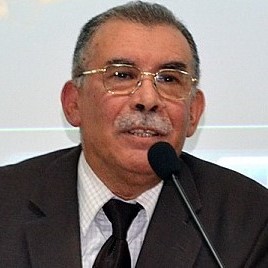
Mohamed Boudhan was an Amazigh writer, thinker, researcher and activist from the Rif, and publisher of the newspaper Tawiza. He was the author of many valuable books and articles on Amazigh identity. May he rest in peace.