Mohamed Chami Calls for More Legal Action to Enforce Amazigh’s Official Status
A statement by researcher and civil rights activist Mohamed Chami has reignited debate over the implementation of Amazigh’s official status. He detailed a long process of engagement with state institutions that, he said, culminated in a commitment from royal advisor André Azoulay to bring the demand for the language’s constitutional protection to the King.
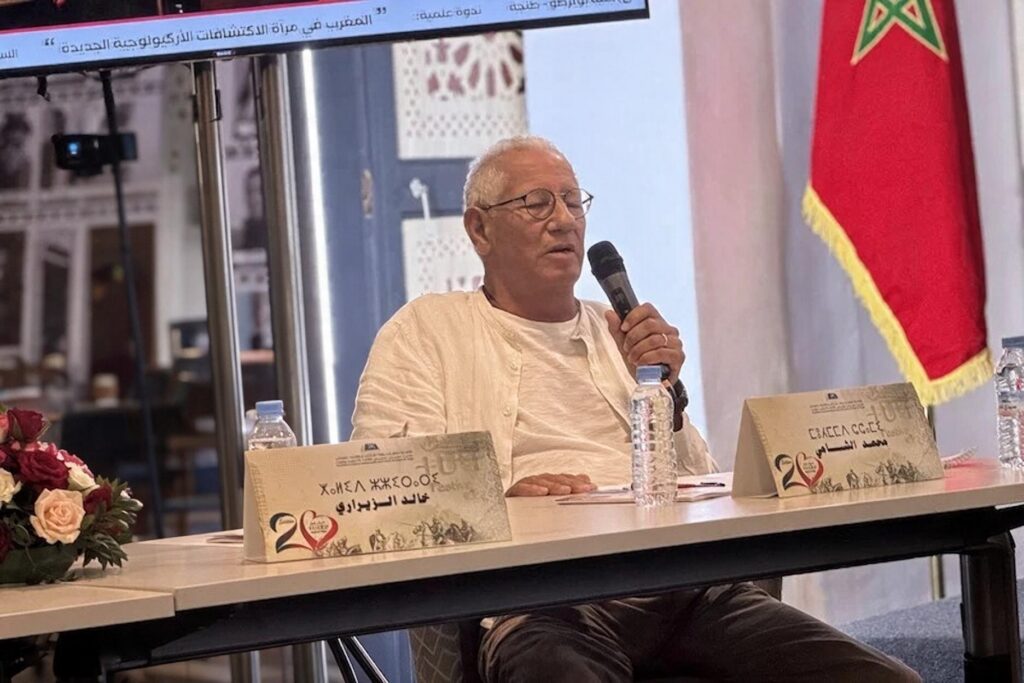
Chami made these remarks at a symposium held Friday morning in Tangier, part of the 20th edition of the “Tawiza” cultural festival, under the theme “From Recognition to Implementation… Amazigh Facing Hate Speech.” He called on Amazigh activists to step up legal action against practices that violate Article 5 of the Constitution and Organic Law No. 26.16.
Chami, one of the first linguists to study Amazigh at a Moroccan university, also addressed figures put forward by Aziz Akhannouch’s government, which cites 2,460 Amazigh-language teachers nationwide. That number, he argued, does not reflect the reality of a rollout — both across regions and through the school system — that remains stalled.
He revisited the key milestones of a forward-looking plan drawn up in the early 2000s, which had set a clear timeline for extending Amazigh instruction across all levels of schooling. Curricula and textbooks for middle and high school, he noted, were in fact developed at the Royal Institute of Amazigh Culture, but were shelved and never implemented.
He also pointed to the Ministry of National Education’s decision, under former minister Chakib Benmoussa, to gradually roll out Amazigh instruction in primary schools only, with full implementation targeted for 2030. That decision left the ministry facing a still-pending appeal before the Court of Appeal, brought by lawyer Ahmed Arehmouch on behalf of an association.
The former board member of the Royal Institute of Amazigh Culture said the current system for teaching Amazigh lacks coherence: it doesn’t extend into middle or high school, and it has never been institutionally integrated into preschool education, even though the Amazigh movement and civil society groups had been early advocates for that stage.
Describing himself as a “witness to the times,” Chami recounted how some former education ministers’ refusal to honor provisions that were in force at the time pushed the Amazigh movement to open a new front: the fight for constitutional protection, which continued until 2011, when Amazigh was officially recognized.
He also revealed that Amazigh activists had approached royal advisor André Azoulay, who asked why they had come to him specifically. They told him their demands, submitted to various ministries, never reached the royal institution. According to Chami, Azoulay said he was willing to raise these demands with the King during their weekly meetings.
Chami argued that certain practices by government departments — ones that disregard or circumvent legal provisions to the detriment of the Amazigh language — run counter to the law. He noted that the organic law implementing Amazigh’s official status took nearly a decade to pass after constitutional recognition, a delay marked by difficulties that persist to this day.
Arabic version | French version