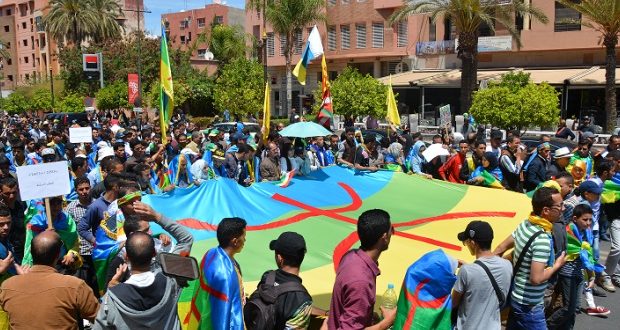
Amazighity Endures: Beyond Hatred and Historical Myths
Before delving into the heart of the matter, it’s worth pausing on the very concept of Amazighity. It is not merely a language or an ethnicity, as the hostile and alienated current (the “imeḥraṣn”) tries to portray it. It is a culture, a history, an identity, a set of values, a way of thinking, a heritage, and a vast land known as “Tamazgha” (North Africa). This civilizational reality is precisely what the alienated Arabist current strives to obscure: Amazighity existed on this land long before the arrival of the religions practiced today by the peoples of the region — a scientific and historical fact that this current seeks to sidestep.
It is nothing short of astonishing that certain media voices, claiming to belong to the journalistic landscape, descend into hostility and outright attack, insisting that discussing the fundamental component of national identity, or unearthing the history of the indigenous people (the Moors), amounts to separatism and a threat to national unity.
It is strange that such voices, operating within private media institutions, would work directly against the very text of the Moroccan Constitution and the most solemn royal speeches. His Majesty King Mohammed VI, may God support him, has repeatedly affirmed that Amazighity is an essential component of Moroccan identity and a shared heritage belonging to all Moroccans without exception.
Yet some “alienated” figures, driven by hatred of the Makhzen — unable to confront it directly — work to spread the opposite narrative through a repugnant, racist discourse, accusing anyone who speaks about Amazighity of being “funded by foreign parties.” This claim has been repeated time and again against Amazigh activists, with those making it seemingly unaware that they themselves are being used by a faction that has given Morocco a bad image — some of whom wish harm on this country day and night, going so far as to try to undermine its founding values of tolerance and coexistence.
The reality of Amazighity as this land’s ancient history no longer requires the sophistry of the alienated: archaeological findings have settled the matter scientifically, and this fact cannot be reopened for debate without descending into sterile rumination. I therefore invite every free Moroccan to move past this unproductive controversy, because Amazigh existence is a scientific reality that cannot be refuted by the narratives of a newcomer who has since become part of this nation — indeed, who has become authentic, fused into the essential component of this country: the Amazigh component.
Amazighity is an ancient identity drawn from humanity’s bond with the land — a land that shaped the consciousness of the Amazigh people, whose geography was marked by the Amazigh language, a sign among the signs of God, spoken through its place names and through the names of the creatures and animals that Amazigh people gave since time immemorial, reflecting an early and profound awareness of their environment and surroundings. “Tamazgha” was a vessel that welcomed every incoming movement across the ages; it would have been more fitting for the alienated to take pride in this millennia-old identity heritage rather than to denounce it.
The Amazigh people welcomed newcomers and foreigners with hospitality and generosity — not out of ignorance or weakness, but stemming from their noble values of hospitality and aid to strangers, values that Amazigh people upheld and lived by throughout history.
Civilizational thought versus a narrow-minded view
I challenge figures like this journalist to actually read about Amazighity as a body of thought and as tangible and intangible heritage, and to conclude that it represents a profound civilization with humanist dimensions. But the alienated voices see nothing in Amazighity but a “colonial fabrication,” oblivious to the fact that this very discourse perpetuates the true, conquering colonial mindset. They regard it as a mere “dialect” incapable of being a language, simply because they have never once taken the trouble to study it — even as they eagerly, and proudly, have foreign languages taught to their own children, though many of them do not even master the Arabic they invoke as a pretext to spread their destructive ideas.
If the Amazigh people were racist, as some try to portray them, such diversity and demographic richness would not exist on the southern shore of the Mediterranean. It is precisely the values of tolerance and shared coexistence (“amidir” and “amsaraf”) that made North Africa a welcoming refuge for diverse religions and ethnicities, which blended and merged to build a Maghrebi identity whose essential component is Amazigh.
Harmony between Amazigh values and Islam
Amazigh values proved harmonious with the aims of the Islamic faith, which led the Amazigh people to embrace it with both love and understanding. They combined their own values with Islam to produce a moderate Islamic model, clearly visible in the ribats, zawiyas, and centers of learning. Amazigh scholars even rivaled — and often surpassed — their counterparts in the East, producing works in Arabic in the fields of Islamic jurisprudence, case law, and terminology: writings in the Arabic language, but imbued with an authentic Amazigh awareness and way of thinking.
And whenever the obscurantist Arabist current (the “Ayt Talst” and the “Imeḥareṣn”) runs out of arguments, it systematically, out of pure hatred, links Amazighity to the “Zionist current” — a cowardly claim born of myths manufactured by decrepit elites unable to keep pace with the times, feeding on historical concepts far removed from the truth that were entrenched by the literature of the nationalist movement, such as the myth of the “Berber Dahir,” or terms like “Arab Maghreb” and “Arab nationalism.”
It is precisely this inability to keep up with the changes Morocco is undergoing today that pushes some to raise these scarecrows. Judaism is an essential, official strand of Moroccan national identity, whether some accept it or reject it, whether it stirs hatred or not, within the framework of a Moroccan Constitution that these same voices are now trying to bypass.
Ultimately, the more the hatred of the obscurantists and the alienated (“Ayt Talst,” “Imeḥareṣn”) grows, the more Amazighity, in its full civilizational dimension, gains in brilliance and radiance. Historical and archaeological truths cannot be erased by lies, myths, and the exploitation of the Islamic religion, and peoples’ awareness of their own identity cannot be smothered by rhetoric of mobilization and hatred. Amazighity is language, identity, culture, history, land, and values — it cannot die, unlike the racist Arabist discourse, which has died out in its own homelands and survives nowhere now but in Morocco.
By Lhoceine Akda
Arabic version | French version