Officializing Tamazight: Progress and Lingering Challenges
It is difficult today to discuss the state of the Amazigh language in Morocco without looking back at the long path it has traveled within the country’s institutions. The place the Amazigh language now occupies did not emerge overnight, nor did it result from a single constitutional milestone. It is the product of decades of accumulated initiatives, where politics intersected with culture, constitutional change with institution-building, and education with media. Since the end of the last century, Morocco has made the management of its linguistic and cultural diversity part of its broader societal project, within a vision that treats the Amazigh language as one of the founding components of national identity rather than a mere cultural relic.
Even before gaining official recognition, the Amazigh language was already present in the daily lives of Moroccans and in the country’s oral, literary and musical heritage, though its presence within the administration, schools and official media remained limited. From the 1970s and 1980s onward, cultural associations and university researchers helped restore the language’s standing by collecting oral heritage, producing linguistic studies, and calling for its inclusion in public policy. Over time, the state began treating these demands as part of the broader national conversation on identity, culture and development.
The earliest official initiatives date back to the reign of the late King Hassan II, who repeatedly affirmed that the Amazigh language represents one of the essential wellsprings of Moroccan identity. Although language policy at the time was built primarily around the promotion of Arabic, public media had already been broadcasting news bulletins and programs in Tamazight since the 1960s, a presence that gradually expanded through the 1980s and 1990s. These programs helped preserve a significant part of the oral heritage and gave millions of Amazigh speakers access to media content in their native tongue — marking the first regular institutional presence of the Amazigh language within the public sector.
King Mohammed VI’s accession to the throne in 1999 opened a new chapter for the issue, marked by a clearer vision and firmer political will. The Ajdir speech, delivered on October 17, 2001, signaled a profound shift in how the state approached the question, affirming that the Amazigh language is a shared heritage of all Moroccans and that its protection is a national responsibility. The speech was not merely a political statement — it became the reference point underpinning subsequent initiatives, both legislative and institutional.
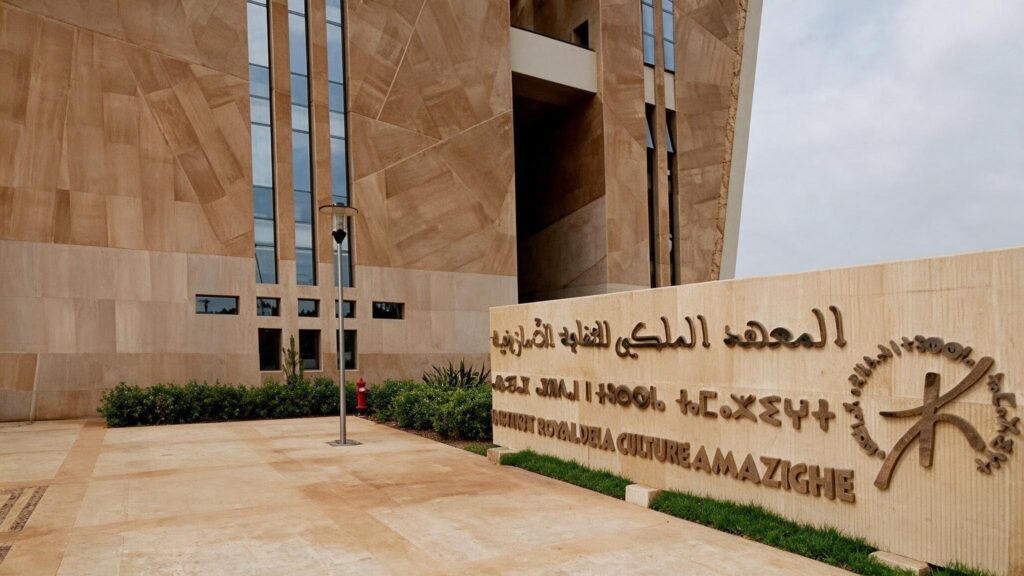
It was in this context that the royal decree establishing the Royal Institute of Amazigh Culture was issued, tasked with promoting the Amazigh language and culture through scientific research, language planning and the development of teaching materials. The institute faced major scientific challenges, chief among them choosing a writing system, codifying the language, compiling dictionaries, standardizing terminology, producing textbooks and training teaching staff. Within a few years, it had completed substantial scientific work that had a direct impact on integrating the Amazigh language into Moroccan schools.
Among the institute’s most significant decisions was the adoption of Tifinagh as the script for writing the Amazigh language. That choice marked a historic turning point: it settled the long-running debate over which script was most suitable and opened the way for textbooks, educational programs, signage and official documents to be produced in a unified script that is now part of Morocco’s linguistic landscape.
In 2003, the teaching of the Amazigh language began in primary schools, with dedicated curricula and textbooks developed for the purpose, along with training sessions for teachers and inspectors. Despite difficulties linked to a shortage of human resources and the lack of nationwide rollout across all schools, the initiative marked the first real attempt to integrate the Amazigh language into the education system. Over the following years, its presence in the curriculum gradually expanded, becoming a standalone subject in a growing number of schools.
Public media, meanwhile, underwent a notable shift in how it handled Amazigh-language content. Once limited to a few short segments, Tamazight programming gradually gained more airtime, culminating in the 2010 launch of the Amazigh television channel — an event that marked a qualitative leap in the history of Moroccan media. The channel created space for news, cultural, documentary, drama and sports programming in the Amazigh language, helping to boost audiovisual production and highlight Morocco’s linguistic and cultural diversity.
The 2011 Constitution represented the most significant milestone in this trajectory, with Article 5 establishing the Amazigh language as an official language of the state alongside Arabic. This was not merely symbolic recognition — it carried a constitutional obligation requiring the state to take the necessary measures to ensure the Amazigh language’s presence across public life. The Constitution also called for an organic law setting out the stages and methods for implementing this official status, giving the initiative, for the first time in Morocco’s history, a clear legal foundation.
After years of debate, Organic Law No. 26.16 on defining the stages for implementing the official status of the Amazigh language was enacted. The law laid out a general framework for integrating the language into education, administration, justice, media, culture, local government, public spaces and public services, adopting a gradual approach to implementation. That choice reflected an awareness that moving from legal recognition to actual practice requires trained personnel, dedicated funding, and the development of the necessary linguistic and technical tools.
Since the law’s publication, various government sectors have begun drawing up programs to integrate the Amazigh language within their respective areas. In national education, officials reaffirmed the need to expand its teaching and broaden teacher training, placing it among the priorities of education reform. In higher education, Amazigh studies programs expanded across several Moroccan universities, producing research in linguistics, literature, translation, teaching methodology and toponymy.
Public administration has gradually introduced the Amazigh language into certain documents, signage and websites, while some institutions have begun offering reception services in Tamazight and training staff to communicate in the language. Despite uneven implementation across sectors, this shift reflects the language’s move from the cultural sphere into the realm of public services.
The justice sector has also taken initial steps in this direction, working to provide translation services for Amazigh-speaking litigants and organizing specialized training for translators, in order to safeguard litigants’ linguistic rights and uphold the principle of equal access to justice.
In recent years, momentum behind implementing the Amazigh language’s official status has grown, after King Mohammed VI announced that Amazigh New Year would become a paid national holiday. The decision carried deep symbolic weight: it went beyond recognizing the language itself to embrace one of its most prominent cultural and civilizational expressions, reflecting the state’s commitment to valuing the different strands of Moroccan identity.
The government has also allocated significant funding to accelerate the rollout of the Amazigh language’s official status, and various sectors are now required to draw up sector-specific plans setting out concrete measures for integrating the language into their areas of responsibility. These measures include updating websites, translating documents, producing bilingual signage, incorporating the Amazigh language into digital services, and expanding training programs for public employees.
Despite the progress made, the effort to implement the Amazigh language’s official status still faces a number of challenges. Full nationwide rollout of its teaching has not yet been achieved, its presence within administration varies from one sector to another, and there remains a pressing need to train more teachers, translators and administrative staff, as well as to develop specialized dictionaries and produce the software and digital applications needed to use the Amazigh language across different fields.
Digital transformation also poses new challenges, requiring investment in artificial intelligence, natural language processing and digitization so that the Amazigh language can keep pace with rapid technological change. A language’s standing in the digital age is no longer measured solely by its presence in schools or the media, but also by its ability to integrate into smart applications, search engines, digital platforms and online services.
Taken as a whole, Morocco’s experience represents a model built on gradual reform: the Amazigh language has moved from cultural recognition to constitutional recognition, then to a phase of institution-building, before entering today’s phase of practical implementation within public services. Completing this effort will undoubtedly depend on sustained political will, the mobilization of human and financial resources, and linking responsibility to accountability in enforcing legal provisions — so that the Amazigh language becomes a natural presence in schools, administration, justice, media and the digital space, as an official language of the state and an essential component of Moroccan identity.
By Abdelouahed Boumasser
Arabic version | French version