Amazigh Associations Sue Morocco’s Education Ministry Over Deferred Language Rollout
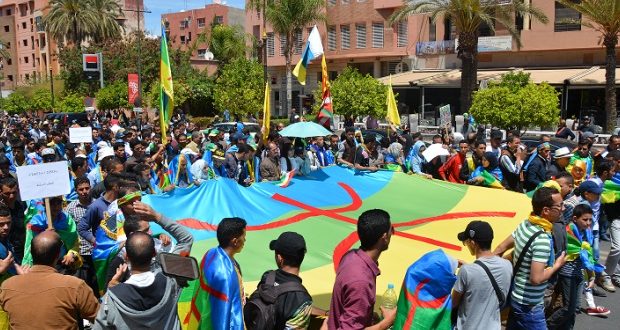
Fifteen civil and cultural Amazigh associations from across Morocco have filed an administrative appeal before the Administrative Court in Rabat challenging two ministerial decisions that push back the nationwide rollout of Amazigh language instruction in primary and pre-primary education to 2030 — in open violation of the deadlines set by the organic law on implementing the official status of the Amazigh language.
The appeal was filed on April 19, 2024, by lawyer and Amazigh activist Ahmed Arrhmouch, and targets both the head of government and the minister of national education. The challenge is directed at two administrative decisions: the first, dated May 23, 2023 (reference 028X23), and the second, dated April 19, 2024 (reference 152724). Both decisions provide for a phased rollout of Amazigh-language instruction, reaching 50% during the 2024/2025 school year, with full coverage of 100% only by the 2029/2030 school year.
The associations describe the two decisions as “tainted by illegality,” arguing that the ministry has retreated from the state’s constitutional and legal commitments. Article 31 of Organic Law No. 26.16 explicitly requires the integration of the Amazigh language into all areas of public life — including education — within a maximum period of five years from the date of the law’s publication in the Official Gazette, that is, since September 26, 2019. This is reinforced by Article 5 of the 2011 Constitution.
The appeal’s legal brief argues that deferring full implementation to 2030 constitutes “unlawful interference with the prerogatives of the legislative branch”: as a higher-ranking norm in the legal hierarchy, the organic law’s deadlines cannot be unilaterally altered by the ministry without parliamentary approval. The appellants also cite what they characterize as “abuse of authority,” given that the ministry issued the decisions outside the scope of its legal competence.
On the international front, the associations invoke the recommendations of United Nations bodies, in particular the Committee on the Elimination of Racial Discrimination, which expressed concern in its periodic reports of November and December 2023 over the “weak integration of the Amazigh language in education and the media,” urging Morocco to accelerate the language’s inclusion in the educational system. The associations also point to international human rights conventions, which require states to respect and protect the cultural and linguistic rights of minorities.
The associations are asking the Rabat Administrative Court to declare both ministerial decisions unlawful and void, with immediate enforcement and full legal costs borne by the defendant.
The fifteen signatory associations are: Al-Mas Cultural Association of Nador, the Confederation of Amazigh Cultural Associations of Northern Morocco, the Massinissa Association of Tangier, the Asid Cultural Association, the Amghar Cultural Association of Khenifra, the National Association of Lawyers of Morocco, the National Federation of Amazigh Associations, the Awal Forum for Development and Citizenship of the Rif, the Young Lawyers Association of Khemisset, the Regional Association of Amazigh Language Teachers of the Fez-Meknes Region, the Association of Amazigh Language Teachers of the Haouz, the Future Forum Tikowin of Agadir, Souss the Wise Youth Tikowin, the Intilaka Association of Marrakech, the Fazaz Association for Culture and Arts of the Haouz, and the Inaruz Mokhtar Association for Culture and Development in the Province of Chtouka.
Arabic version | French version