[PDF] The Book “The Berber Dahir: Truth or Myth?” by Mohamed Boudhan
When we examine and analyze the commonly held ideas about Amazigh and the Imazighen, which circulate as self-evident truths that are never discussed, we conclude that the Amazigh question in Morocco is a question of truth, in its epistemological sense, meaning the conformity of thought to reality. The “cognitive” contents in circulation about Amazigh and the Imazighen, taught in educational institutions, published in books, debated in seminars and debates, and cited in “academic” studies and research, are all ideas that do not conform to reality. They therefore do not express truth in the epistemological sense, as I said, since they have no relation to it. They rather express mythical and ideological contents, the mythical and the ideological being thought that does not conform to reality, as the opposite of truth, which is thought that conforms to reality, as I wrote.
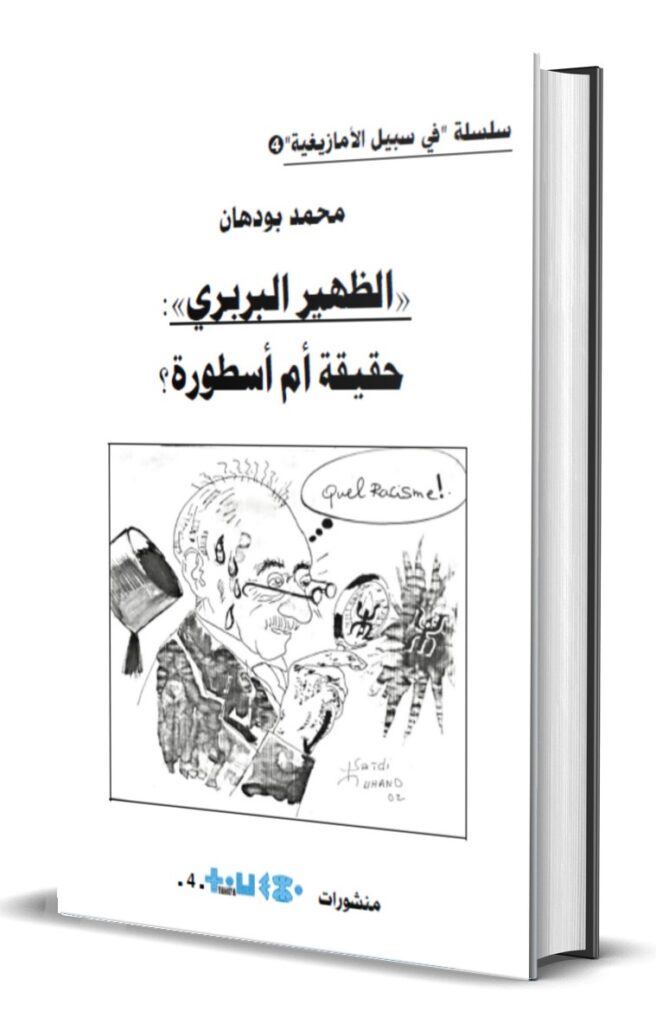
Author: Mohamed Boudhan
Pages: 198
Publisher: Tawiza, No. 4
This year marks the 92nd “anniversary” of the issuing by the French authorities of the dahir of May 16, 1930, on the organization of the administration of justice in regions of Amazigh custom, where there are no sharia courts, a law issued by the French occupation of Morocco and signed on the same day by King Mohammed V. This dahir provided that the administration of justice in certain Amazigh tribal regions would be under the authority of customary courts based on local Amazigh laws and customs, as it was before the colonizer arrived, while the sultan’s Makhzen zones (such as Fez and Rabat) remained under the authority of the justice of the Makhzen government and the Moroccan sultan.
The dahir of May 16, 1930 was not the first dahir issued by the colonial authorities in Morocco: the dahir of September 11, 1914 was the first to codify the organization of the tribes under French control, and it was followed by the circular of June 15, 1914 urging the native affairs officers to preserve Amazigh customs. From this we see that the dahir of May 16, 1930 was preceded by other dahirs, such as the dahir of June 15, 1922 on transferring land to foreigners, without provoking any reaction from those who had appointed themselves guardians of the Moroccan national movement.
What is called the “National Movement” used religion to promote its lies, to stir up the feelings of Moroccans and to rally Arab and Islamic support, by spreading the myth of the Berber dahir, in order to make people believe that this dahir had come to take the Imazighen out of their Islamic religion and Christianize them, and by having the Latif recited in mosques: “O Most Subtle, we ask You for mercy in the face of the decrees of fate: do not separate us from our Berber brothers.” These people (the National Movement) drew their legitimacy from this falsified enterprise and thus became symbols of Arabism and Islam. Yet the real reason for the uproar that the notables of the city of Fez stirred up in the mosques over this text is that they felt the French colonizer no longer needed their help after the end of the Franco-Amazigh war and of the resistance in the early 1930s. So they pressed the colonizer by creating a social crisis with emotional dimensions (national unity) to push him to bring them into the ruling system and to share the new power with them. It should be noted that Amazigh society, before French colonization, operated with a legal arsenal that came from within itself and was not imposed from outside on its culture and social life. The courts were Amazigh, the judges were Amazigh, the laws (izerfan) were Amazigh and the language of litigation was Amazigh. The legal rule was therefore a social and societal expression.
The Moroccan citizen’s representation of contemporary national history has come to suffer from ideological and political fatigue, and this history can no longer hold on and withstand historical and political critique. The reason for its exhaustion lies in the many pressing and embarrassing questions put to it. How long will this history, and with it the myth of the Berber dahir, stay as it is? Is it not time to rewrite national history with objective and honest pens and to dust off the truths in preparation for reconciliation with Moroccan history?
Arabic version | French version

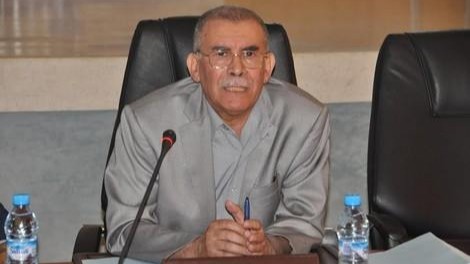
Mohamed Boudhan was an Amazigh writer, thinker, researcher and activist from the Rif, and publisher of the newspaper Tawiza. He was the author of many valuable books and articles on Amazigh identity. May he rest in peace.