The Absence of a State Among the Amazigh People and Its Impact on Language and Identity
The State as a Prerequisite for an Advanced Civilization:
While all the evidence confirms that the Amazigh people achieved an advanced level of civilization in antiquity compared to other contemporary peoples in Africa, the Americas, or Australia, a comparison with other nations of that era—such as the Egyptians, Phoenicians, Greeks, Romans, Persians, Chinese, or Japanese—reveals that their level remained modest and fell short of what these great powers attained.
Why were the Imazighen, despite ranking among the oldest and most illustrious peoples, unable to build a civilization like the Pharaonic, Chinese, Greek, Roman, or Persian empires?
The reason is simple: they failed to establish a state with historical continuity—rather than mere ephemeral and transitory “quasi-states,” those kingdoms of circumstance born out of the demands of resistance to repel invaders. From its founding, a true state would have endured through every stage of Amazigh history, as was the case for the aforementioned peoples, whose civilizational lead over the Imazighen is unmistakable.
Why is the state so crucial? What is its link to civilizational progress?
A people without an enduring state, as was the case for the Imazighen and other nations, can only produce an oral culture of limited local reach, encompassing customs, beliefs, and traditions, all underpinned by a rudimentary social and political organization that never moves beyond the tribal stage. Civilization, however—setting aside the perennial debate over the distinction between culture and civilization—is far more complex, broader, and more comprehensive, with culture being only one of its components. Consequently, a society at an advanced level of civilization possesses a more sophisticated political and social organization. This is generally explained by the existence of a state system, which is itself the embodiment of a complex structure that transcends the simplicity of the tribal order. Indeed, the state represents a higher form of organization, even when it retains a tribal character in which power rests on kinship ties.
It should be clarified here that by “state” (a concept that differs only in appearance from its three classic pillars: territory, people, and authority), particularly in the context of antiquity, we mean any centralized political power—whether a single ruler or a governing body—that commands a regular force (an army, guard, or police) capable of deterring, commanding, forbidding, and coercing. The makeup of this force matters little—whether it consists of mercenaries, brigands, criminals, or members of the same clan—just as it makes no difference whether this state is primitive, tribal, despotic, theocratic, or personalized. What matters most is possessing this force and the right to use it to rule. Tribal social organization must therefore not be confused with a state of a tribal nature. The fundamental difference is that the former—even when based on territorial unity rather than blood ties alone, which was the norm among Amazigh tribes—lacks this organized coercive force. By contrast, the latter possesses both this power and the right to wield it, even though it may be rooted more in kinship than in territory. In short, no matter how developed a tribal organization may be, it remains less complex than a state, however simple, primitive, or tribal in nature that state may be.
The Link Between the State and the Written Use of Language
However, while the state is a key—even indispensable—element in the progress of a civilization, it is not solely:
— Because it is theoretically capable of protecting the group under its wing and defending its lands through its regular force; — Because under its authority, which encompasses the entire community, the conditions are created for stronger collective cooperation in economic production, trade expansion, and the development of crafts, however rudimentary they may be; — Because, thanks to revenue from taxes and levies, it is able to undertake grand architectural projects, such as the pyramids of Egypt or the Great Wall of China, striking symbols of civilizational power…
This is also because the state is a fundamental and necessary factor—not to say an indispensable condition—for the emergence and widespread adoption of writing. While many factors explain the birth of written language, the existence of a state system played a decisive role. Why? Because the state’s need to commit language to writing was far more compelling than that of social relations, commercial trade, or religious beliefs. Why was this need on the state’s part stronger and more urgent?
Since the state rests on a central authority and it is in its nature to extend its power to the most remote regions it can bring under that authority, it necessarily follows that, as the central power, it must deliver its decisions and orders to those territories under its rule, which may lie very far from the seat of central authority (the capital). Before the advent of writing, oral transmission was the only means of conveying those decisions and orders from the center to distant peripheries. Yet this method was neither the most optimal, nor the best, nor the most suitable, given the risk that orally transmitted state decisions and orders could be altered or modified—either through forgetfulness or by passing through more than one person before reaching the final recipient tasked with enforcing them as the central authority’s representative in the region concerned. Furthermore, oral communication did not constitute established, guaranteed proof that could be invoked by anyone with an interest in the matter, whether the state itself or private individuals involved in the case. In addition, relying exclusively on oral communication was no longer sufficient or appropriate for managing state revenues and expenditures, with everything that entails in terms of rigorous oversight and keeping a register of those subject to taxation (a tax in kind in the early stages of the state’s emergence), as well as their amounts and due dates. Hence the pressing need to document and record this information so that it could be referred to whenever the situation required. It is precisely this overriding necessity felt by the state to turn to written documentation and writing that explains the causal link between the state and the emergence of the written use of language. It should also be noted that the population’s inability to read or write has neither bearing nor impact on the state’s role in the emergence and use of writing. Indeed, those charged with reading and understanding the state’s written orders and decisions were the ones responsible for implementing them—namely, the governors and authority officials representing the central power, who were expected to be proficient in reading and writing, a skill that was among the prerequisites for their appointment to those posts.
That is why, even though many ancient peoples—like the Amazigh people themselves—invented writing characters before experiencing a state system, whether figures symbolizing words or ideas (ideograms) or an alphabet made up of letters representing the sounds of spoken language, they did not use them to record official acts, write, transmit news and information, or develop a written cultural and intellectual output. Indeed, the conditions enabling such use were not yet in place. The foremost of these conditions is the existence of a state and the compelling need it feels to resort to such a practice, as I have explained.
In conclusion, if the state serves as a driver of civilizational progress, it is because the written use of language developed under its aegis—with all that this enables in terms of intellectual and cognitive accumulation, as well as the ease of circulating, transmitting, and disseminating knowledge, thereby providing conditions better suited and more favorable to civilizational progress.
The Imazighen between the state of the “town crier” and the state of writing:
Based on what we have explained regarding the causal link between the emergence of the state and its need for the written use of language, the answer to why writing and written record-keeping were absent among the Imazighen becomes clear: writing and written documentation were lacking among the Imazighen because of the absence of a state system—understood in the sense of historical continuity—as has already been noted. Indeed, unlike a state-based organization, tribal social and political organization—even when it takes the form of a federation of tribes—does not need writing to convey the tribal council’s orders and decisions to its members or to the sub-tribes belonging to it. Contrary to what we observed in the case of the state, oral communication is a sufficient and suitable means of delivering these orders and decisions to all those concerned, given the limited geographical area occupied by the tribe, where direct contact among its members and constituent groups remains possible and accessible. That is why it was enough to task a “town crier” with relaying these messages on weekly souk days or after Friday prayers—so much so that communicating by “crying out” became a genuine, recognized “profession,” for which tall men with powerful voices and clear, intelligible diction were selected. This is the “profession” of “abarrah” (abarrap), which is the agent noun derived from the verb “barrah” (barrp), meaning “to call out” in the Amazigh language. It is a term in common use in the northern Amazigh language and does not appear to have a foreign origin. In Darija, it is pronounced “el-barrah.” Moreover, relying on the services of the “town crier” continued for several years after independence, particularly in villages and rural areas, as the author of these lines vividly remembers.
Thus, to the question of why the Imazighen were unable to use their alphabet, “Tifinagh,” to write, record documents, and develop cultural and literary works—as seen, for example, among the Chinese, the Japanese, the Greeks, the Romans…—the answer is that they had no need for it. Indeed, to “publish” the tribal council’s decisions, tribal organization relies solely on oral transmission through the services of the “town crier,” unlike the state system, as we have already explained. The root cause of the absence of writing and written record-keeping among the Imazighen therefore lies in the absence of a state, as noted earlier. They made do with the state of the “town crier,” which does not call for the advent of the state of writing.
The relationship between writing and civilizational progress:
This brings us to the heart of the issue: understanding why the Imazighen’s level of civilizational development remained modest, falling short of that of the other peoples cited as examples. The reason lies in the absence of writing and, by extension, the absence of the cultural output and the intellectual and cognitive accumulation that it makes possible. As I pointed out earlier, the written word creates the conditions conducive to higher civilizational growth, unlike societies that have remained “oral” and have not yet crossed the threshold into written record-keeping.
Thus, although the Imazighen surpassed many of their contemporaries in various respects, the absence of a state deprived them of the fundamental pillar of all civilization and progress: writing. Writing is the key that enables a people to enter History, make it their own, and belong to it. A people that does not write has no history, because it has not yet recorded its past in order to remember it and perceive it as such.
Written production, whether intellectual or cultural, is therefore indispensable to any civilization and all progress. Yet the absence of writing — resulting from the absence of a state — kept the civilizational level of the Imazighen at its most elementary stage, that of the pre-literate era.
The lack of writing due to the absence of a state: the beginning of identity erasure
“A people without a state is a people without defense or protection. It has no regular force — as opposed to a merely volunteer one — to shield it from aggression by another people endowed with a state and an organized army. It is therefore misguided to boast, as some Amazigh activists do, that the Amazigh people have never invaded other nations or occupied their lands. If they never did so, it was simply because they lacked the means, starting with a state apparatus and the standing army it entails — tools indispensable to any aggression or territorial occupation. The absence of Amazigh conquests was thus not a deliberate choice made in full possession of its means (a state and an army) — which might justify a measure of pride — but a condition endured for want of the prerequisites for expansion. It is precisely this absence of a state that explains why other peoples were able to occupy Amazigh land so easily, despite the heroic resistance of the local populations. Behind those invasions stood a regular force — unlike the volunteer Amazigh fighters — in the form of an army overseen by an organized state, whatever its degree of development.”
Beyond this territorial vulnerability to foreign state powers, the absence of a state also facilitated the linguistic “occupation” of Amazigh identity. Out of imitation of the victor, and for religious, cultural, or political reasons, Amazigh people often adopted the occupier’s language for writing and record-keeping. In doing so, they gave up developing their own language to elevate it to the status of a written language, no longer feeling the need since they were already writing in a foreign tongue. This process can go as far as the usurpation of identity: some come to claim belonging to the foreign people whose language they use, completely disowning their Amazigh identity. What ensues is a genuine “identity transmutation,” in which the individual abandons their original belonging to embrace another. Such is the case of those “transmuted” individuals in Morocco who, speaking Darija, refuse to acknowledge their natural Amazigh roots, unaware that Darija itself is a language created by the Imazighen to facilitate this identity mutation (in the primary sense of the Arabic term jinsi, which here refers to national and identity belonging).
The loss of identity is a loss of collective dignity
The greatest danger for a people that lacks writing — and not merely an alphabet — due to the absence of a state is the loss of its collective dignity. This dignity is sustained by a shared identity rooted in its land and homeland. The erosion of this dignity begins with adopting the languages of others. This phenomenon is not problematic when done to gain access to religion, science, or civilization, which is entirely natural. The danger arises when this adoption is driven by a desire for national and identity “transmutation,” aimed at blending into the foreign ethnic group to which that language belongs. This is what happened to Moroccans who believe themselves to be Arabs on the grounds that they speak Darija, even though that language was forged by their Amazigh ancestors — and not by Arabs — to convince themselves that they had become Arabs and were no longer Amazigh (on this subject, see: “When Will Moroccans Discover Their Darija Language?” in the book On Arabic, Darija, and Identity Transmutation, available via this link: http://tawiza.byethost10.com/livre1.pdf).
As we have noted, the lack of a standing army—a corollary of having no state—deprived the Amazigh people of protection against external aggression, leaving them vulnerable to invasion and occupation by other structured peoples. Yet the erosion of their identity and language had far more severe consequences than the occupation of their lands. This phenomenon stems directly from the absence of state institutions and a written tradition. Wherever it exists, the state serves as a shield for identity, regardless of its nature: whether rudimentary or advanced, progressive or backward, religious or secular, democratic or despotic. It remains the unifying entity and the representative of that identity. This was all the more true in an era when “nationality,” in the sense of individual belonging to a nation-state, did not yet exist. At that time, the only form of belonging was collective and crystallized in the state, for the state embodies the territory and the people from which a shared identity springs. Without a state, there is protection for neither the homeland nor the people, leaving identity adrift. Without protection for collective identity, however, collective dignity collapses—a dignity normally expressed through attachment to and pride in one’s belonging. A people that abandons its identity is, in reality, renouncing its dignity. It resembles an individual who, ignorant of their own biological parents, seeks an adoptive family among strangers—just as those Moroccans who are convinced they are Arabs do. By seeking affiliation with a foreign people in this way, they condemn themselves to permanent identity dependence, losing all sovereignty and independence in defining their own being. Ultimately, this amounts to the abdication of the collective dignity that such sovereignty and independence symbolize.
We thus observe a causal chain that led a segment of the Amazigh people to lose their collective dignity. By disowning their original, natural Amazigh affiliation to usurp a fabricated Arab identity, they followed a process set in motion by the absence of an Amazigh state. That absence rendered writing superfluous within a tribal system, inevitably leading to the loss of Amazigh identity in favor of a borrowed one.
The Amazigh state transforms into an Arab state
The grimmest fate for a people, resulting from this process of identity abandonment, is to set out in search of an imaginary and false “noble lineage” (nasab sharif) at the expense of its own lineage, which is far more authentic and dignified. This is precisely what happened to the Amazighs who claim the myth of “Sharifian lineage” in Morocco, trading the honor of their Amazigh origin for the lie of an illusory nobility. Worse still, these Amazighs—having usurped the identity of a foreign people whose language they used for writing, for lack of having developed their own writing system within an Amazigh state—eventually committed an irreparable act: when they finally established their own states, which were Amazigh in essence, they tied them to the identity of the foreign people whose written language they used. Thus, the Moroccan state became an “Arab state,” an integral part of a chimerical homeland called the “Arab world.” The myth of “noble lineage,” which was originally an individual fable, turned into a collective myth championed and sponsored by an equally mythical state: that of the Arab Maghreb. Yet this fiction has produced a very concrete reality: the marginalization of and contempt for Amazigh identity by its own children, who have disowned it to put themselves in the service of foreign languages and identities.
This explains why the Amazigh dynasties that succeeded in establishing states during the Islamic era—such as the Idrisids, the Almoravids, the Almohads, the Marinids, and the Alaouites—did not use this apparatus of power to consolidate their original identity. Unlike the Persians or the Turks, they did not transition their language from oral tradition to written form to establish it as the language of authority and the state. On the contrary, they used power to strengthen and perpetuate a foreign language. They governed their Amazigh states as though they were Arab states, adopting Arabic as the sole language of administration and scholarship. They did not even manage to emulate other peoples who, while adopting foreign languages for writing (as in Mexico, Senegal, or South Africa), used the state to promote and defend their own identity. For historical, political, or religious reasons, those nations succeeded in keeping their identity independent from that of the people whose language they used.
What the history of the Amazigh people teaches us is that they only succeed in establishing a lasting state at the expense of their language and identity. We observe that all the Amazigh states that succeeded one another in North Africa after the “Battle of the Nobles” in 740 AD—which brought a definitive end to the Arab political and military presence (though not the religious and linguistic presence) on Amazigh land—made no effort to promote the Amazigh language or elevate it to the status of a written language. Quite the contrary: these states used their authority to marginalize their own language and weaken their original sense of belonging in favor of the Arabic language. This process culminated in the adoption of an artificial Arab identity, a radical transformation of identity and nationhood that stands as an almost unique case in the annals of history.
The Amazigh movement is repeating the same mistakes as the Imazighen of the past:
The absence of a state anchored in historical continuity has hung like an inescapable fate over the Imazighen throughout their long history. It is precisely this absence that led to the lack of nearly everything else—and in particular, as we have explained, the absence of writing, even though writing is a prerequisite for civilizational progress and the key to entering history and taking one’s place within it, as has already been noted. This is what kept them on the margins of that history, as passive objects rather than active agents. They contented themselves with their tribal systems and remained satisfied with them, without developing them into a state system. And when historical evolution did lead them to establish such a state, they treated it as a state with a non-Amazigh identity, as we explained earlier.
And now, the Amazigh movement is passing over the issue of an Amazigh state in silence, as though it were a matter of no importance. In doing so, it is repeating the same mistakes as the Imazighen of the past, who lived throughout their history without an Amazigh state endowed with historical continuity, settling instead for the “state of the town crier.” Yet such an arrangement does not require writing—unlike what the existence of a state demands, and what is indispensable for intellectual, civilizational, and cultural accumulation, as we have already noted. While it may be possible to excuse our earliest ancestors—given the nature and level of their political consciousness—for failing to build a state with historical continuity, this excuse is no longer acceptable for us today as activists in the Amazigh movement. Nothing can justify the absence of the question of the Amazigh state within this movement, which continues to adopt our forebears’ stance toward the state: after establishing it, they regarded it as a state whose identity belonged to the bearers of the language they used in writing.
It is an absurd and peculiar stance for a people to attribute its own state to an identity foreign to its own—even though it is the rightful master of that state—thereby reducing itself to a mere “foreigner” within its own state. Yet that is precisely what we, as activists of the Amazigh movement, keep repeating when we treat the Moroccan state as an Arab state—even though no constitutional provision affirms this, unlike the constitutions prior to 2011—and when we ask it to recognize our rights as Imazighen whose identity differs from that state’s “Arab” identity. To confirm to the state that it possesses an identity foreign to ours, we invented the myth of the “indigenous people.” In doing so, we prove, first, that we have failed to grasp the true meaning of the concept of “indigenous people” as defined by the United Nations Economic and Social Council (see the text “Why Should the Imazighen Not Be Classified Among ‘Indigenous’ Peoples?” in the book “On Amazighness and the Amazighophobic Trend”), and second, that we want the same framework applied to us as to genuinely indigenous peoples such as the “Eskimos,” Native Americans, and the first inhabitants of Australia… This is what has led the Amazigh movement’s demands into a genuine dead end today—an impasse of its own making, created by demanding that the state recognize the Imazighen as an indigenous people. One manifestation of this impasse is that when this state—”Arab,” just as the movement itself has cast it—treats the Imazighen as a racial and ethnic minority demanding recognition of its linguistic, cultural, and identity rights, like Australia’s Aboriginal people, American Indians, and the Eskimo people, that same movement grows indignant and accuses the state of racism and hostility toward Amazigh identity.
This attitude reveals the absence of strategic thinking within the Amazigh movement, just as it was lacking among the early Imazighen. That is why it pushes for partial and secondary demands to be met while remaining silent on the foundational, strategic demand: the Amazigh state, understood in a territorial and identity-based sense rather than a racial one. This stance also exposes a contradiction: the movement constantly repeats that the Amazigh issue is political in its essence and nature, yet takes no steps toward establishing the Amazigh state, even though the political depth of Amazigh identity lies precisely in its state-centered dimension. Thus, if making the Amazigh language official has turned into a near-mirage that recedes the closer one gets to it, it is because the state behaves as an “Arab” state, for which having the Amazigh language as its official language is unthinkable. Consequently, any advocacy for the Amazigh language aimed at making it a genuine official language of the state—rather than a purely formal and decorative one—is a futile and sterile endeavor, indeed beside the point and a waste of time, if it is pursued apart from advocating for the building of an Amazigh state that protects and shelters this language.
This does not mean it would be enough for the Amazigh movement simply to demand that the state reclaim its true Amazigh identity—which it draws from its Amazigh homeland in North Africa—for Morocco to become an Amazigh state in this territorial and identity-based sense. What is expected of this movement, however—so that it takes center stage in its discourse and writings—is that it place among its priorities, and at the very top of its demands, the advocacy of an Amazigh state in the territorial sense: that is, a state that derives its identity from that of its homeland, as I have explained. This requires the movement to overhaul its strategy, its priorities, and its discourse, within which the notion of an Amazigh state still belongs to “the unthought.” At the same time, it must work to raise awareness of the Moroccan state’s Amazigh identity and demonstrate that this is a state usurping a status that does not belong to it—and living, as a result, in imposture, duplicity, and contradiction (a contradiction between the identity of its Amazigh homeland and its claimed Arab affiliation). It must also show that returning to its Amazighness represents a return to its true, non-usurped identity, as well as a break with these manifestations of imposture, duplicity, and contradiction.
Arabic version | French version

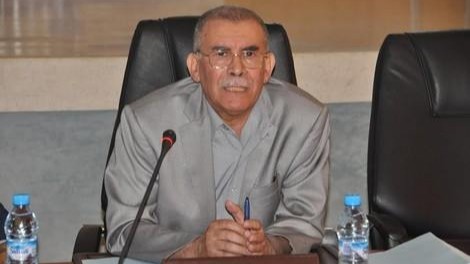
Mohamed Boudhan was an Amazigh writer, thinker, researcher and activist from the Rif, and publisher of the newspaper Tawiza. He was the author of many valuable books and articles on Amazigh identity. May he rest in peace.